In modern water treatment systems, filtration efficiency directly affects equipment service life, water quality stability, and overall operating costs. Among the many filtration options available, wound filter cartridges have become one of the most widely used depth filter products in industrial and commercial applications, thanks to their consistent performance, excellent cost‑effectiveness, and broad chemical compatibility.
From industrial water purification and food processing to electroplating, chemical manufacturing, and reverse osmosis (RO) pretreatment, wound filter cartridges play a vital role in protecting downstream equipment and improving overall filtration efficiency.
As global demand for reliable filtration solutions continues to grow, more distributors, OEM manufacturers, and industrial purchasers are paying close attention to the structure, raw materials, and practical value of wound filter cartridges.
What is a Wound Filter Cartridge?
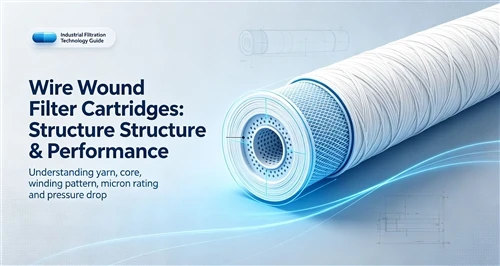
A wound filter cartridge is a depth filter element made by precisely winding a specially engineered textile yarn around a central core in a controlled pattern. The winding density gradually increases from the outer to the inner layers, creating a gradient density structure that effectively captures particles of different sizes.

Unlike ordinary surface filters, wound cartridges retain contaminants throughout the entire depth of the filter media. This provides several advantages:
- Higher dirt‑holding capacity
- Longer service life
- More stable flow performance
- Better particle retention
- Lower replacement frequency
Typical contaminants removed include:
- Sand and sediment
- Rust particles
- Suspended solids
- Sludge impurities
- Scale particles
- Mechanical debris
For these reasons, wound filter cartridges are widely used as pre‑filters in industrial water treatment systems.
Common Raw Materials for Wound Filter Cartridges
The performance of a wound filter cartridge depends largely on the filter yarn material used. Different industries have varying requirements for chemical compatibility, water absorption, and filtration stability.
1.Polypropylene (PP) Filter Yarn
PP filter yarn is one of the most common materials in modern filtration systems. Its features include:
- Excellent chemical resistance
- Low extractables
- Good resistance to acids and alkalis
- Suitability for harsh industrial environments
PP wound filter cartridges are widely used in:
- Industrial water treatment
- Chemical filtration
- Electroplating processes
- RO reverse osmosis systems
- Cooling water recirculation
2.Degreased Cotton Filter Yarn
Degreased cotton filter yarn is better suited for industries that demand high water absorption and fiber cleanliness. Compared to ordinary cotton yarn, degreased cotton yarn offers:
- Superior hydrophilicity
- Better contaminant adsorption
- A cleaner filtration environment
- More stable winding performance
Typical applications include:
- Food processing
- Pharmaceutical filtration
- Beverage production
- Fine chemical filtration
-


How Wound Filter Cartridges Work
The filtration principle of a wound cartridge is based on its gradient density structure. The outer layers first trap larger particles, while finer impurities are progressively captured deeper inside the cartridge.
This layered filtration approach prevents rapid surface clogging and extends service life.
Key advantages of this design:
1. Depth Filtration Structure – Contaminants are retained throughout the entire filter depth, not just on the surface.
2. Stable Differential Pressure – Well‑designed winding density helps maintain steady flow and reduces sudden pressure increases.
3. Multiple Filtration Ratings – Wound cartridges are commonly available in precision ratings such as:
1 micron
5 microns
10 microns
20 microns
50 microns
This flexibility allows them to meet the filtration needs of various industrial systems.
Common Applications of Wound Filter Cartridges
Thanks to their practicality and economy, wound filter cartridges are used across many industries worldwide.
1. Industrial Water Treatment – Removing sediment to protect pumps, membranes, and valves.
2. RO Reverse Osmosis Systems – As pre‑filtration to reduce membrane fouling and extend membrane life.
3. Food and Beverage Industry – For ingredient water filtration and production line purification.
4. Chemical Industry – Suitable for corrosive liquids and process water filtration.
5. Electronics Manufacturing – Helping maintain the high‑purity water required for precision manufacturing.
6. Electroplating – Removing suspended impurities to improve plating quality consistency.
Why Raw Material Quality Affects Filtration Performance
In many filtration systems, performance issues are not caused by the cartridge design itself, but by inconsistent raw material quality.
Low‑quality filter yarn can lead to:
- Uneven winding density
- Fiber shedding
- Unstable filtration precision
- Shortened cartridge life
- Reduced filtration efficiency
For filter cartridge manufacturers and distributors, choosing a reliable supplier of consistent filter yarn is critical. In export markets especially, more overseas buyers are focusing on product consistency, raw material traceability, and long‑term supply stability.
About Zibo Anda Textile Co., Ltd.
Zibo Anda Textile Co., Ltd. specializes in the development and production of filtration materials and wound filter products, serving both domestic and international markets.
The company's main products include:
- Wound filter cartridges
- Polypropylene (PP) filter yarn
- Degreased cotton filter yarn
With years of dedicated experience in the filtration material industry, Anda continuously improves yarn purity, winding stability, and product consistency to meet the needs of global industrial filtration customers who demand reliable performance.
By serving clients across multiple industries and export markets, Zibo Anda Textile Co., Ltd. has gained deep insight into the real‑world challenges and needs of filter cartridge manufacturers, wholesalers, and water treatment equipment providers.
What to Consider When Choosing a Wound Filter Cartridge
Purchasers should typically focus on the following key factors:

1. Filtration Rating – Choose the appropriate micron rating based on the actual particle size to be removed.
2. Yarn Material – PP yarn and degreased cotton yarn suit different operating conditions.
3. Core Material – Common core options include:
- Polypropylene (PP) core
- Stainless steel core
- Galvanized steel core
4. Chemical Compatibility – Ensure the filter media is compatible with the liquid being filtered.
5. Operating Temperature and Pressure – Industrial systems may require higher temperature resistance and structural stability.
Future Trends in the Wound Filtration Industry
As global industrial filtration standards continue to rise, the market is demanding more from wound filter cartridges, including:
- Higher filtration precision
- More consistent raw materials
- Longer service life
- Better chemical compatibility
- More environmentally friendly production processes
In the future, manufacturers that maintain stable yarn quality and advanced winding processes will have a stronger competitive advantage in both domestic and international markets. At the same time, industries such as semiconductor manufacturing, fine chemicals, pharmaceuticals, and high‑end water treatment are creating new opportunities for high‑performance filter materials.
Although wound filter cartridges are a traditional filtration product, their reliable depth filtration structure, good economy, and broad applicability mean they still play an essential role in modern industrial water treatment systems.
For filter cartridge manufacturers, distributors, and industrial purchasers, understanding the relationship between filter yarn materials, winding processes, and filtration performance will help improve system stability and reduce long‑term operating costs.
As a manufacturer focused on filtration materials and wound filter products, Zibo Anda Textile Co., Ltd. will continue to leverage material optimization and production expertise to provide more stable and reliable filtration solutions for customers both at home and abroad.
📞:8215264322563
📫:bella@anda-filter.com