If you're replacing the pre-filter cartridges in your reverse osmosis (RO) system every few weeks-or even every few days-the problem may not be your water quality alone.
Frequent cartridge changes are often a sign that the pretreatment system isn't properly matched to the feed water. The cartridge may have the wrong filtration rating, insufficient dirt-holding capacity, incompatible filter media, or simply the wrong design for the application.
A cartridge that clogs prematurely does more than increase maintenance costs. It can raise pressure drop, reduce system efficiency, put additional strain on downstream equipment, and potentially shorten the service life of the RO membranes.
So before simply ordering another batch of the same cartridges, it is worth asking a more fundamental question:
Is the cartridge actually right for your RO pretreatment system?
The Real Cost of Frequent RO Filter Replacement
Replacing a cartridge is a routine maintenance task. Replacing it far more often than expected is a different matter.
When an RO pre-filter reaches its loading limit too quickly, the resulting costs can extend well beyond the price of the cartridge itself. Frequent replacements can lead to:
- Higher maintenance labor costs from repeated filter changes
- More system downtime during cartridge replacement
- Higher operating pressure as the filter becomes increasingly loaded
- Greater stress on downstream RO equipment
- More frequent membrane cleaning and maintenance
- Shorter overall membrane service life when pretreatment performance is inadequate

For many industrial RO systems, a cartridge that requires replacement every few weeks deserves investigation rather than simply being treated as a normal maintenance interval.
The cartridge may be functioning exactly as designed-but the design itself may not be suitable for the application.
Why RO Pre-Filter Cartridges Clog Too Quickly
There are several reasons an RO pretreatment cartridge can reach its pressure-drop limit prematurely. In practice, the cause is often a combination of feed water conditions, cartridge design, and upstream pretreatment performance.

1. The Filtration Rating Doesn't Match the Feed Water
One of the most common problems is selecting a cartridge based on a standard specification rather than the actual characteristics of the feed water.
If the incoming water contains a high concentration of suspended solids or has elevated turbidity, a very fine cartridge can load rapidly. The media captures a large amount of particulate matter in a relatively short period, causing differential pressure to rise and reducing the cartridge's useful service life.
Going too coarse creates the opposite problem. A cartridge that allows too much particulate matter through may fail to provide adequate protection for downstream RO equipment.
The objective is not simply to choose the smallest available micron rating. The goal is to select a filtration level that provides effective particulate removal without causing unnecessary premature loading.
For RO applications, Silt Density Index (SDI) is another important indicator of feed water quality. Many RO systems target an SDI below 5, while more demanding systems may require even better pretreatment performance.
If SDI remains high after cartridge filtration, changing to a different cartridge rating may not be enough. The upstream pretreatment process may also need to be reviewed.
2. The Cartridge Doesn't Have Enough Dirt-Holding Capacity
Two cartridges with the same nominal micron rating can have very different service lives.
The difference often comes down to dirt-holding capacity-the amount of particulate contamination the filter can retain before pressure drop becomes excessive.
When feed water carries a heavy sediment load, a cartridge with limited holding capacity can become saturated quickly. Once the available filtration area is heavily loaded, differential pressure rises and the cartridge needs to be replaced even if it does not appear particularly dirty from the outside.
For applications with high suspended-solid loading, cartridge structure and media volume can be just as important as the stated micron rating.
3. The Filter Media Isn't Compatible With the Water
Filtration performance isn't determined by particle size alone. The chemistry of the water also matters.
Different filter materials respond differently to oils, organic compounds, cleaning chemicals, oxidants, and other substances found in industrial water streams.
For example, polypropylene is widely used because of its broad chemical resistance, but the suitability of any specific cartridge still depends on the actual operating environment. Applications involving oils, solvents, aggressive chemicals, or unusual contaminants require a closer review of material compatibility.
A cartridge that performs well in one water treatment application may not provide the same service life in another.
4. The Real Problem May Be Upstream
Sometimes the cartridge is not the source of the problem.
It may simply be catching contamination that should have been removed earlier in the treatment process.
A sudden increase in cartridge consumption can indicate problems with upstream equipment, such as:
- A multimedia filter that is no longer performing properly
- Exhausted or damaged filtration media
- A malfunctioning pretreatment stage
- Sediment released from a storage tank
- Corrosion inside tanks or piping
- Disturbed or deteriorating distribution lines
If cartridge life suddenly drops without a corresponding change in the feed water, check the entire pretreatment train before changing cartridge specifications.
5. Cartridge Construction Can Affect Service Life
Manufacturing consistency matters just as much as the basic filter design.
Poorly controlled winding, uneven media density, inconsistent fiber distribution, or insufficient core strength can all affect cartridge performance.
Potential problems include:
- Localized loading, where certain sections of the media become blocked faster than others
- Fiber shedding, which can introduce unwanted material downstream
- Structural deformation under differential pressure
- Inconsistent filtration performance between production batches
- Shorter service life than expected under the same operating conditions
This is why comparing cartridges solely by micron rating and price can be misleading.
Two cartridges may carry the same nominal specification but perform very differently once installed in an operating RO system.
How to Know When Your RO Cartridge Is the Wrong Choice
You don't always need to wait until a cartridge completely blocks to identify a problem.
Several operating indicators can point to an unsuitable cartridge or inadequate pretreatment.
Watch for:
- Rapid increases in differential pressure (ΔP)
- Significantly shorter cartridge change intervals
- More frequent RO membrane cleaning
- Declining permeate flow
- Increasing pressure across the RO membrane stage
- Persistently high SDI after pretreatment
- Visible sediment loading soon after cartridge installation
A differential pressure increase of 0.1–0.2 MPa can be a useful warning threshold in some systems, but the appropriate replacement point should always follow the cartridge manufacturer's specifications and the RO system's operating requirements.
Likewise, there is no universal rule that every cartridge should last one, two, or three months. Actual service life depends on feed water quality, flow rate, cartridge dimensions, filtration rating, media design, and the performance of upstream pretreatment.
The important point is consistency.
If a cartridge that previously lasted several months suddenly lasts only a few weeks, the change deserves investigation.
How to Choose the Right RO Pretreatment Cartridge
Choosing a better cartridge starts with understanding the application rather than simply selecting a familiar product.
Start With Your Feed Water
Before changing cartridge specifications, review the characteristics of the water entering the RO system.
Important parameters include:
Turbidity and suspended solids
High particulate loading may require greater dirt-holding capacity or a staged filtration approach.
01
SDI
A useful indicator of particulate fouling potential for RO feed water.
02
Oil and organic contamination
Certain applications may require specific media or additional pretreatment.
03
Chemical composition
Cartridge materials must be compatible with the water and any chemicals used during operation or cleaning.
04
Temperature and flow rate
Both can influence cartridge performance and pressure drop.
05
The more accurately you understand the feed water, the easier it becomes to select a cartridge that can operate effectively over the required service interval.
String Wound vs. Melt-Blown Cartridges for RO Pretreatment
Two of the most widely used depth filtration technologies for RO pretreatment are string wound cartridges and melt-blown cartridges.
1.String Wound Filter Cartridges
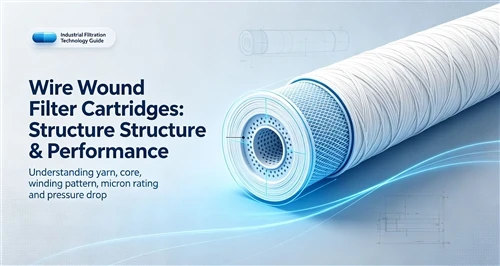
String wound cartridges are produced by winding filter yarn around a central core. The winding pattern can create a graded-density structure, with relatively larger openings toward the outside and progressively finer filtration toward the inner layers.
This structure allows the cartridge to capture particles throughout the depth of the media rather than concentrating all loading at the outer surface.
Depending on the yarn, winding pattern, cartridge dimensions, and manufacturing process, string wound cartridges can offer:
- High dirt-holding capacity
- Good mechanical strength
- Effective depth filtration
- Stable performance under differential pressure
- A wide range of filtration ratings
They are commonly used in applications with relatively high sediment or suspended-solid loading.

2.Melt-Blown Filter Cartridges
Melt-blown cartridges are manufactured by extruding and thermally bonding polypropylene microfibers into a depth filtration structure.
Because the fibers are thermally bonded rather than wound around a core, melt-blown cartridges provide a different filtration structure and performance profile.
Typical advantages include:
- 100% polypropylene construction in many configurations
- Broad chemical compatibility
- Consistent depth filtration
- Multiple filtration ratings
- Cost-effective filtration for many applications
Melt-blown cartridges are widely used in water treatment, RO pretreatment, process water filtration, and other applications where polypropylene depth filtration is appropriate.

Neither technology is universally better.
The better choice depends on feed water quality, contaminant loading, required filtration efficiency, operating pressure, flow rate, cartridge dimensions, and target service life.
Choosing the Right Micron Rating
Micron rating is one of the first specifications buyers look at, but it should not be the only one.
RO pretreatment cartridges are available in a wide range of ratings, commonly from approximately 1 to 20 μm for applications requiring relatively fine particulate removal, although cartridge products are available across a broader range.
A 5 μm polypropylene cartridge is commonly used as a final particulate barrier ahead of RO membranes in many systems.
However, a 5 μm cartridge isn't automatically the best choice for every installation.
If the feed water carries a high sediment load, using a finer cartridge as the first filtration stage can result in rapid loading. A staged approach may be more effective-for example, using a coarser depth filter upstream followed by a finer cartridge closer to the RO membrane.
The right filtration strategy should therefore be based on actual feed water conditions rather than a standard micron rating selected by default.
Dirt-Holding Capacity Matters More Than the Micron Number Alone
A common mistake is to compare cartridges primarily by micron rating.
Micron rating tells you something about particle capture, but it doesn't tell you how much contamination the cartridge can hold before pressure drop becomes unacceptable.
For high-sediment applications, dirt-holding capacity can have a major impact on operating cost.
A cartridge that costs slightly more but lasts significantly longer may be more economical than a lower-priced cartridge that requires frequent replacement.
This is particularly relevant for industrial RO systems operating continuously, where every additional filter change involves labor, downtime, and disposal costs.
Don't Overlook Cartridge Construction Quality
A well-designed filtration media can still underperform if manufacturing quality is inconsistent.
When evaluating a cartridge supplier, look beyond the product datasheet and consider:
- Raw material consistency
- Media density
- Winding or fiber distribution
- Core strength
- Dimensional consistency
- Batch-to-batch performance
- Quality control procedures
These factors can influence how reliably the cartridge performs once it is installed in a real filtration system.
ANDA's RO Pretreatment Filter Solutions
ANDA supplies string wound and melt-blown filter cartridges for industrial water treatment and RO pretreatment applications.
Our PP yarn filter cartridges use polypropylene filter yarn designed for consistent winding and depth filtration. The graded structure allows suspended particles to be captured throughout the cartridge, making these cartridges suitable for applications where sediment loading and service life are important considerations.
Our melt-blown filter cartridges are manufactured from polypropylene and are available in multiple filtration ratings for applications including RO pretreatment, industrial water filtration, and desalination pretreatment.
Rather than treating every RO system the same, ANDA focuses on matching the cartridge to the application.
Feed water quality, cartridge size, filtration rating, flow rate, operating pressure, contaminant loading, and replacement intervals all affect cartridge selection. Reviewing these factors before specifying a cartridge can help avoid the common cycle of installing a filter, watching it clog prematurely, and replacing it with the same specification.
For customers experiencing short cartridge life, the first step is often to look at the complete filtration process-not just the cartridge itself.
A Better Cartridge Can Mean a More Stable RO System
Frequent cartridge replacement should not simply be accepted as part of normal RO operation.
If pre-filters are clogging every few weeks, the issue may be excessive sediment loading, an unsuitable micron rating, insufficient dirt-holding capacity, incompatible media, poor cartridge construction, or a problem somewhere upstream.
The solution isn't necessarily a finer cartridge.
In some cases, the better answer is a different media structure. In others, it may be a staged filtration strategy or an upstream pretreatment adjustment.
The key is to match the cartridge to the water rather than choosing a cartridge first and trying to make the system fit it.
For RO operators, that approach can mean longer cartridge service intervals, more predictable maintenance, lower operating costs, and better protection for the RO membrane stage.

If you're unsure whether your current RO pre-filter cartridges are properly matched to your application, ANDA can help evaluate the relevant operating parameters and identify a more suitable filtration option based on your actual water and system conditions.