For decades, water treatment filter cartridges have been among the least visible components of industrial and municipal water systems.
Operators typically bought them in bulk, replaced them on a routine schedule, and paid little attention to them as long as the system was running normally. A cartridge was essentially treated as a consumable: install it, use it, replace it, and move on.
That mindset is changing.
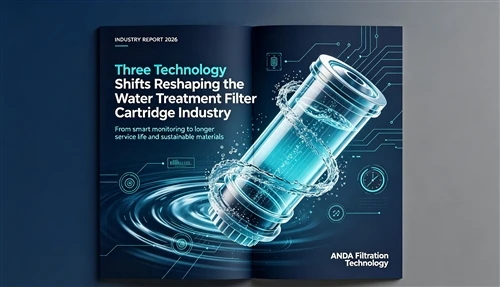
In 2026, the filter cartridge industry is entering a new phase. Three technology trends are beginning to reshape the way cartridges are designed, manufactured, monitored, and eventually disposed of: intelligent monitoring, longer service life, and more sustainable materials.
These developments go beyond incremental improvements in filter media. They are changing the role of the cartridge itself-from a passive consumable that is replaced when it becomes saturated into a more sophisticated component of the overall water treatment system.
1. From Scheduled Replacement to Intelligent Filter Monitoring
The first major shift is the growing use of intelligent filtration systems that combine filter cartridges with sensors, digital monitoring, and IoT connectivity.

Traditionally, filter replacement has been based on a relatively simple set of rules. A plant might replace cartridges every three or six months, or wait until differential pressure reaches a predefined alarm point.
The problem is that neither approach tells operators exactly how much useful filtration capacity remains.
Some cartridges are removed while they still have substantial dirt-holding capacity. Others remain in service longer than they should, increasing the risk of pressure loss, contaminant breakthrough, or reduced protection for downstream equipment.
Smart filtration systems are designed to make that decision more data-driven.
By monitoring parameters such as differential pressure, flow rate, and contaminant loading, sensors can provide a more accurate picture of the cartridge's operating condition. In more advanced systems, this information can be transmitted through wireless networks to centralized monitoring platforms.
Operators can then receive alerts when operating conditions approach predefined limits, allowing maintenance to be planned around actual filter performance rather than an arbitrary replacement calendar.
The potential operational benefits are significant:
Predictive maintenance instead of routine replacement
Cartridges can be replaced based on actual operating conditions rather than a fixed date.
Less unplanned downtime
Maintenance can be scheduled before a filter reaches a critical condition.
Better protection for downstream equipment
More consistent filtration can help reduce the risk of particulate breakthrough and membrane fouling.
Lower maintenance labor
Digital monitoring can reduce the need for frequent manual inspections.
The broader water treatment industry is also moving toward more connected operations. Online water-quality monitoring, automated maintenance alerts, and digital filter-life tracking are increasingly being incorporated into modern treatment systems.
Artificial intelligence is likely to play a growing role as well. Instead of simply reporting that a filter is approaching its pressure limit, future systems can use historical operating data to identify changes in water quality, estimate remaining filter life, and help operators plan maintenance before performance begins to deteriorate.
This is no longer purely a future concept.
The technology is already moving into commercial applications, and it is changing what customers expect from filtration suppliers. The value of a filter cartridge is increasingly tied not only to the filter media itself, but also to how effectively that cartridge can operate as part of a connected filtration system.
2. From Short Replacement Cycles to Longer Service Life
The second major shift is taking place inside the cartridge itself.

For many years, filtration economics were relatively straightforward: cartridges were inexpensive consumables, and frequent replacement was simply considered part of operating a treatment system.
That equation is becoming less attractive.
Labor costs are increasing, treatment systems are expected to operate more efficiently, and customers are paying closer attention to total cost of ownership. As a result, plant operators are looking for cartridges that can hold more contaminants, maintain stable pressure drop, and operate longer between replacements.
Manufacturers are responding through improvements in filter media, cartridge geometry, winding techniques, and overall structural design.
Some newer depth-filtration designs have demonstrated service-life improvements of up to 40% compared with conventional wrapped cartridges. High-flow cartridges using advanced pleated structures and felt media have also achieved substantially longer operating periods, with some designs offering up to twice the service life of comparable coarse large-volume filter elements.
Several factors are driving these improvements.
1.More Efficient Filter Media
Modern fiber configurations and graded-density structures allow contaminants to be distributed more effectively throughout the depth of the filter.
Instead of loading most of the contaminants onto the outer surface, the filter media can make better use of its available depth. This increases usable filtration capacity and can delay the point at which differential pressure becomes too high.
2.Stronger Cartridge Construction
The physical structure of the cartridge also matters.
Improved core strength, tighter control over winding precision, and better manufacturing consistency can help the cartridge withstand higher differential pressure while maintaining its shape and filtration characteristics.
This becomes particularly important in industrial systems where flow rates are high and pressure conditions can change significantly during operation.
3.Higher-Quality Materials
Material selection has an equally important role.
High-purity polypropylene with a consistent fiber structure and low extractables can provide more predictable filtration characteristics over an extended operating period.
For manufacturers, the challenge is therefore no longer simply to produce a cartridge with a specified micron rating.
The real objective is to develop a cartridge that maintains useful filtration capacity for as long as possible while balancing three competing factors: dirt-holding capacity, pressure drop, and structural integrity.
That is where cartridge engineering increasingly makes a difference.
The market outlook reflects this demand. The global string wound filter materials market is estimated in the original source at approximately USD 2.7 billion in 2026 and is projected to reach USD 5 billion by 2034, representing a compound annual growth rate of 8.3%.
Growth is being supported by demand for clean process water, expansion of municipal and industrial water and wastewater treatment, and continued filtration requirements in industries such as chemicals and petrochemicals.
As these systems become more demanding, longer filter life is becoming an operational requirement rather than simply a product advantage.
3. From Disposable Plastics to More Sustainable Filter Materials
The third shift is arguably the most difficult: reducing the environmental impact of used filter cartridges.

Most conventional cartridges rely on synthetic polymers such as polypropylene, polyester, or nylon. These materials provide the mechanical strength and chemical resistance required for many filtration applications, but they do not readily biodegrade after disposal.
A cartridge may have a useful operating life of only one to three months before it is discarded. When millions of cartridges are used across industrial, commercial, municipal, and residential applications, the cumulative volume of waste becomes difficult to ignore.
That is driving greater interest in biodegradable filter media and alternative materials.
In 2026, some biodegradable filter concepts are moving beyond laboratory research and into commercial development. One example described in the original source involves biodegradable bioplastic housings combined with activated carbon derived from coconut shells. These systems have been demonstrated for reducing chlorine, taste, and odor while meeting the requirements of NSF/ANSI Standard 42.
Research into biodegradable filtration media is also advancing.
Recent studies cited in the original article have shown that biodegradable polylactic acid (PLA) melt-blown nonwoven materials can achieve filtration efficiencies above 95% while maintaining a pressure drop below 160 Pa. Such results indicate that biodegradable materials may be capable of delivering filtration performance comparable to some conventional synthetic media under specific test conditions.
Other research and patent activity is focused on combinations of biodegradable fibers, advanced filter structures, and materials designed with circular-economy principles in mind.
The push toward more sustainable filtration is being driven by several factors.
Regulatory Pressure
Governments and regulatory bodies in many markets are placing greater emphasis on reducing single-use plastics and managing non-biodegradable waste.
Corporate Sustainability Goals
Industrial companies are increasingly setting targets for reducing waste and improving the environmental performance of their operations. Filtration consumables are becoming part of those sustainability discussions.
Changing Customer Expectations
End users are also paying more attention to the environmental impact of the products they purchase, particularly in residential and commercial water treatment.
However, biodegradable filtration is not yet a simple replacement for conventional synthetic materials.
Cost remains an issue. So do long-term filtration performance, mechanical strength, chemical resistance, consistency between production batches, and the availability of reliable raw materials.
For industrial applications in particular, a sustainable cartridge still has to perform reliably under real operating conditions.
The transition will therefore take time.
But the direction of the industry is becoming increasingly clear: future filter cartridges will need to balance filtration performance with the environmental impact of the materials used to manufacture and dispose of them.
What These Changes Mean for ANDA
For ANDA, these three developments are more than industry trends. They are influencing the way the company approaches product development, manufacturing, and customer requirements.
ANDA has extensive experience manufacturing polypropylene yarn and string wound filter cartridges, with products exported to markets including India, Pakistan, Cyprus, and the Middle East.
Its product range includes food-grade and industrial-grade PP yarn, string wound cartridges with graded-density structures, and melt-blown cartridges manufactured from 100% pure polypropylene.
These products are designed around several core performance requirements: consistent filtration, high dirt-holding capacity, stable physical structure, and reliable performance during continuous operation.
1.Supporting the Move Toward Intelligent Filtration
The shift toward data-driven filtration does not mean that the cartridge itself becomes secondary.
In fact, the opposite is true.
For a cartridge to work effectively with a monitoring system, its filtration characteristics need to be predictable. Consistent fiber structure, stable pressure-drop behavior, and repeatable contaminant-loading characteristics all make it easier for sensors and monitoring software to interpret cartridge performance.
ANDA is working with customers to better understand how data-driven filtration management can be used to improve maintenance planning and reduce operating costs.
While sensor hardware and digital monitoring platforms are often supplied by specialized technology companies, the filter remains the physical component at the center of the process.
Its performance needs to be consistent enough for the surrounding monitoring system to produce useful data.
2.Extending Cartridge Service Life
Longer service life is another area where cartridge manufacturing details matter.
ANDA's engineering team continues to refine factors such as winding precision, material purity, and cartridge structure.
The company's PP yarn is manufactured with low oil content, a stable fiber structure, and consistent winding characteristics, all of which contribute to predictable cartridge performance.
Its melt-blown cartridges are manufactured from 100% pure polypropylene without additives or binders, providing a consistent filter medium for applications that require reliable particle retention and stable performance.
The objective is not simply to make a cartridge last longer on paper.
A longer-lasting cartridge has to maintain useful filtration performance throughout its operating cycle while keeping pressure drop within an acceptable range.
That is the balance manufacturers must achieve if extended service life is going to deliver a genuine reduction in operating costs.
3.Preparing for More Sustainable Materials
The transition toward biodegradable filtration materials presents a different challenge.
Performance requirements vary significantly between applications, and biodegradable materials still need to demonstrate sufficient mechanical strength, chemical resistance, filtration efficiency, and production consistency before they can replace conventional polymers across a broad range of industrial applications.
ANDA is actively following developments in sustainable filter materials and related manufacturing technologies.
As biodegradable and lower-impact materials become more mature and commercially viable, the company intends to evaluate opportunities to incorporate them into future filtration solutions without compromising the performance requirements of its customers.
For ANDA, sustainability is not simply about replacing one material with another. The larger goal is to develop filtration products that provide the required performance while reducing their overall environmental impact.
The Bottom Line
The water treatment filter cartridge is changing.
It is no longer viewed simply as a low-cost consumable that is installed and discarded on a fixed schedule. Advances in intelligent monitoring, extended service life, and sustainable materials are gradually changing the role of the cartridge within the broader water treatment system.
For plant operators, the implications are straightforward.
The future of filtration will be less about replacing cartridges blindly and more about understanding exactly how a cartridge is performing, how much useful life remains, and what can be done to reduce waste when that service life ends.
For manufacturers, the challenge is broader still.
A competitive cartridge manufacturer must deliver consistent filtration performance, improve manufacturing precision, increase usable service life, and respond to growing environmental expectations.
The companies that can combine those requirements will be better positioned as the filtration industry enters its next stage of development.
For ANDA, that means continuing to invest in material quality, manufacturing consistency, product engineering, and more sustainable filtration technologies.
If you are evaluating string wound filter cartridges, polypropylene filter cartridges, melt-blown cartridges, or other filtration solutions for an industrial or commercial water treatment system, ANDA's technical team can evaluate your application based on operating conditions, feedwater characteristics, required filtration rating, flow rate, and maintenance requirements.
The goal is not simply to supply another replacement cartridge.
It is to provide a filtration solution that performs reliably today while remaining adaptable to the changing demands of the water treatment industry.