In industrial liquid filtration, one question comes up time and again among engineers and procurement professionals: Should you choose a string wound filter cartridge or a melt blown filter cartridge?
At first glance, the two technologies may seem quite similar. Both are cylindrical depth filtration cartridges designed to remove particulate contaminants from liquids. In actual operating conditions, however, their filtration performance, pressure resistance, service life, and suitability for different fluids can vary considerably.
Choosing the wrong filtration media can result in poor filtration performance, rapid differential-pressure buildup, frequent cartridge replacement, or even damage to downstream equipment.
The right choice depends largely on the specific operating conditions. To make an informed decision, it is useful to compare the two technologies from four key perspectives: manufacturing process, filtration mechanism, performance characteristics, and typical applications.
What Is a String Wound Filter Cartridge?
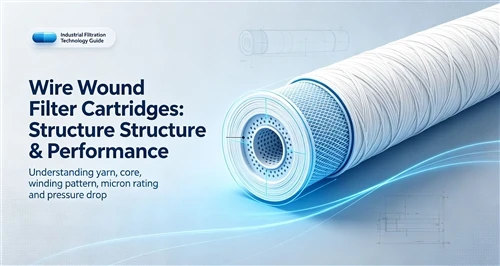
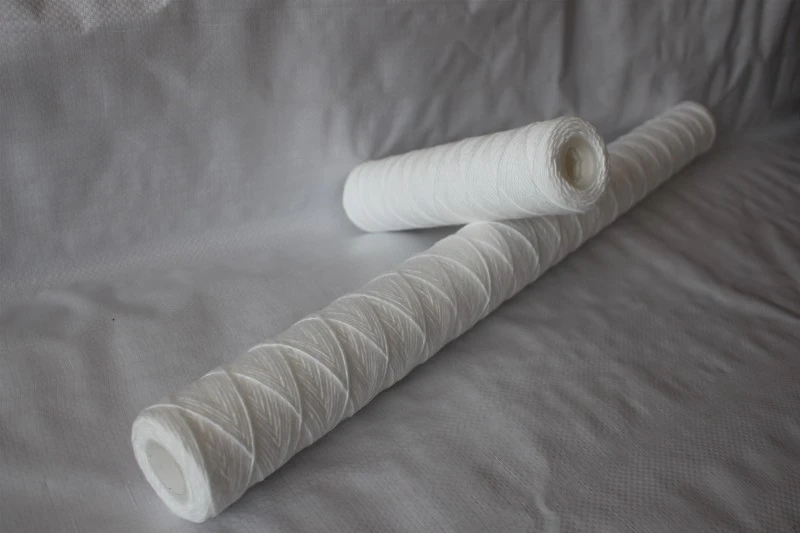
A string wound filter cartridge is a well-established depth filtration solution that has been used across industrial applications for decades. It is manufactured by winding textile yarn around a perforated central core in a carefully controlled pattern.
Depending on the application, the yarn may be made from polypropylene (PP), cotton, fiberglass, or other suitable materials. The inner core is typically manufactured from polypropylene or stainless steel to provide structural support.
During the winding process, the yarn creates a network of interconnected openings. The winding pattern and density can be adjusted to create a progressively tighter filtration structure from the outside of the cartridge toward the core.
As liquid flows from the outside toward the center, larger particles are captured in the outer layers, while progressively smaller particles are retained deeper within the cartridge. This graded-density structure allows contaminants to be distributed throughout the depth of the media instead of being concentrated primarily on the outer surface.
ANDA manufactures PP string wound filter cartridges with filtration ratings ranging from 5 to 100 μm. Winding density and yarn materials can also be customized according to specific filtration requirements. The PP core is injection-molded from 100% virgin polypropylene, providing reliable mechanical support under demanding operating conditions.

Key Advantages of String Wound Cartridges
One of the biggest advantages of string wound cartridges is their high dirt-holding capacity.
The relatively open structure between the yarn layers provides considerable void volume for contaminant retention. This allows the cartridge to accommodate a high solids load without clogging prematurely.
String wound cartridges also offer strong mechanical performance. The wound construction provides good resistance to compression, making this type of cartridge particularly suitable for applications involving higher operating pressures or more viscous fluids.
For this reason, string wound cartridges are often selected for applications involving high-turbidity water, high-solid-loading fluids, and viscous liquids.
Typical applications include:
- Food and beverage processing, including edible oils, syrups, and chocolate-based products
- Plating bath filtration
- Chemical solvent pre-filtration
- Municipal and industrial water treatment
- Pre-filtration for processes with relatively high contaminant loads
What Is a Melt Blown Filter Cartridge?
Melt blown filter cartridges use a fundamentally different manufacturing process.
In melt blown production, polypropylene resin is heated until it melts and is then extruded through fine spinnerets. High-velocity hot air stretches the molten polymer into extremely fine fibers. As the fibers come into contact with one another, they bond thermally at their intersection points, forming a continuous three-dimensional porous structure.
Unlike some filtration media that require binders or adhesives, a properly manufactured melt blown PP cartridge can be produced without binders or chemical additives.
The resulting fibers are randomly distributed throughout the cartridge, creating a complex network of microscopic flow channels. Like string wound cartridges, melt blown cartridges can also be manufactured with a graded-density structure. The outer layers generally feature a more open structure for capturing larger particles, while the inner layers become progressively finer for more precise filtration.
ANDA's PP melt blown filter cartridges are manufactured from 100% virgin polypropylene and are available with filtration ratings ranging from 1 to 100 μm.
Their binder-free construction and integrated fiber structure make them suitable for applications where clean filtration media and low risk of fiber shedding are important considerations.


Key Advantages of Melt Blown Cartridges
The primary strengths of melt blown cartridges are consistent filtration performance, fine filtration capability, and broad chemical compatibility.
The use of very fine polypropylene fibers allows melt blown media to achieve tighter and more uniform pore structures than many conventional wound media. According to the product specifications in this article, the cartridges can capture particles down to approximately 0.3 μm.
Polypropylene also provides good resistance to a wide range of chemicals, including many acids, alkalis, and solvents. The PP construction described here is suitable for applications across a broad pH range of 1–13.
Another advantage is manufacturing efficiency. Melt blown production can be highly automated, and polypropylene resin is relatively economical as a raw material. As a result, melt blown cartridges are often an attractive option for applications where cartridges are replaced frequently and operating cost is a major consideration.
Common applications include:
- Reverse osmosis (RO) system pre-filtration
- Pure water production
- Ultrapure water rinsing in electronics manufacturing
- Food and beverage processing
- Plating solution filtration
- Chemical solvent filtration
- General fine-particle pre-filtration
String Wound vs. Melt Blown: A Six-Point Comparison
1. Manufacturing Process
String wound:
String wound cartridges are produced through a mechanical winding process. Filtration yarn is wound layer by layer around a central core, with the winding pattern and density determining the resulting filtration structure.
Melt blown:
Melt blown cartridges are produced through a thermal extrusion process. Polypropylene resin is melted, extruded into fine fibers, stretched with hot air, and thermally bonded to form the filtration media.
The difference in manufacturing method directly affects the resulting fiber arrangement, pore structure, filtration consistency, and mechanical properties.
2. Filtration Accuracy
String wound:
String wound cartridges typically cover filtration ratings from 5 to 100 μm. Actual filtration performance depends on yarn diameter, winding pattern, and winding density. Because the winding process can involve different levels of mechanical automation, some variation between production batches may occur.
Melt blown:
Melt blown cartridges generally cover a broader range of filtration ratings, from 1 to 100 μm, with tighter control over fiber diameter and pore structure. They are particularly well suited to finer filtration requirements in the 1–5 μm range.
If your process requires relatively fine and consistent filtration in the 1–5 μm range, melt blown cartridges are generally the more suitable option.
3. Dirt-Holding Capacity and Service Life
String wound:
String wound cartridges typically provide excellent dirt-holding capacity. The open spaces between the wound yarn layers provide substantial volume for storing captured contaminants.
For applications with high particle loading, a string wound cartridge of the same nominal size can often accommodate a larger contaminant load before reaching its replacement point.
Melt blown:
Melt blown cartridges also provide good depth filtration and contaminant-holding capacity. Their fiber structure is generally denser, resulting in less open volume per unit of media. However, the graded-density structure allows contaminants to be distributed throughout the cartridge rather than accumulating exclusively on the outer surface.
For high-turbidity water or fluids with a heavy solids load, string wound cartridges are often the better choice when maximizing cartridge life is the priority.
4. Mechanical Strength and Pressure Resistance
String wound:
String wound cartridges offer strong mechanical integrity and good resistance to compression. The wound construction can withstand demanding operating conditions, and stainless steel cores can be used when additional mechanical strength, temperature resistance, or specialized sanitary requirements are needed.
Melt blown:
Melt blown cartridges generally have more moderate mechanical strength. Under excessive differential pressure, the porous fiber structure can deform or collapse.
The source specifications used for this article indicate a recommended maximum differential pressure of approximately 0.4 MPa for melt blown cartridges. Actual allowable pressure should always be determined according to the specific cartridge design and manufacturer's specifications.
For high-pressure systems or highly viscous fluids, string wound cartridges are generally the safer option.
5. Chemical Compatibility
String wound:
Chemical compatibility depends largely on the materials used to manufacture the yarn and core.
A PP yarn combined with a PP core provides good chemical resistance, while cotton yarn may have limitations in certain chemical environments. Fiberglass yarn can be considered for applications requiring compatibility with a broader range of chemicals.
Melt blown:
Melt blown cartridges manufactured from 100% polypropylene provide broad chemical resistance. PP is resistant to many strong acids, alkalis, and organic solvents, with the product specifications in this article covering a pH range of 1–13.
The absence of binders or adhesives also reduces concerns related to additive leaching from the filtration media.
For applications involving aggressive or highly corrosive liquids, a 100% PP melt blown cartridge can therefore be an attractive option, provided the specific chemical compatibility has been confirmed for the process conditions.
6. Cost
String wound:
String wound cartridges generally have a higher manufacturing cost. The winding process requires additional processing time, and textile yarn can be more expensive than polypropylene resin used in melt blown production.
Melt blown:
Melt blown cartridges can be produced efficiently through a highly automated manufacturing process, while polypropylene resin is relatively economical. This allows melt blown cartridges to offer a lower unit cost in many applications.
The source comparison estimates that the cost of one string wound cartridge may be equivalent to approximately two to three melt blown cartridges. For systems with frequent cartridge replacement, melt blown technology can therefore provide a more economical overall solution.
However, cartridge price alone should not determine the selection. Service life, pressure drop, replacement frequency, labor, and the cost of process interruptions should also be considered when evaluating total filtration cost.
How Do You Choose the Right Filter Cartridge?
There is no universally superior depth filtration technology. The better choice depends on the fluid being treated, contaminant loading, operating pressure, required filtration rating, chemical environment, and replacement strategy.

Choose String Wound Cartridges When:
- You are filtering high-viscosity liquids such as syrups, oils, or paints
- The feed water has high turbidity or a high particle load
- The system operates under relatively high pressure
- High dirt-holding capacity is a priority
- You want to extend cartridge replacement intervals
- Reducing maintenance frequency is important
- A stainless steel core is required for higher-temperature operation or specialized sanitary applications
Choose Melt Blown Cartridges When:
- You require relatively fine filtration in the 1–5 μm range
- The cartridge will be used as an RO pre-filter or guard filter
- You are processing pure or ultrapure water
- The application involves electronic-grade liquids
- The process involves aggressive acids, alkalis, or compatible organic solvents
- Cartridge replacement is frequent and minimizing unit cost is important
- Consistent filtration performance and a binder-free PP structure are priorities

Can String Wound and Melt Blown Cartridges Be Used Together?
In many industrial filtration systems, the choice does not have to be one or the other.
A multi-stage filtration approach can often provide better overall performance. For example, a string wound cartridge can be installed as the first-stage filter to handle larger particles and higher contaminant loads, followed by a melt blown cartridge for finer filtration.
This arrangement allows each filtration technology to perform the job it is best suited for:
String wound → high dirt loading and coarse depth filtration → Melt blown → finer filtration and polishing
The result can be a practical balance between dirt-holding capacity, filtration precision, cartridge life, and operating cost.
ANDA's Approach to Filter Cartridge Selection
As an experienced filter cartridge manufacturer, ANDA supplies both string wound and melt blown filter cartridges for a wide range of industrial applications.
Offering both technologies allows ANDA to recommend a filtration solution based on actual process conditions rather than simply promoting one type of cartridge.
ANDA's string wound cartridges are manufactured using high-quality PP yarn and high-strength PP cores. Available sizes range from 10 to 50 inches and beyond, providing options for applications across food and beverage processing, chemical treatment, water treatment, and other industrial processes.
ANDA's melt blown cartridges are manufactured from 100% virgin polypropylene using advanced melt blown technology. Their integrated fiber structure is designed to provide consistent filtration performance while minimizing concerns about fiber shedding and additive leaching.
These characteristics make melt blown cartridges particularly suitable for RO pre-treatment, fine-particle filtration, and applications requiring clean polypropylene filtration media.
String Wound or Melt Blown: Which One Is Better?
Neither technology is inherently better than the other.
The more important question is: Which filtration technology is better suited to your operating conditions?
- If your priority is high dirt-holding capacity, long service intervals, mechanical strength, or filtration of high-turbidity or viscous fluids, string wound cartridges may be the better fit.
- If you need finer filtration, consistent pore structure, broad PP chemical compatibility, or an economical solution for frequent cartridge replacement, melt blown cartridges may be the better choice.
- For some systems, the most effective solution may be to use both technologies in sequence, allowing each cartridge to handle a different stage of the filtration process.
Before selecting a cartridge, it is important to evaluate the fluid characteristics, particle concentration, target filtration rating, flow rate, operating temperature, differential pressure, chemical compatibility, and expected replacement frequency.
ANDA's technical team can help evaluate these parameters and recommend a suitable string wound or melt blown filtration solution based on the actual requirements of your system.