When it comes to string wound filter cartridges, the yarn used to make the filter is one of the most important factors affecting overall performance. Yet it is often overlooked during the purchasing process.
Buyers typically pay close attention to cartridge dimensions, micron ratings, and compatibility with existing filter housings. Those specifications certainly matter, but the filter material itself can have an equally significant impact on filtration performance, chemical resistance, operating temperature, service life, and long-term operating costs.
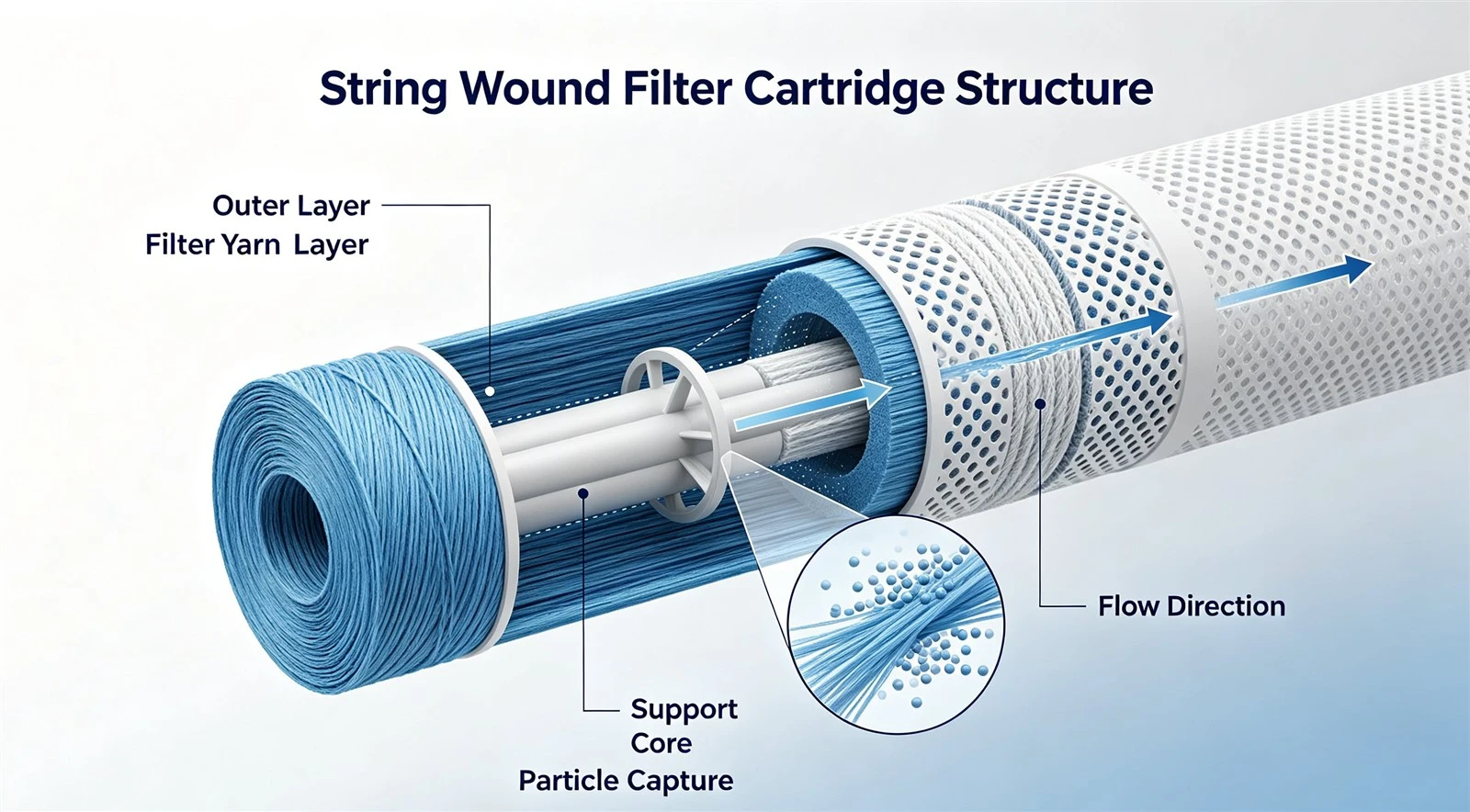
Two of the most widely used materials for string wound filter cartridges are polypropylene (PP) yarn and cotton yarn. Each material offers distinct performance characteristics, and neither is universally better than the other. The right choice depends on the fluid being filtered, operating temperature, chemical exposure, filtration requirements, and expected service conditions.
Understanding these differences before selecting a filter yarn can help prevent premature cartridge replacement, compatibility issues, and unnecessary operating costs.
This guide compares PP yarn and cotton yarn from a practical filtration perspective, focusing on the material properties that matter most when selecting yarn for string wound filter cartridge production.
What Is PP Filter Yarn?
Polypropylene filter yarn is a synthetic filtration material made from polypropylene resin and processed into continuous fibers suitable for winding into filter cartridges.
Because the material can be manufactured with a consistent fiber structure and controlled winding characteristics, PP yarn is widely used in string wound cartridges for water treatment, chemical processing, industrial filtration, and other applications where predictable filtration performance is required.
ANDA manufactures polypropylene filter yarn in different grades for industrial and food-related filtration applications. Food-grade versions are produced using 100% virgin polypropylene and are designed for applications where material purity and suitability for food-contact environments are important.
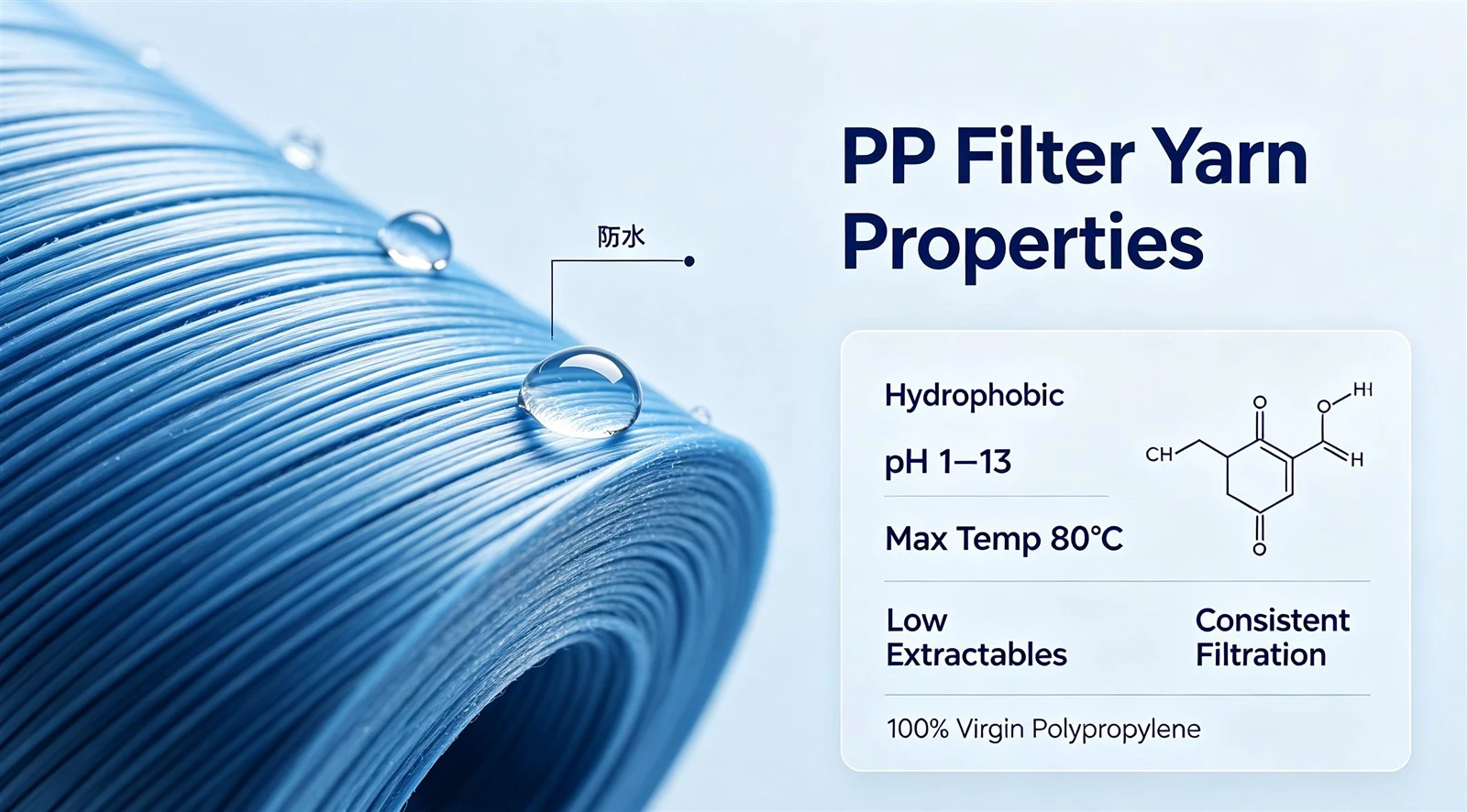
Key Properties of PP Filter Yarn
Broad chemical resistance
Polypropylene provides good resistance to many acids, alkalis, and other chemicals, making it suitable for a wide range of industrial filtration environments. The source material specifies a working pH range of approximately 1 to 13.
Low water absorption
PP is naturally hydrophobic, so its fibers do not readily absorb water. This characteristic helps maintain a relatively stable fiber structure during filtration.
Moderate temperature resistance
PP yarn is suitable for applications with operating temperatures up to approximately 80°C (176°F).
Resistance to microbial growth
Compared with many natural fibers, polypropylene provides a less favorable environment for microbial growth.
Cost efficiency
PP yarn is generally more economical than cotton yarn, making it well suited to high-volume filtration applications where cartridges are replaced regularly.
Low extractables
High-purity polypropylene yarn can be manufactured with very low oil and additive content, which is beneficial when minimizing the risk of unwanted substances entering the filtered fluid is important.
These characteristics make PP yarn a practical choice for applications where chemical compatibility, consistent filtration, and cost control are key considerations.
What Is Cotton Filter Yarn?
Cotton filter yarn is a natural-fiber filtration material used in string wound filter cartridges. For filtration applications, cotton yarn is commonly degreased to remove naturally occurring oils and waxes that could otherwise migrate into the filtered fluid.
ANDA produces degreased cotton filter yarn for string wound cartridges used in food and beverage processing, pharmaceutical applications, chemical filtration, and industrial processes.
One of the main advantages of cotton is its ability to tolerate significantly higher temperatures than polypropylene. Its natural fiber structure also provides strong capillary action, giving cotton an advantage in applications where oil or other organic substances need to be captured.
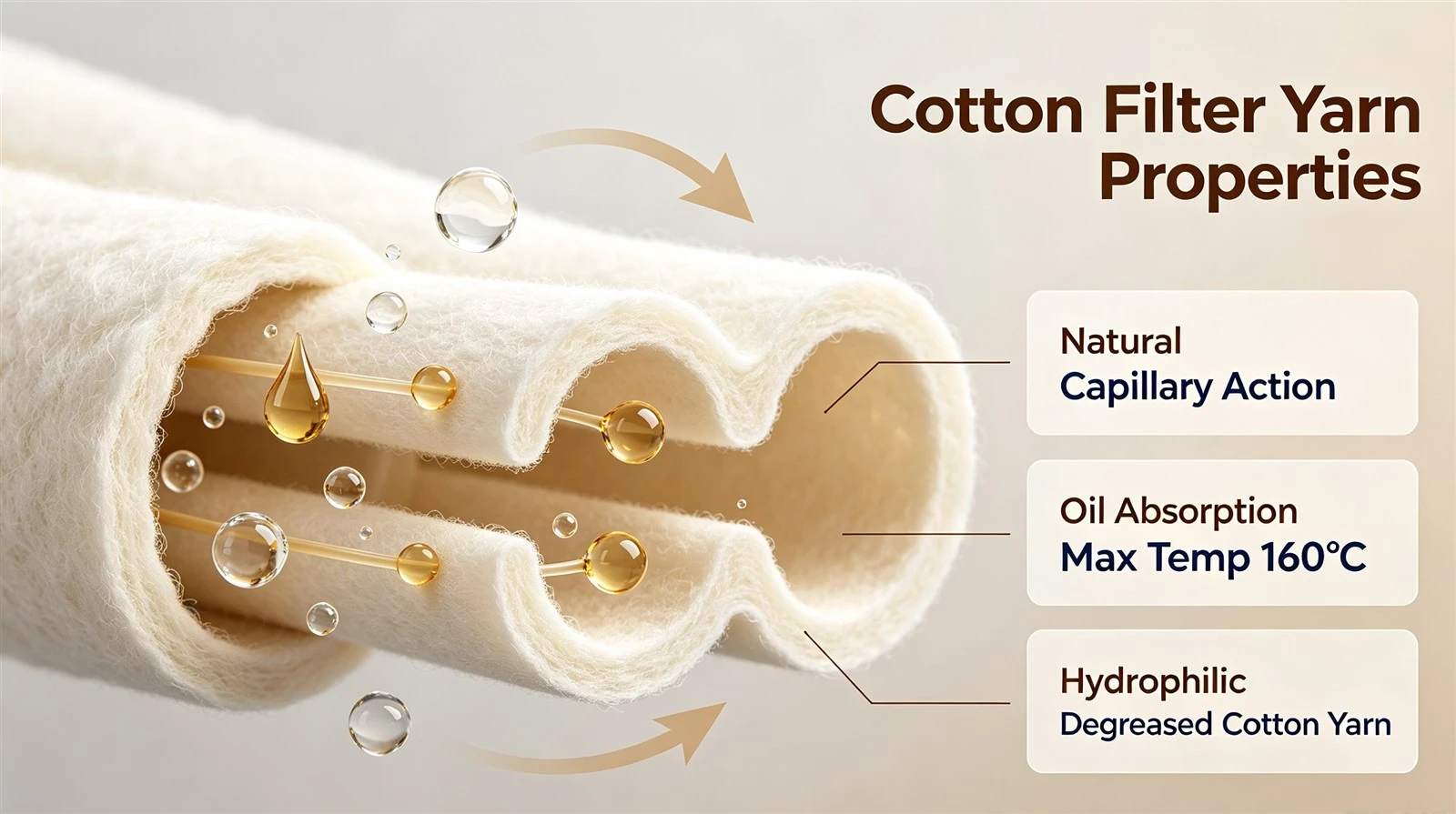
Key Properties of Cotton Filter Yarn
Higher temperature resistance
Cotton can withstand operating temperatures of approximately 160°C (320°F), making it suitable for applications beyond the normal temperature range of polypropylene.
Natural oil absorption
The capillary structure of cotton fibers allows them to absorb oils and certain organic substances, making cotton particularly useful when oil retention is part of the filtration requirement.
Hydrophilic characteristics
Unlike hydrophobic polypropylene, cotton naturally attracts and retains water, which can be beneficial in certain filtration processes.
Flexible fiber structure
Cotton yarn forms a relatively soft and flexible wound structure, which can be advantageous in specific cartridge designs and sealing conditions.
Narrower chemical resistance
Natural cotton fibers are less resistant to certain chemicals than polypropylene and therefore require more careful material compatibility evaluation.
Higher material cost
Cotton yarn generally costs more than polypropylene, which can increase the manufacturing cost of the finished filter cartridge.
Cotton therefore tends to be a more specialized filtration material. Its higher temperature tolerance and oil absorption characteristics can make it the better option for specific applications, even when PP would be more economical for general-purpose filtration.
PP Yarn and Cotton Yarn: Why Material Selection Matters
The difference between PP and cotton is not simply a matter of choosing a synthetic material versus a natural one. The fiber itself influences how a string wound cartridge behaves once it is exposed to the process fluid.
For example, a PP cartridge may be a better fit for a chemical filtration system operating at moderate temperatures because of polypropylene's broad chemical resistance. A cotton cartridge, on the other hand, may be more appropriate for a high-temperature process or an application where oil absorption is an important part of contaminant removal.
That is why material selection should come before simply choosing a micron rating.
A cartridge with the correct micron rating can still deliver unsatisfactory results if the yarn material is incompatible with the fluid, temperature, or operating environment.
For buyers and filter manufacturers, the goal is not to identify a universally superior yarn. The goal is to match the yarn's properties with the actual demands of the filtration process.
PP Yarn vs. Cotton Yarn: A Closer Look at Performance
Choosing between polypropylene and cotton yarn requires more than comparing the price of the raw material. The better option depends on how the filter will be used - particularly the fluid chemistry, operating temperature, contaminant type, expected service life, and replacement frequency.
The following comparison focuses on the performance factors that have the greatest impact on string wound filter cartridge selection.
1.Chemical Compatibility
Chemical compatibility is one of the strongest reasons to choose PP filter yarn.
Polypropylene offers good resistance to a broad range of chemicals, including many acids, alkalis, and oxidizing agents. This makes PP yarn suitable for a wide variety of industrial filtration applications, from water treatment to chemical processing.
Cotton has a narrower chemical resistance profile. Although it performs well in water-based applications and can be used with oils, alkaline solutions, and a range of food, beverage, and pharmaceutical fluids, it can be affected by strong acids, oxidizing agents, and certain organic solvents.
For filtration systems where the process fluid has aggressive chemical properties, polypropylene generally provides greater material compatibility and a wider operating window.
For chemical resistance, PP yarn is generally the more versatile choice.
2.Temperature Resistance
Temperature changes the equation considerably.
Polypropylene yarn has a typical maximum operating temperature of approximately 80°C (176°F). Within that range, it provides the combination of chemical resistance, dimensional stability, and cost efficiency expected from a general-purpose synthetic filter material.
Cotton can tolerate considerably higher temperatures, with the source material specifying operating temperatures of up to approximately 160°C (320°F).
That difference can be decisive in processes involving hot fluids, elevated process temperatures, or steam sterilization. When the operating temperature exceeds the practical range of polypropylene, cotton may provide a more suitable fiber option.
For high-temperature cotton applications, the original source recommends using a stainless steel core as the internal support structure because a conventional PP core may not withstand the same elevated temperatures.
When temperature is the limiting factor, cotton has the clear advantage.
3.Filtration Performance
Both PP yarn and cotton yarn can be manufactured into string wound cartridges covering nominal filtration ratings of approximately 5 to 100 microns. The micron rating, however, is only part of the performance equation.
The physical characteristics of the fiber also influence how contaminants are retained and how the cartridge behaves during operation.
PP Yarn: Consistent Fiber Structure
Polypropylene provides a relatively uniform synthetic fiber structure. When properly processed and wound, this helps create a consistent filtration path and predictable particle retention.
PP fibers also do not absorb water in the same way as natural fibers. This helps the wound structure maintain relatively stable characteristics during wet operation.
For applications where repeatable filtration performance is the priority, PP yarn provides a strong and dependable option.
Cotton Yarn: Natural Capillary Action
Cotton behaves differently because of its natural fiber structure.
When exposed to water, cotton fibers can swell, which may influence the internal pore structure of a wound cartridge. This characteristic needs to be considered when consistent pore geometry is important.
At the same time, cotton's natural capillary structure provides an important advantage: oil absorption.
For applications involving oily fluids or significant organic content, this absorption capability can make cotton a more suitable choice than polypropylene.
In practical terms, the distinction is straightforward: PP is generally better suited to applications that prioritize predictable filtration behavior, while cotton can offer additional value when oil absorption is part of the filtration requirement.
4.Service Life and Maintenance
Filter life depends on many factors, including fluid quality, contaminant loading, operating conditions, and cartridge design. However, the yarn material itself can influence how well a cartridge performs over time.
Polypropylene is resistant to chemical degradation in a wide range of applications and does not provide the same biological substrate associated with natural fibers. This can help reduce concerns related to microbial growth and contribute to longer service intervals in suitable applications.
Cotton, as a natural fiber, is more susceptible to biological degradation, particularly when exposed to warm and consistently wet conditions. Over time, this can affect the integrity of the filter material and may lead to more frequent cartridge replacement.
For applications where long service intervals and resistance to environmental degradation are important, PP yarn is generally the more practical option.
However, service life should never be estimated from yarn material alone. Actual cartridge life depends heavily on the process fluid, contaminant concentration, flow conditions, and the amount of solids the filter is expected to retain.
5.Cost: Look Beyond the Price of the Yarn
For many buyers, material cost is an important part of the selection process.
In general, PP yarn costs less than cotton yarn, both as a raw filtration material and in the finished cartridge. This makes polypropylene particularly attractive for high-volume applications where filters are replaced frequently.
For example, when a filtration system requires large quantities of cartridges over the course of a year, even a relatively small difference in material cost can have a meaningful impact on the overall purchasing budget.
But the lowest purchase price does not automatically represent the lowest operating cost.
A more useful way to evaluate filter materials is to consider total cost of ownership. This includes:
- Initial cartridge price
- Expected service life
- Cartridge replacement frequency
- Maintenance requirements
- Process downtime during filter changes
- Compatibility with the process fluid
- Potential impact on downstream equipment
A lower-cost PP cartridge may be the obvious choice for a moderate-temperature industrial process, while a more expensive cotton cartridge may make better economic sense if its high-temperature performance or oil absorption capability solves a specific process requirement.
In other words, material cost should be considered together with performance rather than evaluated in isolation.
Which Material Performs Better?
There is no single answer because PP and cotton are designed for different operating conditions.
PP yarn is generally the stronger all-around choice when you need:
- Broad chemical compatibility
- Consistent filtration performance
- Moderate-temperature operation
- Resistance to microbial growth
- Lower material cost
- Longer service intervals in suitable applications
Cotton yarn becomes more attractive when the application requires:
- Higher operating temperatures
- Filtration of oily fluids
- Natural oil absorption
- A natural-fiber filtration medium
- Performance in specialized food, pharmaceutical, or industrial processes where its specific properties are suitable
The important point is that the choice should be driven by the application rather than by the material's general reputation.
A filter that performs exceptionally well in one process may be a poor fit for another. Matching the yarn to the fluid and operating conditions is therefore one of the most important steps in designing or purchasing a string wound filter cartridge.
How to Choose Between PP Yarn and Cotton Yarn
Once the technical differences are clear, the next step is to determine which material actually fits your filtration process.
There is no universal filter yarn that works best for every application. The right choice depends on the conditions the cartridge will face throughout its service life.
Before selecting a material, consider the following factors.

1. What Fluid Are You Filtering?
Start with the process fluid.
If the application involves water, acids, alkalis, or other chemically demanding fluids, PP yarn is often the more practical option because of its broad chemical resistance.
If the process involves oil or other substances that benefit from natural absorption, cotton may offer an advantage because of its inherent capillary and oil-retention properties.
2. What Is the Operating Temperature?
Temperature is one of the easiest ways to narrow the selection.
For applications operating around or below 80°C (176°F), polypropylene can provide a good combination of chemical resistance, filtration consistency, and cost efficiency.
If the process temperature approaches or exceeds that range, cotton may be worth considering because of its higher temperature tolerance.
The filter cartridge as a whole must also be evaluated. End caps, cores, seals, and other components need to be compatible with the intended operating temperature rather than selecting the yarn in isolation.
3. What Type of Contaminants Need to Be Removed?
The nature of the contaminants matters just as much as their size.
For general particulate removal, PP yarn can provide consistent filtration characteristics across a broad range of industrial applications.
When the filtration process also involves oils or organic substances, cotton's natural absorption characteristics may provide an additional benefit.
This is why simply choosing a cartridge based on micron rating is not always enough. The contaminant profile should be considered together with the yarn material and cartridge construction.
4. How Important Is Service Life?
If filters are difficult to replace or downtime is expensive, service life should be part of the purchasing decision from the beginning.
PP yarn is resistant to many forms of chemical degradation and can provide reliable long-term performance when used within its recommended operating conditions.
Cotton can also provide dependable filtration performance, but its natural-fiber characteristics make application conditions more important, particularly in warm, continuously wet environments.
For high-throughput industrial systems where minimizing cartridge replacement is a priority, PP is often the more practical starting point.
5. What Does the Total Cost Look Like?
Purchase price is only one part of the equation.
A lower-cost cartridge may not be the most economical choice if it needs to be replaced frequently. Likewise, paying more for a specialized material may be justified if it extends service life or performs better under demanding process conditions.
When comparing filter materials, look at the complete operating picture:
Cartridge cost + replacement frequency + maintenance labor + downtime + process requirements = actual filtration cost.
This approach gives buyers a much more useful basis for comparing PP and cotton than simply looking at the price per kilogram of yarn.
Why PP Yarn Is Widely Used in String Wound Filter Cartridges
For many general-purpose industrial filtration applications, polypropylene offers a particularly practical balance of performance and cost.
Its combination of chemical resistance, low moisture absorption, relatively stable fiber characteristics, and competitive pricing makes it suitable for a broad range of filtration environments.
PP yarn can also be processed into different winding structures to achieve the required filtration characteristics. By controlling yarn properties and winding parameters, filter manufacturers can produce cartridges designed for different micron ratings, flow requirements, and applications.
This flexibility is one reason polypropylene has become a common material in string wound cartridge manufacturing.
However, material quality matters.
The performance of a finished cartridge depends not only on whether it uses polypropylene, but also on the quality and consistency of the yarn itself.
Variations in yarn diameter, strength, fiber structure, and processing quality can affect winding consistency and, ultimately, cartridge performance.
For filter manufacturers, sourcing stable and consistent filter yarn is therefore just as important as choosing the correct polymer.
Choosing the Right PP Filter Yarn Supplier
For manufacturers of string wound filter cartridges, the yarn supplier becomes part of the overall quality-control process.
A reliable supplier should be able to provide consistent material specifications from batch to batch, clear technical documentation, and yarn characteristics suitable for the intended cartridge design.
Important factors to evaluate include:
- Raw material quality
- Yarn consistency
- Tensile strength
- Yarn size and weight
- Processing method
- Color and appearance
- Chemical resistance
- Applicable certifications
- Production capacity
- Quality-control procedures
- Technical support
For food, beverage, pharmaceutical, or other sensitive filtration applications, material traceability and certification can become especially important.
The goal is not simply to purchase polypropylene yarn at the lowest possible price. It is to source a material that can be processed consistently and deliver predictable performance in the finished cartridge.
PP Filter Yarn from ANDA
ANDA supplies 100% polypropylene filter yarn for manufacturers producing string wound filter cartridges for industrial and commercial filtration applications.
The material is made from polypropylene and processed for use in cartridge winding applications where consistent filtration performance and chemical resistance are important.
Depending on the application, polypropylene filter yarn can be used in filtration systems serving water treatment, chemical processing, food-related applications, and other industrial processes.

ANDA's product range includes yarn manufactured with different specifications to accommodate different cartridge designs and filtration requirements.
For applications where material purity is important, the use of virgin polypropylene provides a more controlled raw-material composition. The available product specifications also include OEKO-TEX Standard 100 certification, supporting applications where material safety and controlled composition are important considerations.
Rather than selecting a yarn solely by price, manufacturers can work with the supplier to match the yarn specification with the intended cartridge construction and operating environment.
PP Yarn or Cotton Yarn: Which One Should You Choose?
The answer ultimately depends on the application.
If you need a cost-effective filter material with broad chemical compatibility, consistent performance, and suitability for moderate operating temperatures, PP yarn is usually the more versatile choice.
If the application involves substantially higher temperatures or requires the natural oil-absorption characteristics of cotton, cotton yarn may be the better fit.
The key is to evaluate the entire filtration process rather than choosing a material based on a single specification.

| Selection Factor | PP Yarn | Cotton Yarn |
|---|---|---|
| Chemical resistance | Excellent for a broad range of chemicals | More limited |
| Temperature resistance | Up to approximately 80°C / 176°F | Up to approximately 160°C / 320°F |
| Water absorption | Very low | Higher |
| Oil absorption | Limited | Good |
| Microbial resistance | Good | More susceptible in certain conditions |
| Typical cost | Lower | Higher |
| Filtration consistency | Highly consistent when properly processed | Can vary with fiber behavior |
| Best suited for | General industrial filtration and chemically demanding applications | High-temperature and oil-related applications |
The comparison makes one point clear: there is no universally superior filter yarn.
PP and cotton serve different filtration requirements. Selecting the right material requires a clear understanding of the fluid, contaminants, temperature, cartridge design, and expected operating life.
Final Thoughts
The choice between PP yarn and cotton yarn can have a direct impact on the performance, durability, and operating cost of a string wound filter cartridge.
Polypropylene has become a widely used filtration material because it offers a strong combination of chemical resistance, consistent processing characteristics, low moisture absorption, and cost efficiency. Cotton remains valuable in applications where higher temperature resistance and natural oil absorption are more important than broad chemical compatibility or low material cost.
For filter cartridge manufacturers, the best approach is to start with the application requirements and then select the yarn accordingly.
The right material can help improve cartridge consistency, reduce unnecessary replacements, and ensure that the finished filter performs as expected under actual operating conditions.
If you are developing or manufacturing string wound filter cartridges and need help selecting the appropriate polypropylene filter yarn specification, contact ANDA to discuss your application requirements and yarn options.