Product Focus: Polypropylene Filter Yarn and Degreased Cotton Filter Yarn
Brand: ANDA
In industrial liquid filtration, the performance of a wound filter cartridge depends heavily on one often overlooked component: the filter yarn itself.
While many buyers focus on cartridge dimensions, micron ratings, or housing compatibility, experienced manufacturers and industrial users understand that the real filtration stability begins with the winding material.
As global industries place higher demands on water purity, chemical stability, and production efficiency, the market is moving toward higher-quality wound filtration solutions. This shift is especially visible in sectors such as water treatment, food processing, electroplating, pharmaceuticals, chemicals, and industrial manufacturing.
For filtration manufacturers and distributors, choosing the correct filter yarn is no longer simply a material decision. It directly affects filtration precision, service life, pressure resistance, customer satisfaction, and long-term operating cost.

ANDA specializes in the production of high-performance filter yarns and wound filter cartridge materials for both domestic and international markets, focusing on two widely used filtration yarn categories:
- Polypropylene Filter Yarn
- Degreased Cotton Filter Yarn
Both materials are widely applied in industrial filtration systems, but their structure, performance characteristics, and application logic are fundamentally different.
Why Polypropylene Filter Yarn Is Widely Used in Industrial Filtration?
1.Excellent Chemical Resistance Improves Filtration Stability
Polypropylene filter yarn has become one of the most commonly used materials in industrial wound cartridges because of its outstanding chemical compatibility.
In many industrial environments, filtration systems are exposed to acidic liquids, alkaline solutions, salts, and chemical additives. Traditional fiber materials may swell, degrade, or release contaminants under these conditions, which reduces filtration efficiency and shortens cartridge lifespan.
Polypropylene fibers maintain structural stability under a wide range of chemical environments. This allows wound cartridges made from polypropylene yarn to operate more consistently in:
- Industrial water treatment
- Electroplating filtration
- Chemical processing
- RO pre-filtration systems
- Cooling water circulation systems
This material stability is one of the main reasons polypropylene filter yarn is preferred in export markets where industrial standards and consistency requirements are higher.
2.Controlled Fiber Structure Supports Stable Micron Performance
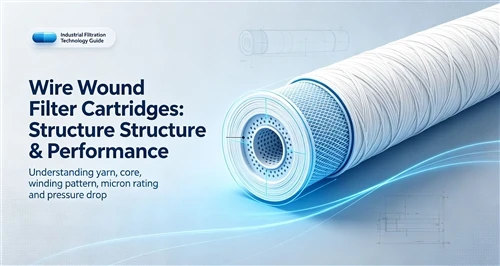
The filtration efficiency of a wound filter cartridge depends heavily on yarn tension consistency and fiber uniformity during winding.
High-quality polypropylene filter yarn provides:
- Stable winding density
- Better depth filtration structure
- Reduced fiber shedding
- More consistent micron retention
This is important because uneven yarn structure can create unstable filtration channels inside the cartridge. Once pressure changes during operation, those weak areas may allow particles to bypass the filtration layer.
ANDA polypropylene filter yarn is engineered to maintain stable winding performance during high-speed cartridge production, helping manufacturers improve product consistency while reducing production defects.
For cartridge manufacturers, this directly improves production efficiency and lowers reject rates.
Why Degreased Cotton Filter Yarn Remains Important in Precision Filtration?
1.Natural Fiber Structure Offers Strong Oil Absorption Performance
Unlike polypropylene, degreased cotton filter yarn contains natural fiber capillary structures that provide excellent oil absorption capability.
This makes degreased cotton yarn highly suitable for applications involving:
- Edible oil filtration
- Industrial oil purification
- Lubricant filtration
- Fine suspended particle removal
The degreasing process removes natural oils, waxes, and impurities from raw cotton fibers. As a result, the yarn achieves higher cleanliness and improved liquid compatibility.
Without proper degreasing treatment, residual impurities inside cotton fibers may affect liquid purity or create unstable filtration performance.
This is why high-quality degreased cotton filter yarn requires strict production control rather than simple textile processing.
2.Better Temperature Resistance for Specific Industrial Conditions

Another important advantage of degreased cotton filter yarn is its temperature tolerance in certain operating environments.
Compared with standard synthetic fibers, properly processed cotton yarn can maintain more stable performance in applications involving elevated liquid temperatures.
For some industrial users, this helps improve filtration reliability while reducing cartridge replacement frequency.
However, cotton yarn is not universally suitable for every filtration condition. Material selection should always depend on:
- Liquid composition
- Operating temperature
- Pressure conditions
- Chemical exposure
- Required filtration precision
Professional filtration solutions are based on matching the correct material to the actual working environment rather than simply choosing the lowest-cost option.
Why Raw Material Quality Directly Affects Filter Cartridge Performance?
Many filtration problems originate from unstable raw materials rather than cartridge structure itself.
Common issues caused by low-quality filter yarn include:
- Fiber shedding
- Unstable micron ratings
- Short service life
- Poor pressure resistance
- Channeling inside cartridges
- Reduced contaminant holding capacity
For industrial buyers, these problems increase maintenance cost and system downtime.
For cartridge manufacturers, they may lead to customer complaints, inconsistent batches, and reduced market competitiveness.
This is why more professional filtration companies now pay closer attention to upstream yarn manufacturing quality.
ANDA focuses on stable fiber processing, winding compatibility, and production consistency to help filtration manufacturers produce more reliable wound filter cartridges for both domestic and overseas markets.
With stricter environmental standards and increasing industrial water treatment requirements worldwide, the demand for stable filtration materials continues to expand.
Markets in Southeast Asia, the Middle East, Europe, and South America are showing increasing demand for:
- Industrial water filtration
- Food-grade liquid filtration
- Chemical filtration systems
- High-flow pre-filtration solutions
As filtration standards become more demanding, buyers are placing greater importance on:
- Material consistency
- Production stability
- Supply reliability
- Customization capability
- Long-term cooperation
This creates significant opportunities for professional filter yarn manufacturers capable of delivering stable quality and scalable production.


ANDA is committed to supplying high-quality filtration yarn solutions for wound filter cartridge production.
- Main products include:
- Polypropylene filter yarn
- Degreased cotton filter yarn
- Wound filter cartridge materials
- Industrial filtration support materials
By focusing on stable raw material control, production consistency, and application-oriented manufacturing, ANDA supports filtration manufacturers, distributors, and industrial users across both international and domestic markets.
For modern filtration systems, stable filtration performance does not begin at the cartridge housing.
It begins with the fiber itself.