Seawater desalination is no longer a niche solution used only in regions facing severe water shortages. It has become an increasingly important part of the global water supply strategy, particularly in coastal regions where freshwater resources are limited.
In 2026, the global desalination market is estimated at approximately USD 20.76 billion, with a projected compound annual growth rate of 9.1%.
Installed desalination capacity worldwide has reached roughly 130 million cubic meters per day, and continued investment is expected as demand for reliable freshwater supplies increases.
But behind the expansion of desalination capacity is a challenge that every plant operator has to deal with: pretreatment.
For a seawater reverse osmosis (SWRO) plant, pretreatment is much more than an initial filtration step. The quality of the water entering the RO system has a direct impact on membrane fouling, cleaning frequency, membrane service life, and overall operating costs.
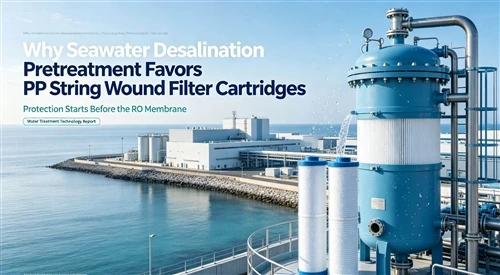
Among the different cartridge filtration technologies used for this stage, PP string wound filter cartridges have become a widely used option, particularly in demanding seawater applications. Their combination of depth filtration, dirt-holding capacity, chemical resistance, and mechanical strength makes them well suited to the conditions encountered in large-scale desalination plants.
This is especially relevant in North Africa, where growing demand for freshwater is driving major investment in seawater desalination and where feedwater conditions can place considerable demands on pretreatment systems.
The Pretreatment Challenge in Seawater Desalination
Seawater contains far more than dissolved salts.
Depending on the location, season, and weather conditions, seawater can carry sand, silt, suspended solids, fine sediments, organic matter, and microorganisms. If these contaminants are not adequately removed before the RO stage, they can contribute to membrane fouling and reduce system performance.
The purpose of pretreatment is to reduce the contaminant load before water reaches the RO membranes and to bring the Silt Density Index (SDI) within an acceptable operating range. An SDI below 5 is commonly targeted, while more demanding high-recovery systems may aim for values below 3.
Cartridge filters often serve as the final filtration barrier immediately upstream of the RO membranes.
That makes cartridge performance particularly important.

If a cartridge has insufficient particle retention, becomes clogged too quickly, suffers structural failure, or allows untreated water to bypass the filter media, the effects can quickly move downstream. Membrane fouling can increase, cleaning intervals can become shorter, permeate flow can decline, and membrane replacement costs can rise.
North African desalination projects can face particularly demanding feedwater conditions. Coastal areas along the Mediterranean and Red Sea may experience significant seasonal changes in water quality. Storms can increase turbidity, while algal blooms and other biological activity can introduce additional organic and particulate loads.
For pretreatment systems operating under these conditions, cartridge selection is not simply a matter of choosing a nominal micron rating. Dirt-holding capacity, construction quality, pressure resistance, chemical compatibility, and expected service life all matter.
Why PP String Wound Filter Cartridges?
PP string wound filter cartridges are manufactured by winding polypropylene yarn around a central core. Depending on the application, the core may be made from polypropylene or, in specialized configurations, stainless steel.
The winding process creates a graded-density filtration structure.
The outer layers are generally more open and capture larger particles first. As water moves toward the center of the cartridge, the progressively tighter structure captures smaller particles.
This depth-filtration design is one of the main reasons string wound cartridges remain widely used in industrial water treatment.

1. High Dirt-Holding Capacity
Unlike a surface filter, which primarily captures contaminants on the outer surface, a string wound cartridge traps particles throughout the depth of the filter media.
This allows the cartridge to make use of a much greater portion of its filtration material before the pressure differential reaches the replacement point.
For seawater pretreatment systems exposed to relatively high suspended-solid loads, that can translate into longer operating intervals and fewer cartridge replacements.
Longer service intervals also mean less maintenance work and lower filter consumption over the operating life of the system.
2. Strong Mechanical Construction
The wound-yarn structure provides the cartridge with a high degree of mechanical integrity.
This is important in large-scale desalination systems, where flow rates can be high and differential pressure can increase as the filter becomes loaded with contaminants.
A cartridge must maintain its structural integrity throughout its service life. If the filter media deforms or fails under changing pressure conditions, filtration performance can be compromised and downstream equipment can be exposed to untreated water.
For continuously operating desalination plants, mechanical stability is therefore an important part of cartridge performance.
3. Broad Chemical Compatibility
Polypropylene is also well suited to many of the chemical conditions encountered in water treatment.
An all-polypropylene construction, including the filter yarn and PP core, provides good resistance to a broad range of chemicals commonly used in pretreatment and cleaning processes, including acids and alkalis.
The original specifications indicate a working pH range of approximately 1–13, making PP cartridges suitable for a variety of demanding industrial filtration environments.
Actual chemical compatibility should always be evaluated against the specific chemical concentration, temperature, exposure time, and operating conditions of the application.
4. Consistent Filtration Performance
Stable filtration performance is particularly important upstream of an RO system.
The filter media needs to maintain its physical structure throughout the operating cycle so that particle removal remains predictable as the cartridge accumulates contaminants.
Polypropylene yarn provides a stable filter medium that can maintain consistent filtration characteristics under normal operating conditions. This helps provide more predictable feedwater quality for the downstream RO stage.
For desalination operators, that predictability matters. A cartridge that performs consistently from installation through replacement makes it easier to manage differential pressure, maintenance intervals, and overall pretreatment performance.
North African Desalination Projects: A Practical Example
Freshwater demand is increasing across North Africa, and several countries are investing heavily in seawater desalination.
Morocco, for example, has significantly expanded its desalination capacity, while Algeria has moved forward with several large-scale seawater desalination projects. Egypt is also developing multiple desalination facilities along its Mediterranean and Red Sea coastlines.
As more plants move into continuous high-flow operation, pretreatment reliability becomes increasingly important.
In one large North African seawater desalination project described in the original case, the plant was experiencing frequent clogging with its conventional string wound cartridges.
The maintenance team was replacing cartridges more often than expected, increasing labor requirements and filter consumption. At the same time, differential pressure was becoming less stable, while the downstream RO system showed increasing signs of fouling risk.

The plant subsequently switched to high-density 50-inch PP string wound filter cartridges.
The difference was not simply the cartridge length. The new cartridges also had a substantially higher media loading.
The previous cartridges typically weighed between 500 and 700 grams, while the new cartridges weighed approximately 950–1,000 grams. The higher media weight reflected a denser winding structure and greater polypropylene yarn loading, giving the cartridge more filtration material available to capture suspended contaminants.
The reported results included:
Longer cartridge service life
Longer replacement intervals reduced overall filter consumption.
01
Fewer cartridge changes
Maintenance teams spent less time replacing filters.
02
Lower maintenance workload
Fewer change-outs reduced labor requirements.
03
More stable differential pressure
Filtration performance remained more consistent during operation.
04
Better protection for downstream RO membranes
Improved pretreatment helped reduce the contaminant load reaching the RO stage.
05
For the plant's maintenance team, the most important improvements were the cartridge's dirt-holding capacity and its ability to maintain stable filtration performance under demanding seawater conditions.
Why Larger Filter Cartridges Are Gaining Ground
Cartridge material and filtration structure are only part of the equation.
Another change taking place in large-scale desalination pretreatment is the growing use of longer, larger-format filter cartridges.
Forty-inch cartridges have traditionally been common in many industrial filtration applications. However, 50-inch and even 70-inch configurations are increasingly being considered for high-flow systems.
The reasoning is straightforward.
A longer cartridge can provide more filtration media within a single filter position. This allows a plant to achieve the required filtration capacity with fewer individual cartridges.
Fewer cartridges can mean fewer connections, fewer seals, and fewer potential bypass points. It can also simplify cartridge replacement and reduce the amount of maintenance required inside the housing.
For a large desalination plant operating continuously, these details can have a meaningful impact.
Every additional cartridge creates another connection and another sealing point. Under conditions involving high flow rates, pressure fluctuations, water hammer, or continuous operation, these components can become potential points of failure.
A bypass around a damaged seal or improperly seated cartridge can allow inadequately filtered seawater to reach the downstream RO system.
Larger-format cartridges can help reduce the number of individual components within the filtration system while increasing the amount of filtration media available per cartridge.
That combination can improve maintenance efficiency while reducing potential failure points.

ANDA's String Wound Filter Solutions
ANDA manufactures string wound filter cartridges in lengths ranging from 5 inches to 60 inches, including 50-inch configurations designed for applications where higher dirt-holding capacity and longer service intervals are required.
The STF-1001 series, for example, is designed for depth filtration in industrial and commercial water treatment applications, including RO pre-filtration and seawater desalination pretreatment.
The availability of different cartridge lengths and configurations allows filtration systems to be matched more closely to actual operating requirements rather than relying on a one-size-fits-all approach.
For high-flow desalination applications, cartridge selection should take into account factors such as feedwater quality, suspended-solids loading, target micron rating, flow rate, housing configuration, differential pressure limits, and expected replacement intervals.
ANDA's Role in Seawater Desalination Filtration
With years of experience in filter cartridge manufacturing, Zibo Anda Textile Co., Ltd. supplies filtration products to customers in North Africa, the Middle East, and other international markets.
ANDA's PP string wound filter cartridges are manufactured using polypropylene yarn with a consistent fiber structure and controlled winding process.
Depending on the application, available configurations include polypropylene yarn with a PP core as well as specialized options for more demanding operating environments.
Filtration ratings range from 1 to 100 microns, allowing customers to select a cartridge according to the particle-removal requirements of their particular process.
Product selection, however, is only one part of the solution.
Desalination plants operate under very different conditions depending on their location. Seawater quality, suspended-solids concentration, seasonal changes, system flow rate, housing configuration, pressure conditions, and maintenance practices can all affect cartridge performance.
For this reason, cartridge selection should be based on the actual operating environment rather than micron rating alone.
ANDA works with customers to evaluate these operating conditions before recommending a filtration configuration. The objective is not simply to supply a replacement cartridge, but to identify a solution that can provide reliable filtration performance while helping control maintenance requirements and long-term operating costs.
ANDA's products are exported to markets including India, Pakistan, Cyprus, the Middle East, and North Africa, with growing demand from seawater desalination and industrial water treatment projects.
From product development through manufacturing, the company's engineering and production teams oversee the manufacturing process with a focus on consistent product quality and filtration performance.
Conclusion
Seawater desalination is becoming an increasingly important part of the global water infrastructure. As new plants are built and existing facilities expand, the demand for reliable and cost-effective pretreatment will continue to grow.
The original market projections cited in this article estimate that the global desalination market could increase from approximately USD 17.76 billion in 2025 to USD 38.80 billion by 2034.
Whatever the exact pace of market growth, one point remains clear: RO membrane protection starts with effective pretreatment.
PP string wound filter cartridges continue to be a practical choice for this application because of their depth-filtration structure, high dirt-holding capacity, mechanical strength, and broad chemical compatibility.
In challenging seawater environments, these characteristics can translate into longer cartridge service intervals, fewer maintenance interventions, and more consistent protection for downstream RO membranes.
The right pretreatment cartridge does more than remove particles from water.
It helps protect one of the most expensive and performance-sensitive components in a desalination plant-the RO membrane system.
For plant operators and procurement teams, cartridge selection should therefore be viewed as part of the overall operating strategy rather than simply a routine consumables purchase.
If you are evaluating pretreatment filtration for a seawater desalination project in North Africa, the Middle East, or another coastal market, ANDA's technical team can help evaluate the application based on feedwater characteristics, flow requirements, filtration rating, housing configuration, and expected maintenance intervals.
The goal is simple: select a cartridge that performs reliably under the conditions your plant actually faces.