For an industrial water treatment system that depends on reverse osmosis (RO), choosing a pre-filtration cartridge is not simply a matter of selecting a routine consumable. The cartridge installed upstream can have a direct impact on membrane life, operating stability, maintenance frequency, and the overall cost of producing treated water.
Two of the most widely used depth-filtration options are string wound cartridges and melt blown cartridges. At first glance, they may appear similar. Both are designed to remove suspended solids from feed water, yet the way they are manufactured and the way they retain contaminants are quite different.
That difference matters.
A cartridge with the wrong filtration characteristics can load up too quickly, cause a rapid increase in differential pressure, allow fine particles to reach the membrane, and ultimately contribute to premature RO membrane fouling.
So which type should you choose?
The answer depends less on the nominal micron number printed on the cartridge and more on the quality of the incoming water, contaminant loading, required filtration precision, and the role the cartridge is expected to play within the pretreatment system.
This guide breaks down the practical differences between string wound and melt blown cartridges and explains where each technology makes the most sense.
What Is the Real Purpose of an RO Pre-Filter?
An RO membrane is designed for high-precision separation. It is not intended to function as the first barrier against large amounts of suspended solids.
Particles such as fine silt, rust, colloidal material, carbon fines, and biological debris can create problems when they reach the membrane elements.
They can accumulate on the membrane surface or feed spacer, increase localized pressure losses, accelerate fouling, and make subsequent membrane cleaning less effective.
That is why cartridge filtration plays such an important role upstream of an RO system.
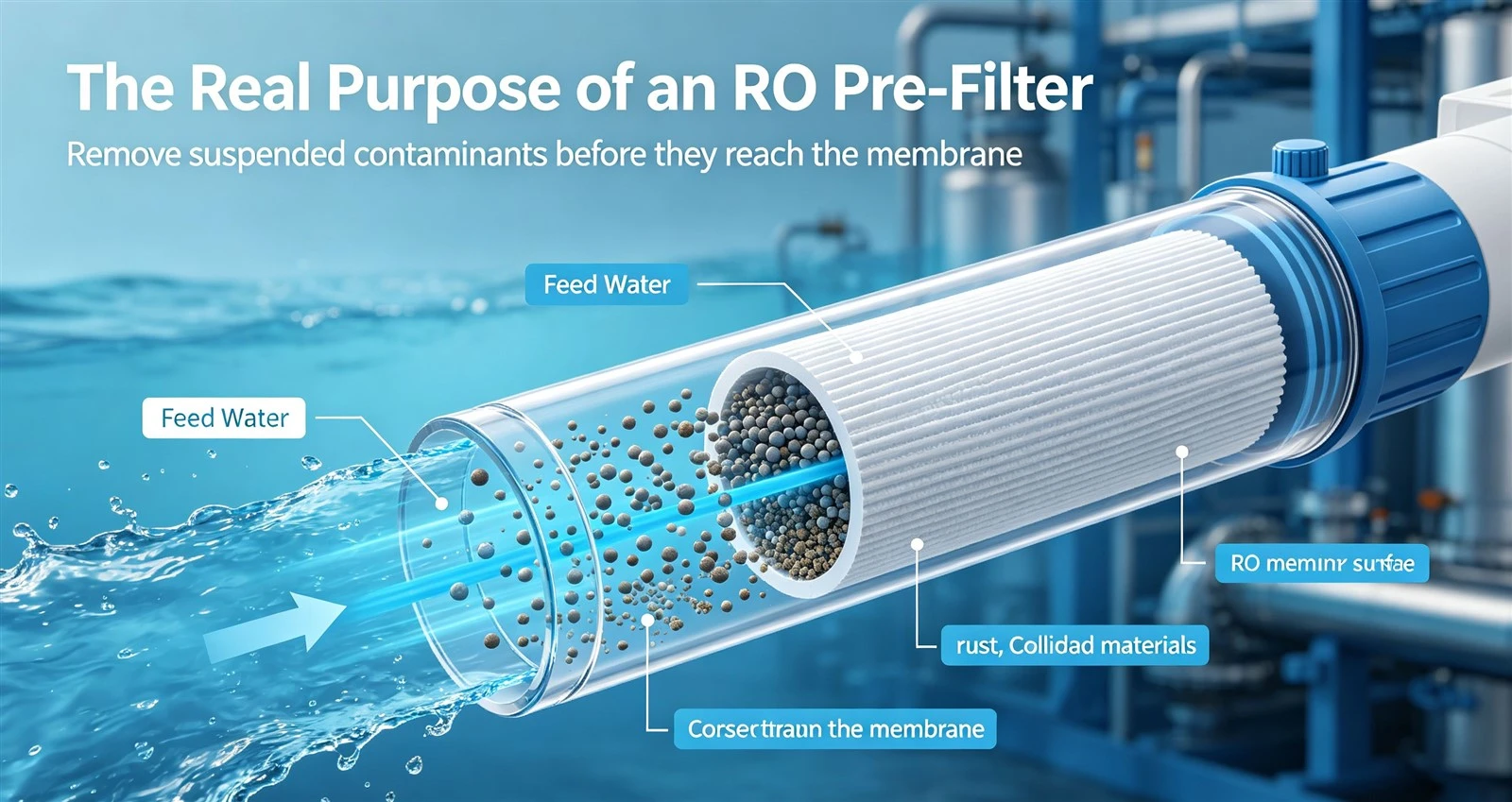
The job of the pre-filter is straightforward: remove suspended contaminants before they reach the RO membrane.
According to DuPont's technical guidance, RO systems should include at least one cartridge filter with an absolute pore size below 10 μm, with a 5 μm absolute rating generally recommended as a minimum pretreatment level. Where colloidal silica or metal-silicate fouling is a concern, filtration in the 1–3 μm range may be required.
This is where the difference between string wound and melt blown cartridges becomes particularly important.
String Wound Cartridges: Built for High Dirt Loading
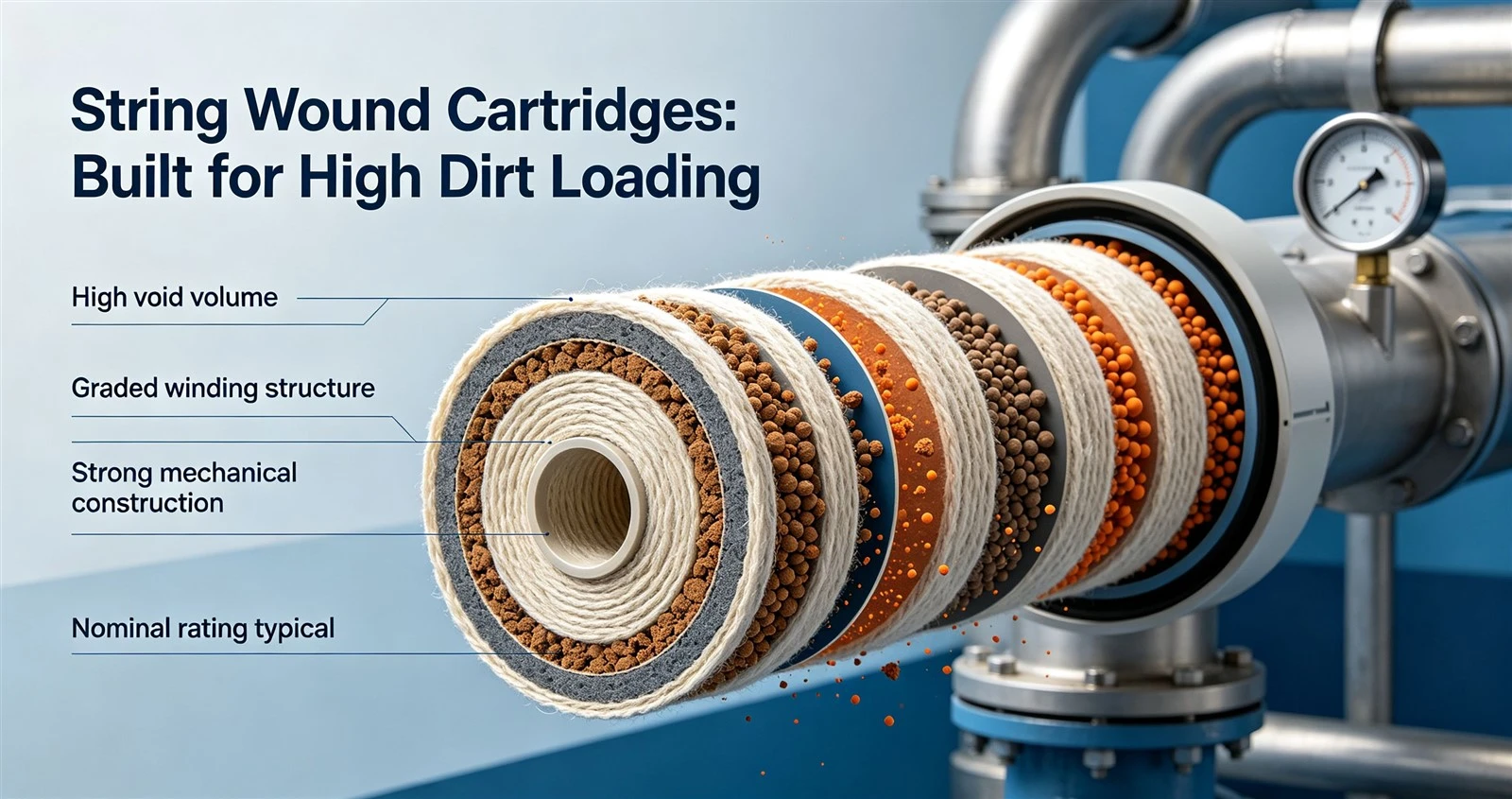
A string wound cartridge is made by winding filtration yarn around a central core. Polypropylene is widely used, while cotton and fiberglass are available for specific applications.
The winding pattern creates a progressively tighter filtration structure from the outside toward the core. Larger particles are captured in the outer layers, while smaller contaminants penetrate farther into the cartridge before being trapped.
This depth-filtration structure gives string wound cartridges one major advantage: they can hold a substantial amount of dirt before becoming fully loaded.
Where String Wound Cartridges Perform Well
High dirt-holding capacity
The spaces between the wound yarn provide considerable void volume for contaminant accumulation. When feed water contains high levels of suspended solids or turbidity, this can translate into longer cartridge service life and fewer replacement cycles.
For systems where the incoming water carries a heavy sediment load, this capacity can be particularly valuable.
Strong mechanical construction
The wound structure provides good mechanical strength and allows the cartridge to handle demanding operating conditions and pressure fluctuations. This makes string wound cartridges a practical choice for applications where water quality can vary significantly, including certain seawater pretreatment systems.
Flexible material options
The cartridge can be configured with different yarn and core materials according to the application.
Polypropylene yarn combined with a PP core is widely used for general water treatment and chemical filtration. Other materials, such as cotton yarn or stainless-steel cores, can be selected when temperature, fluid characteristics, or mechanical requirements call for a different construction.
The Main Limitation: Filtration Rating Stability
The biggest consideration when using string wound cartridges for RO protection is not dirt-holding capacity. It is rating reliability.
Because the filtration media consists of physically wound yarn rather than a permanently bonded fiber matrix, the structure can change slightly under operating pressure. In some conditions, the yarn layers may separate or shift, allowing particles smaller than the nominal rating to pass through.
For this reason, string wound cartridges are generally specified using nominal filtration ratings rather than absolute ratings.
That distinction is important in applications where the final cartridge must provide highly consistent particle removal for membrane protection.
Typical Applications for String Wound Cartridges
String wound cartridges are particularly well suited to:
- Coarse pretreatment for RO systems
- High-turbidity feed water
- Water with high suspended-solids loading
- Seawater desalination pretreatment
- Oily or relatively viscous liquids
- Applications where high dirt-holding capacity is more important than final-stage filtration precision
In these situations, the cartridge is often most effective when used as the first filtration stage rather than the final barrier immediately before the RO membrane.
Melt Blown Cartridges: Designed for Consistent Fine Filtration
Melt blown cartridges take a different approach.
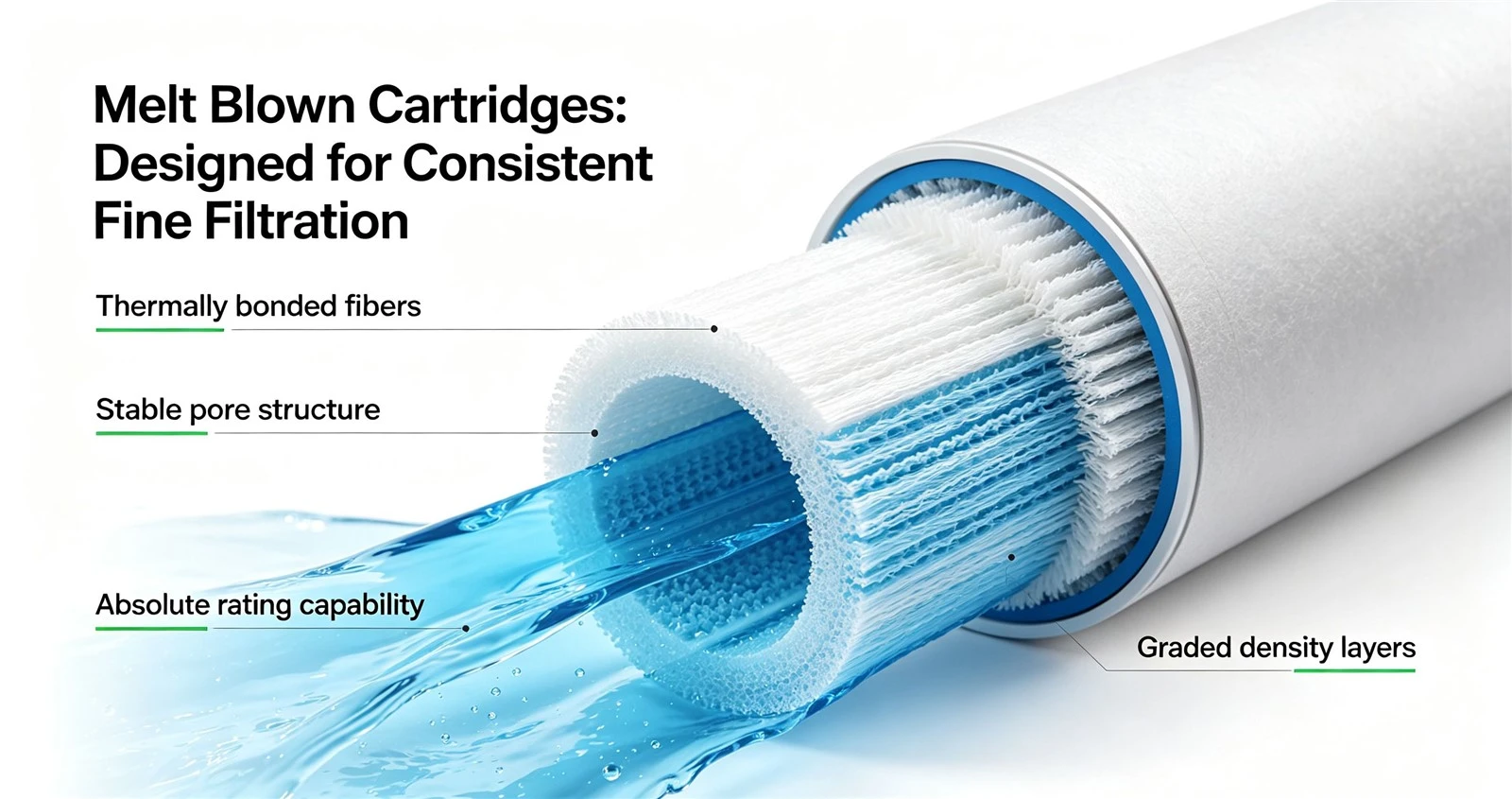
During manufacturing, polypropylene resin is heated until it melts and is then extruded through fine spinnerets. High-velocity hot air stretches the polymer into extremely fine fibers. As the fibers cool, they bond together to create a three-dimensional porous structure.
Unlike some other filtration media, the process does not require binders or chemical additives.
The result is a cartridge with a stable fiber matrix and controlled pore structure.
Why Melt Blown Cartridges Are Often Preferred for Final RO Protection
Stable filtration performance
The fibers are thermally bonded together during manufacturing, so the filtration structure remains relatively stable under operating pressure.
This helps reduce the risk of particle breakthrough and makes it possible to produce cartridges with consistent absolute filtration ratings, commonly in the 1–5 μm range and, depending on the design, even finer.
For RO pretreatment, that consistency can be more important than simply having a high dirt-holding capacity.
Depth filtration with a graded structure
Melt blown cartridges can be manufactured with progressively finer fiber structures from the outside toward the inside.
The outer portion captures larger particles first, while the finer inner layers retain smaller contaminants. Because filtration occurs throughout the depth of the cartridge rather than only at its surface, the available media volume is used more efficiently.
Broad chemical compatibility
A cartridge made from 100% polypropylene without binders or additives offers good resistance to many acids, alkalis, and chemical solutions. The source specifications indicate a broad working pH range of approximately 1–13.
Polypropylene construction also makes these cartridges suitable for a range of water treatment, food and beverage, and other industrial liquid filtration applications where material compatibility is important.
Consistent manufacturing quality
Because melt blown media is produced through a controlled thermal process, manufacturers can closely control fiber diameter, density, and cartridge structure. This supports more consistent performance from one production batch to the next.
For industrial buyers, that consistency can be just as important as the initial cartridge price.
What Are the Trade-Offs?
Melt blown cartridges are not automatically the best option for every application.
Their manufacturing cost can be somewhat higher than that of conventional string wound cartridges. They also may not provide the same level of dirt-holding capacity as a string wound cartridge when the feed water contains an exceptionally high concentration of suspended solids.
That is why melt blown cartridges often work best when the heavier particulate load has already been reduced by an upstream filtration stage.
Typical Applications for Melt Blown Cartridges
They are commonly used for:
- Final or guard filtration ahead of RO membranes
- Precision water treatment
- Pure water production
- Ultrapure water pretreatment
- Food and beverage liquid filtration
- Pharmaceutical and other applications requiring consistent fine-particle removal
String Wound vs. Melt Blown: Key Differences at a Glance
| Feature | String Wound | Melt Blown |
|---|---|---|
| Manufacturing Process | Filtration yarn is physically wound around a core | Polymer is melt-blown into thermally bonded fibers |
| Filtration Structure | Layered, gradient-density wound structure | Three-dimensional gradient-density fiber structure |
| Typical Rating | Nominal | Absolute |
| Available Rating Range | 1–100 μm | 0.5–100 μm |
| Dirt-Holding Capacity | Very high | High |
| Mechanical Strength | Excellent | Good |
| Chemical Compatibility | Depends on yarn and core materials | Broad compatibility with polypropylene |
| Typical PP Temperature Resistance | Approximately 80°C | Approximately 70°C |
| Relative Cost | Lower | Moderate |
| RO Protection | Better suited to coarse pretreatment | Better suited to fine/guard filtration |
Specifications and performance ranges can vary depending on cartridge construction, media grade, operating conditions, and manufacturer specifications.
Why Using Both Can Make More Sense Than Choosing One
In many industrial RO systems, the real question is not whether to use string wound or melt blown cartridges.
It is whether the system should use both.
A two-stage cartridge arrangement can take advantage of the strengths of each technology.
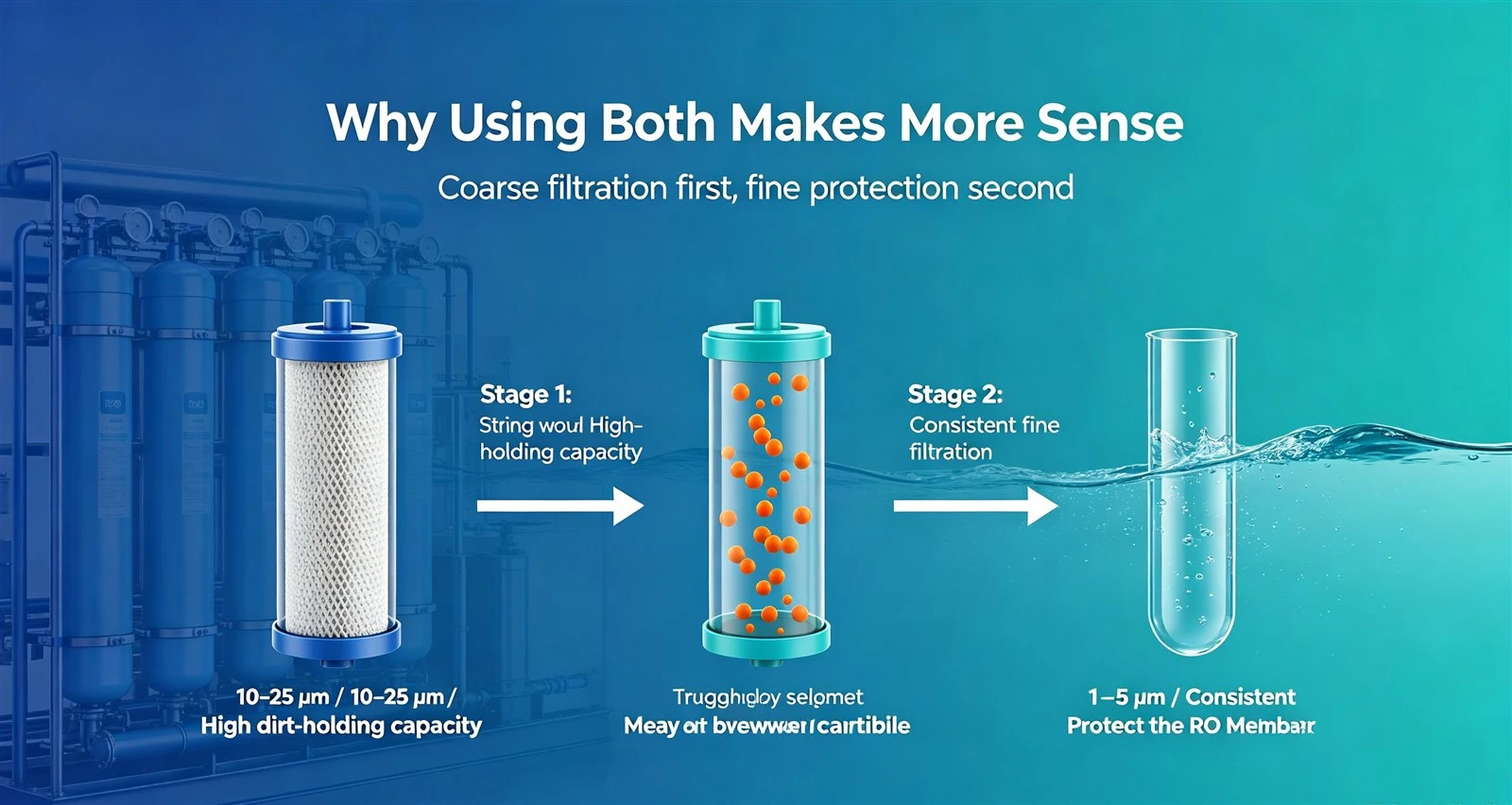
Stage 1: String Wound Cartridge for Coarse Filtration
A string wound cartridge in the 10–25 μm range can be installed as the first cartridge stage.
Its high dirt-holding capacity allows it to capture a large portion of the incoming sediment and suspended solids before the water reaches the finer filter.
This reduces the contaminant load placed on the downstream cartridge and can extend its service life.
It also provides an economical way to handle feed water with a relatively heavy particulate load.
Stage 2: Melt Blown Cartridge for Fine Filtration
A 1–5 μm melt blown cartridge can then serve as the final cartridge filtration stage before the RO membrane.
Because its fiber matrix is thermally bonded and its filtration rating can be specified on an absolute basis, it provides a more consistent barrier against fine particles that could otherwise reach the membrane.
The result is a more balanced pretreatment strategy:
the string wound cartridge handles volume, while the melt blown cartridge handles precision.
This arrangement can reduce the frequency of fine-filter replacement without sacrificing the level of particle removal required to protect the RO membrane.
ANDA: Two Filtration Technologies, One Practical Approach
As a manufacturer of both string wound and melt blown filter cartridges, ANDA takes a technology-neutral approach to cartridge selection.
There is no single cartridge design that is ideal for every water source.
Feed-water quality, suspended-solids concentration, system flow rate, operating pressure, chemical compatibility, housing configuration, and the required filtration level all influence the appropriate cartridge specification.
ANDA's string wound cartridges are manufactured using high-purity polypropylene filtration yarn and precision winding technology. Available configurations cover ratings from 0.5 μm to 150 μm and lengths from 5 to 40 inches, with PP and stainless-steel core options.
Their high dirt-holding capacity and strong mechanical structure make them suitable for applications such as high-turbidity water, coarse RO pretreatment, and seawater desalination pretreatment.
For applications where more consistent fine filtration is required, ANDA's PP melt blown cartridges are manufactured from 100% virgin polypropylene using thermal melt-blown technology.
The graded-density structure is designed to provide stable filtration performance without binders or additives. Their polypropylene construction also offers broad chemical compatibility and supports applications including RO guard filtration, pure water production, and food and beverage processing.
Rather than treating the two cartridge types as competing products, ANDA's approach is to match the cartridge design to the actual filtration duty.
The Right Cartridge Is About More Than the Micron Rating
When selecting a cartridge for an RO pretreatment system, looking only at the micron number can be misleading.
Two cartridges with the same nominal micron rating may behave very differently once they are exposed to actual operating pressure and a real contaminant load.
The more important questions are:
- Is the stated rating nominal or absolute?
- How much suspended solids does the feed water contain?
- How quickly does differential pressure rise?
- Is the cartridge being used for coarse or final-stage filtration?
- What level of particle removal does the RO membrane require?
- What are the operating pressure, temperature, and chemical conditions?
- How often can the cartridge be replaced economically?
Answering these questions provides a much better basis for cartridge selection than comparing price or micron ratings alone.
Final Takeaway
String wound and melt blown cartridges are designed for different filtration priorities.
String wound cartridges stand out when the main challenge is a heavy particulate load. Their high dirt-holding capacity, mechanical strength, and relatively low cost make them effective for coarse pretreatment.
Melt blown cartridges are better suited to applications where filtration precision and rating stability are critical. Their thermally bonded fiber structure and available absolute ratings make them particularly useful as a final protective barrier before an RO membrane.
For many commercial and industrial RO systems, the most practical solution is not to choose one technology at the expense of the other. A string wound cartridge for coarse filtration followed by a melt blown cartridge for fine filtration can provide a better balance between contaminant capacity, filtration precision, operating cost, and membrane protection.
Ultimately, cartridge selection should be based on the actual feed-water conditions and the role each filter is expected to perform.
If you are evaluating cartridge options for an RO system, ANDA can help match the appropriate cartridge construction, micron rating, dimensions, and core material to your operating requirements.