When choosing a PP cotton filter cartridge, many buyers focus primarily on price, dimensions, and filtration micron rating. However, two filter cartridges that look almost identical on the outside can perform very differently in actual use.
The difference often comes down to three factors: raw material quality, manufacturing technology, and filter structure.
For water purification systems and industrial filtration applications, these details directly affect filtration efficiency, service life, pressure drop, and the consistency of the treated water. A lower-priced filter is not necessarily a better value if it contains less filtration material or uses a simpler internal structure.
So, what makes one PP cotton filter cartridge different from another?
What Is a PP Cotton Filter Cartridge?
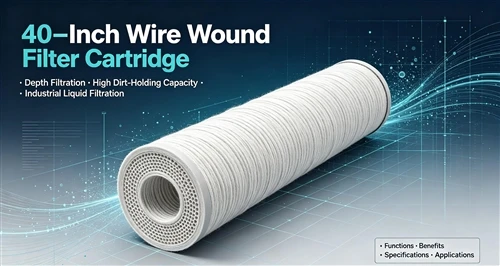
A PP cotton filter cartridge, commonly known as a polypropylene (PP) sediment filter, is a depth-filtration element designed to remove suspended solids and particulate contaminants from liquids.
Unlike a simple surface filter that mainly captures particles on the outside, a properly manufactured PP filter cartridge uses its internal fiber structure to trap contaminants throughout the filtration media.
Depending on the manufacturing process and design, PP filter cartridges can be used to reduce:
- Sand and sediment
- Rust particles
- Dust and other suspended solids
- Pipe scale
- Larger particulate contaminants
- Other insoluble particles in water and industrial liquids
PP is widely used because it offers good chemical resistance and can be manufactured into filtration media with different densities and pore structures.
However, not all PP filter cartridges are manufactured to the same standard.
Raw Material Directly Affects Filter Cartridge Weight and Service Life
One of the simplest ways to identify differences between PP filter cartridges is to compare their weight.
The weight of a filter cartridge is largely determined by the amount and density of filtration material used during production. If a manufacturer reduces the amount of PP material to lower manufacturing costs, the finished cartridge may be noticeably lighter than a properly manufactured product of the same size.
For example, two cartridges with identical dimensions may have different weights because they contain different amounts of PP filtration media.
This difference matters because the filtration material is the working medium of the cartridge. In general, a cartridge with insufficient or poorly distributed material may have a shorter service life and lower contaminant-holding capacity.
Of course, weight alone does not determine filtration quality. Fiber structure, density, manufacturing consistency, and the specified micron rating must also be considered.

For buyers, this means that comparing only the external dimensions and selling price can be misleading.
A more meaningful comparison should include:
- Type and quality of PP raw material
- Filter cartridge weight
- Fiber density
- Filtration structure
- Rated micron size
- Contaminant-holding capacity
- Pressure drop
- Expected service life
A reliable manufacturer should be able to provide consistent specifications from one production batch to another.
Filtration Structure Matters More Than Appearance
Another important difference is the internal structure of the PP filter cartridge.
A high-quality depth filter is not simply a large block of polypropylene. Its internal structure is designed to create different levels of filtration as liquid passes through the cartridge.
A commonly used design incorporates multiple density zones, from a relatively open outer structure to a progressively denser inner structure.
This type of construction allows larger particles to be captured in the outer portion of the filter while smaller particles are retained deeper inside the media.
The result is a more effective use of the entire filter volume.
Depending on the specific manufacturing process, a PP filter cartridge can be designed with three functional filtration zones:
1. Outer layer - coarse filtration
The outer portion has a relatively open structure. It captures larger suspended particles before they penetrate deeper into the cartridge.
2. Middle layer - primary filtration
The middle section provides a progressively tighter filtration structure and captures smaller particles that pass through the outer layer.
3. Inner layer - fine filtration
The inner section has a denser structure and provides the final stage of depth filtration before the liquid leaves the cartridge.

This gradual change in density is important because it distributes the contaminant load throughout the filter instead of concentrating it entirely on the surface.
However, the exact internal structure varies by manufacturer, product design, and production technology. Therefore, buyers should not assume that every PP cartridge advertised as a "three-layer filter" has the same performance.
Why Micron Rating Alone Is Not Enough
A common mistake when purchasing filter cartridges is to compare products only by their micron rating.
A cartridge may be labeled as 1 μm, 5 μm, 10 μm, or 20 μm, but the number itself does not tell the entire story.
Actual filtration performance also depends on:
- Fiber arrangement
- Filter density
- Manufacturing consistency
- Flow rate
- Liquid properties
- Contaminant concentration
- Pressure conditions
- Filter cartridge dimensions

For example, two 5-micron PP cartridges may have different pressure drops, service lives, and contaminant-holding capacities because their internal structures are different.
This is why professional filtration buyers should evaluate the complete filtration system, rather than treating the micron rating as the only performance indicator.
Manufacturing Technology Creates the Difference
The production process is another major factor behind the quality gap between PP filter cartridges.
During manufacturing, the polypropylene fibers must be processed and formed into a consistent filtration structure. Parameters such as fiber distribution, density, diameter, and overall cartridge geometry influence the final performance.
Poor process control can result in:
For manufacturers and distributors purchasing large quantities, consistency is particularly important.
A cartridge that performs well in one batch but differently in another can create problems for downstream water purification equipment and increase maintenance costs.
Therefore, production consistency is just as important as the nominal specifications printed on the product label.
A Good PP Filter Should Balance Filtration and Flow
Filtration is not simply about making the filter as dense as possible.
A very dense filter structure may provide fine particle retention, but it can also create greater resistance to liquid flow. As contaminants accumulate, pressure drop can increase further.
For this reason, filter design needs to balance:
Filtration precision + flow rate + pressure drop + contaminant capacity + service life
A well-designed depth filter allows liquid to pass through the media while retaining contaminants within the available filtration volume.
This balance is particularly important in systems where continuous water flow is required.
For household water purification, commercial water treatment, and industrial applications, an unsuitable filter can cause reduced flow, frequent replacement, or unnecessary operating costs.
PP Filter Cartridges Are Not Limited to Water Purification
Although PP filter cartridges are widely associated with household and commercial water purification, their applications extend well beyond drinking-water systems.
Polypropylene has useful chemical-resistance characteristics, making appropriately designed PP filtration media suitable for a variety of liquid filtration applications.
Depending on the specific PP material, cartridge construction, operating temperature, and chemical compatibility requirements, PP filter cartridges may be used in areas such as:
- Water treatment
- Industrial process water
- Chemical processing
- Food and beverage processing
- Pre-filtration systems
- Pure water systems
- Industrial liquid filtration
However, chemical compatibility should always be evaluated according to the actual liquid, concentration, temperature, pressure, and operating conditions. A PP filter should not automatically be assumed to be suitable for every strong acid, alkali, or organic solvent.
Why Contaminant-Holding Capacity Is Important
A filter cartridge does not only need to capture particles. It also needs to hold those contaminants while maintaining acceptable flow and pressure conditions.
This is where contaminant-holding capacity becomes important.
A filter with a suitable depth structure can distribute particles throughout the filtration media. Instead of accumulating all contaminants on the outer surface, particles can penetrate into different regions of the cartridge and become trapped within the fiber network.
This can help make better use of the available filter volume.
When selecting a cartridge for a high-contamination application, buyers should therefore consider more than filtration precision. Contaminant concentration, expected flow rate, operating hours, and replacement frequency should all be included in the evaluation.
How to Compare Different PP Cotton Filter Cartridges

When purchasing PP cotton filter cartridges, a practical comparison should include the following points.
1. Check the Raw Material
Ask whether the cartridge is manufactured from consistent polypropylene material and whether the manufacturer can provide clear material specifications.
2. Compare Filter Weight
For cartridges with the same dimensions and similar construction, significant weight differences may indicate differences in material usage.
Weight should not be used as the only quality criterion, but it can be a useful reference when comparing similar products.
3. Look at the Internal Structure
A proper depth-filtration structure is generally more important than simply making the outer surface look uniform.
Ask the supplier about the density distribution and filtration mechanism.
4. Verify the Micron Rating
Confirm whether the stated micron rating meets the requirements of the actual application.
Do not compare products solely by the number printed on the package.
5. Consider Pressure Drop
A filter that provides fine filtration but causes excessive pressure loss may not be suitable for a high-flow system.
6. Evaluate Service Life
Consider how quickly the filter becomes loaded with contaminants under actual operating conditions.
A slightly higher purchase price may be reasonable if the cartridge provides longer service life and more stable performance.
7. Check Batch Consistency
For distributors and OEM buyers, consistent production quality is especially important. Ask manufacturers about quality-control procedures and production standards before placing large orders.
Why the Cheapest PP Filter Is Not Always the Most Cost-Effective
Price is naturally an important factor in filtration procurement, particularly for distributors purchasing large quantities.
However, the purchase price is only one part of the total cost.
A lower-priced cartridge may have a lower material content, shorter service life, higher pressure drop, or less consistent performance. If it needs to be replaced more frequently, the actual operating cost may be higher.
A better approach is to evaluate cost per operating period rather than simply cost per cartridge.
For example:
Total filtration cost = purchase cost + replacement cost + maintenance cost + operating impact
This approach gives buyers a clearer picture of the actual value of a filter cartridge.
Choosing a Reliable PP Filter Cartridge Manufacturer
For professional buyers, the manufacturer behind the product can be just as important as the product specification.
A reliable supplier should be able to provide clear information about:
- PP raw materials
- Product specifications
- Micron ratings
- Cartridge dimensions
- Weight
- Production process
- Quality-control procedures
- Application recommendations
- Packaging and delivery
- OEM or customized requirements
For large-volume procurement, communication and production consistency are particularly important. A manufacturer that understands the application can also help buyers select a suitable filter structure instead of simply recommending the lowest-priced option.
ANDA: PP Filtration Solutions for Different Applications
As a filtration manufacturer, ANDA focuses on the development and production of filtration products for water treatment and industrial applications.
The company can incorporate different filtration materials, structures, dimensions, and filtration ratings according to application requirements. This allows PP filter cartridges to be selected based on actual operating conditions rather than a one-size-fits-all approach.
For distributors, water-treatment equipment manufacturers, and industrial users, the selection of the right filtration structure can make a significant difference to system performance and replacement frequency.
ANDA also provides filtration products for different application scenarios, helping customers evaluate factors such as filtration precision, flow requirements, pressure loss, material compatibility, and service life when selecting a filter cartridge.
Final Thoughts
The quality of a PP cotton filter cartridge is determined by much more than its appearance or selling price.
Raw material, filter weight, fiber structure, filtration density, manufacturing technology, micron rating, pressure drop, and contaminant-holding capacity all influence how a cartridge performs in real-world applications.
For buyers, the key is to look beyond the label and compare the complete product specification and manufacturing process.
A properly designed PP depth filter should provide a reasonable balance between particle removal, flow performance, service life, and operating cost. When these factors are evaluated together, it becomes much easier to identify the right PP filter cartridge for a particular water-treatment or industrial filtration system.