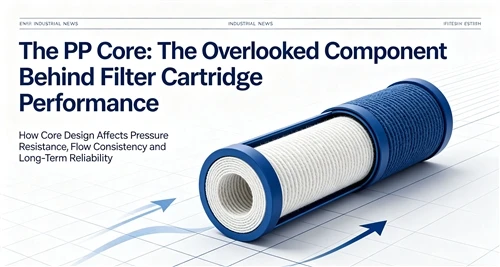
A string wound filter cartridge may look simple: yarn wound layer by layer around a perforated core. But when a cartridge clogs too quickly, delivers inconsistent filtration, sheds fibers, or fails to maintain its rated performance, the root cause is often hiding in plain sight.
It is not always the filter housing. It is not always the micron rating. And it is not necessarily the winding machine.
Very often, the problem starts with the material that makes up most of the cartridge itself: the PP filter yarn.
For manufacturers of string wound filter cartridges, yarn is not just a raw material. Its filament structure, consistency, tensile strength, cleanliness, and winding behavior directly influence the final cartridge's filtration stability and production quality.
Understanding this relationship is essential for anyone manufacturing, sourcing, or specifying industrial filtration cartridges.
A String Wound Filter Cartridge Is Only as Stable as Its Filter Yarn
A typical string wound filter cartridge consists of three main elements:
- A central support core
- Filter yarn
- A controlled winding structure
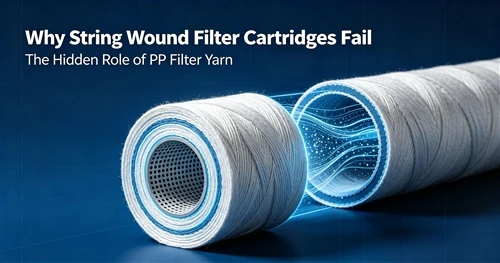
The yarn is wound around the core in a carefully designed pattern to create a three-dimensional filtration path. As liquid moves from the outside toward the center, suspended contaminants are captured throughout the depth of the cartridge.
Ideally, larger particles are intercepted in the outer layers, while smaller particles penetrate deeper into the media before being retained. This is what gives a properly designed string wound cartridge its depth filtration capability and dirt-holding capacity.
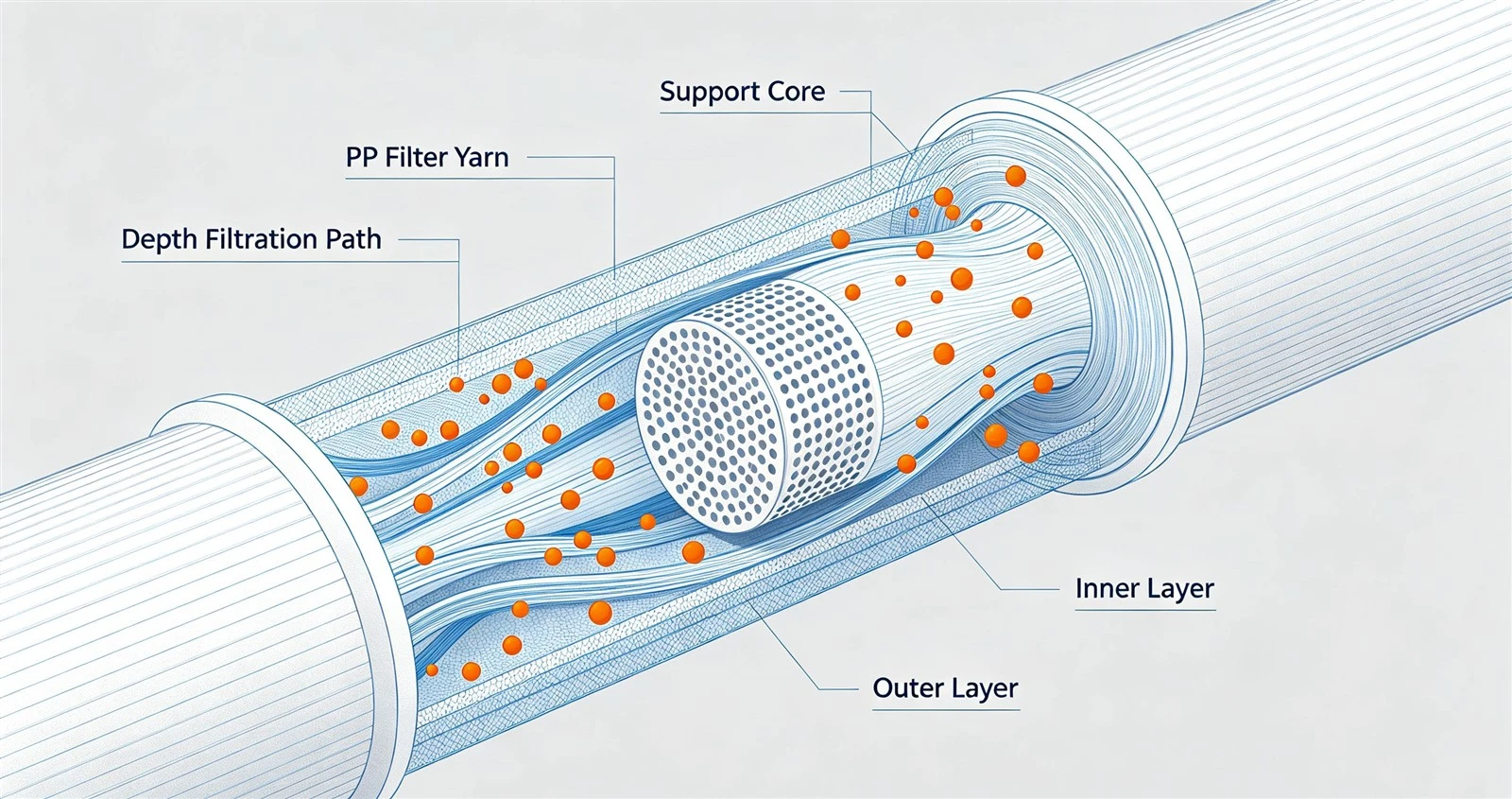
But this principle only works when the yarn itself behaves consistently.
If the yarn diameter varies significantly, its tension changes during winding, or the fiber structure is unstable, the cartridge may develop irregular flow channels. Instead of passing through the intended filtration path, liquid naturally moves toward areas with lower resistance.
The result can be inconsistent filtration performance, premature bypass, localized clogging, or reduced cartridge life.
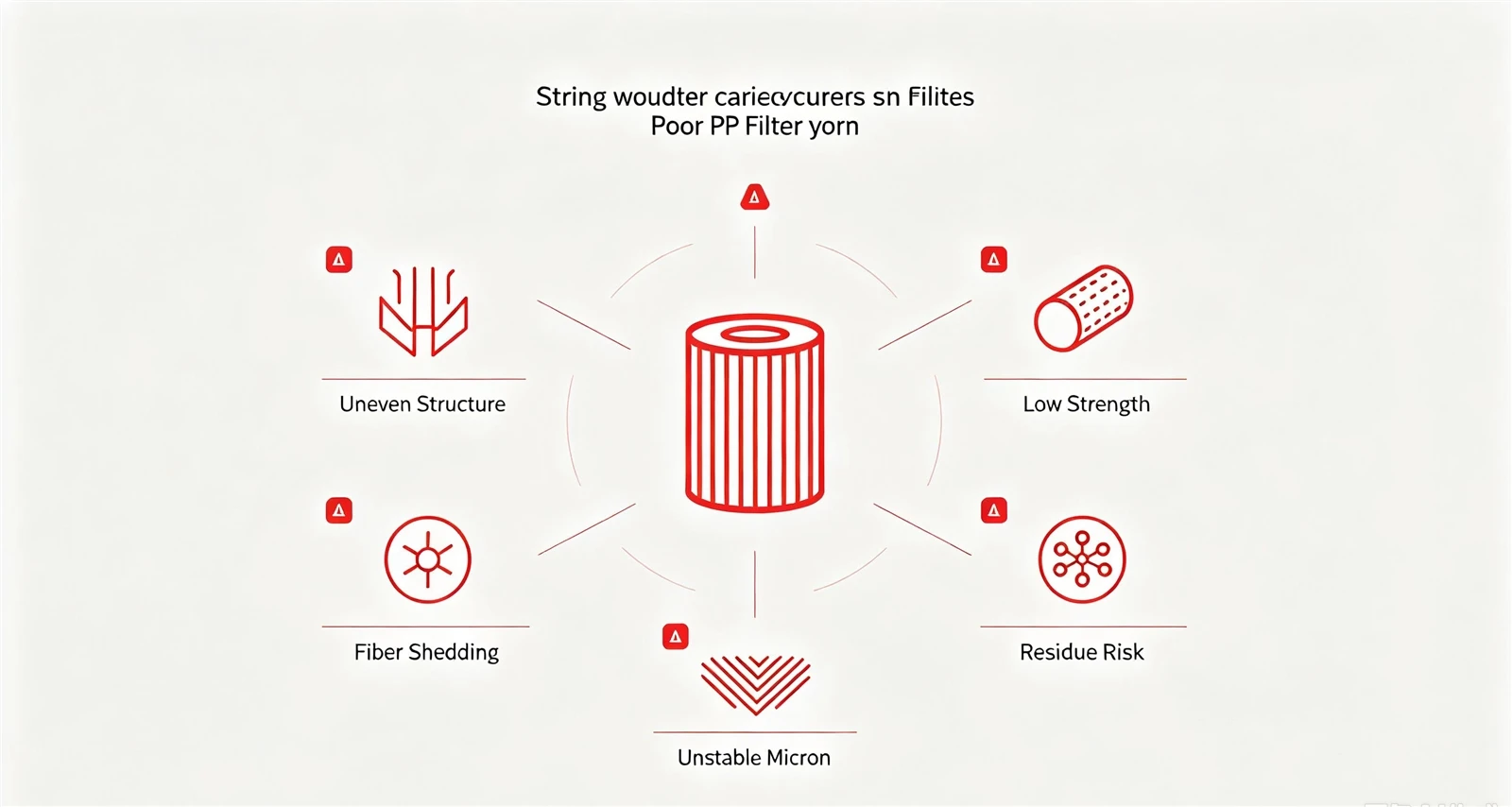
Failure Mode 1: Uneven Yarn Structure Creates Uneven Filtration
One of the most overlooked problems in filter cartridge manufacturing is inconsistent yarn structure.
Imagine winding a cartridge with yarn that varies from section to section:
- One area is bulky.
- Another area is thin.
- One spool has higher tension.
- Another spool has a slightly different density.
Even if the winding machine follows the exact same program, the finished cartridge will not have a perfectly consistent internal structure.
Problem One: Oversized Flow Channels
Where yarn is thinner or loosely packed, larger openings can form between adjacent windings.
Liquid tends to follow the path of least resistance. If those channels become significant, contaminants may pass through areas that offer less filtration resistance.
Problem Two: Localized Clogging
In denser areas, contaminants accumulate more quickly.
Instead of using the entire depth of the cartridge efficiently, certain areas become overloaded while other parts of the filter media remain underutilized.
That means the cartridge may show a rising pressure drop even though much of its filtration media still has unused capacity.
For a cartridge manufacturer, this creates an important lesson:
A precise winding pattern cannot fully compensate for inconsistent raw material.
The PP yarn must be consistent before the winding process begins.
Failure Mode 2: Poor Yarn Strength Causes Production and Performance Problems
A string wound cartridge is produced under tension.
During manufacturing, the yarn must withstand the winding process without excessive stretching, breaking, or changing its physical characteristics.
If the yarn has insufficient or inconsistent tensile strength, manufacturers may experience:
- Frequent yarn breaks
- Reduced production efficiency
- Uneven winding tension
- Irregular cartridge density
- Increased scrap rates
The problem does not necessarily end when the cartridge leaves the factory.
A poorly supported or unstable yarn structure can also respond differently when exposed to liquid flow and differential pressure.
Under changing operating conditions, sections of the wound media may compress, shift, or open up. This can alter the internal flow path and affect filtration consistency.
For this reason, purchasing PP yarn based only on price per kilogram can be misleading.
A lower-cost yarn may appear economical at the purchasing stage but become expensive when manufacturers calculate:
- Machine downtime
- Yarn breakage
- Labor losses
- Rejected cartridges
- Customer complaints
The real cost of yarn is not simply its purchase price.
It is its impact on the entire production line.
Failure Mode 3: Unstable Fiber Structure Can Lead to Media Migration
Another potential problem is fiber migration.
In some yarn structures containing shorter or poorly secured fibers, loose fiber fragments may become detached from the media under liquid flow or pressure changes.
This is particularly undesirable in applications involving:
- RO pretreatment
- Industrial process water
- Food and beverage processing
- Chemical filtration
- High-purity liquid systems
The ideal filter should remove contaminants from a liquid-not introduce additional particles downstream.
For manufacturers, this raises an important sourcing question:
What type of filament structure is actually inside the PP filter yarn?
Two yarns may look almost identical when viewed from several meters away. Their internal construction may be completely different.
That difference can affect:
- Filtration stability
- Fiber retention
- Winding performance
- Surface cleanliness
- Cartridge consistency
Failure Mode 4: Poor Yarn Consistency Makes Micron Ratings Less Reliable
Many buyers focus heavily on micron ratings:
- 1 micron,5 micron,10 micron,25 micron,50 micron
But a micron rating is not created by printing a number on the cartridge label.
In a string wound filter, the effective filtration structure depends on multiple manufacturing variables, including:
Yarn dimensions
Yarn bulk
Winding pattern
Winding density
Tension control
Layer construction
If the yarn changes from batch to batch, the manufacturer may need to continuously adjust production parameters.
For example, the same machine settings may produce different cartridge densities when switching to a new yarn batch.
This creates a difficult quality-control problem.
A manufacturer may believe the winding process is standardized while the raw material is quietly changing the final product.
That is why batch consistency matters as much as the initial yarn specification.
Failure Mode 5: Contamination in the Yarn Can Become a Filtration Problem
Filter media should be evaluated not only by its mechanical properties but also by its cleanliness.
During yarn manufacturing, certain processing methods may involve surface treatments or processing aids. Depending on the application and material design, residues or contaminants can become relevant to downstream filtration performance.
This is especially important when the cartridge will be used in sensitive liquid applications.
For industrial buyers, the practical takeaway is straightforward.
Before selecting PP yarn, ask:
- What is the raw material source?
- Is the material virgin polypropylene or blended material?
- What processing aids are used?
- How is yarn cleanliness controlled?
- Is the product designed specifically for filtration applications?
A yarn suitable for general textile use is not automatically optimized for filter cartridge manufacturing.
The Hidden Relationship Between PP Yarn and Dirt-Holding Capacity
Many manufacturers try to improve cartridge life simply by increasing the amount of yarn used.
More material, however, does not automatically mean better filtration.
If the structure becomes too dense:
- Initial pressure drop may increase
- Flow resistance may become excessive
- The outer surface may clog prematurely
If the structure is too open:
- Filtration efficiency may decrease
- Contaminants may pass through preferential channels
The goal is balance.
A well-designed string wound filter cartridge needs a structure that allows contaminants to be captured progressively throughout the depth of the cartridge.
This is why yarn properties and winding parameters must work together.
PP filter yarn provides the material foundation. The winding process converts that material into a functional filtration structure.
Neither can fully compensate for weaknesses in the other.
How to Evaluate PP Filter Yarn for Cartridge Manufacturing
For manufacturers sourcing polypropylene filter yarn, a practical evaluation should go beyond appearance and price.
1. Material Consistency
Check whether the yarn maintains stable characteristics from spool to spool and batch to batch.
Look for consistency in:
- Linear density
- Bulk
- Filament distribution
- Mechanical performance
01
2. Tensile Performance
The yarn should maintain sufficient strength for stable high-speed winding.
Unnecessary breaks can reduce productivity and increase material waste.
02
3. Winding Behavior
Good filter yarn should perform predictably on the production line.
Evaluate:
- Tension stability
- Break frequency
- Yarn accumulation
- Winding uniformity
- Compatibility with automated winding equipment
03
4. Fiber Structure
Understand whether the yarn is designed to maintain structural integrity during filtration.
This can influence media stability and the potential for fiber release.
04
5. Raw Material Quality
For filtration applications, material quality matters.
Manufacturers should understand:
- PP source
- Virgin material content
- Batch consistency
- Processing controls
- Chemical compatibility
05
Why the Cheapest PP Yarn Can Become the Most Expensive Choice
In industrial procurement, price comparisons often focus on one number:
Cost per kilogram.
But for filter cartridge manufacturers, this is rarely the complete picture.
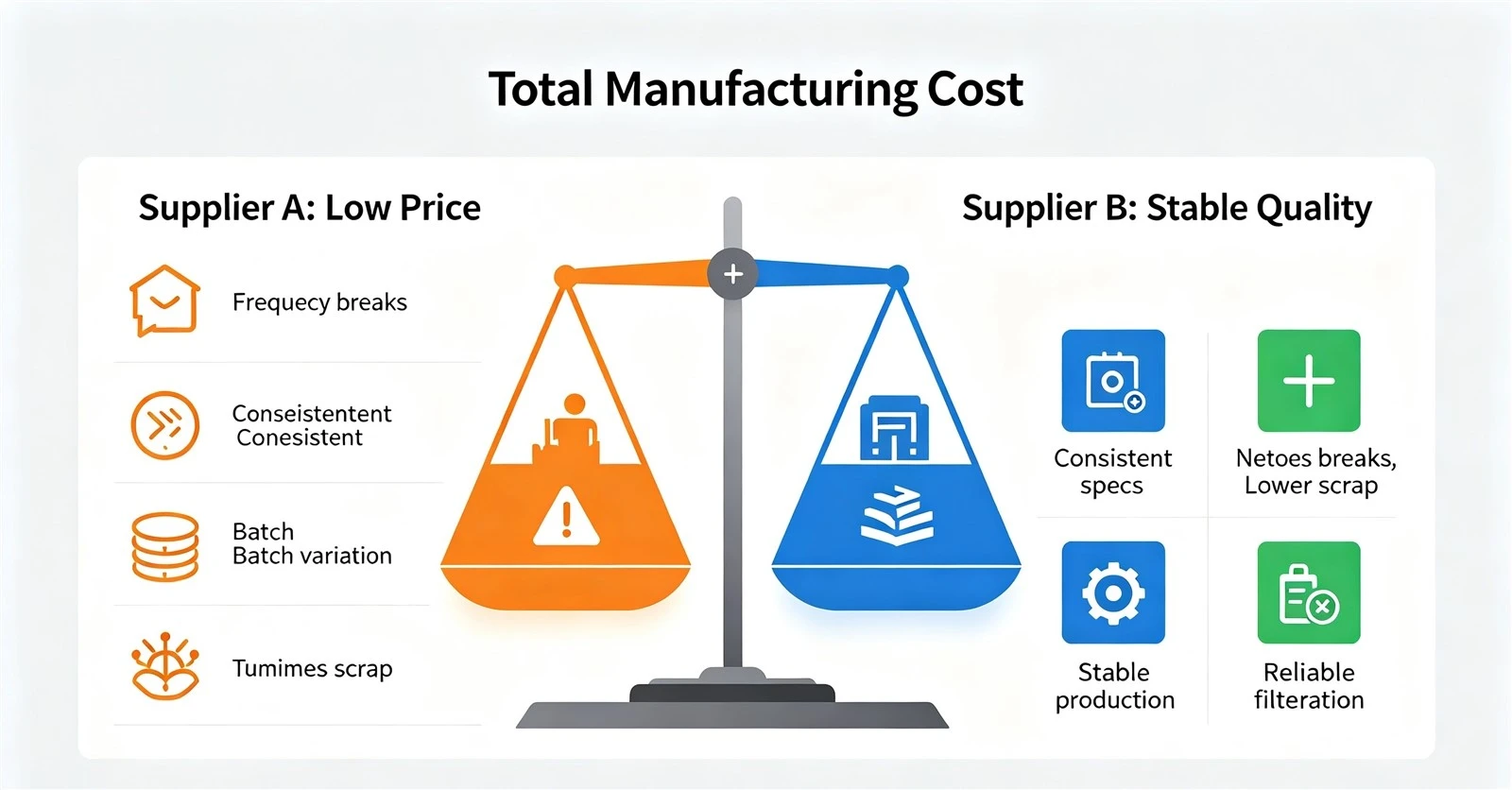
Consider two hypothetical yarn suppliers.
Supplier A offers a lower price but has:
- Higher yarn breakage
- Inconsistent bulk
- Greater batch variation
- More production adjustments
Supplier B charges slightly more but provides:
- Stable specifications
- Consistent winding performance
- Reduced downtime
- Lower scrap rates
Which supplier is actually cheaper?
The answer depends on total manufacturing cost, not the invoice price.
The true calculation should include:
Raw Material Cost + Production Efficiency + Scrap Rate + Labor + Quality Risk
For manufacturers producing thousands or millions of cartridges, even a small improvement in yarn consistency can have a significant impact on overall operating efficiency.
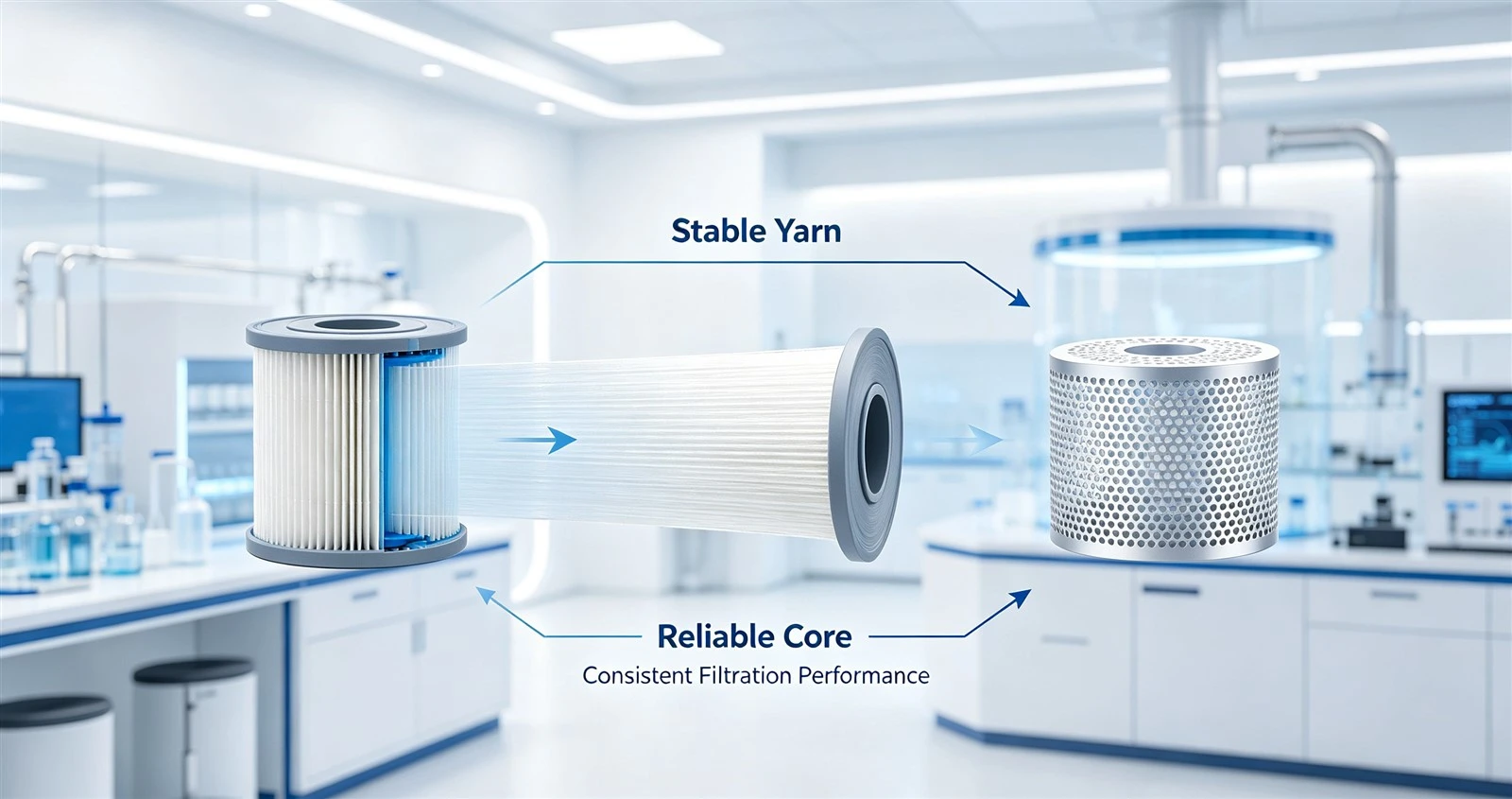
PP Yarn and PP Core: A System, Not Two Separate Components
The yarn is the filtration media, but the PP core provides the internal support structure.
A high-quality yarn wound around a poorly designed core may still produce problems.
Likewise, a strong PP core cannot compensate for unstable yarn.
The two components must work together.
The core must provide:
- Structural support
- Dimensional stability
- Reliable liquid flow
- Resistance to deformation during use
The yarn must provide:
- Stable winding behavior
- Consistent pore structure
- Mechanical integrity
- Reliable depth filtration
This is why manufacturers increasingly benefit from working with suppliers that understand the entire construction of a string wound filter cartridge rather than treating every component as an isolated commodity.
Choosing the Right PP Yarn Supplier
Before choosing a supplier, manufacturers should ask more than:
What is your price?
Better questions include:
- Can you maintain stable specifications between batches?
- Is the yarn designed specifically for filter cartridge production?
- Can you provide consistent supply for long-term production?
- Does the yarn perform reliably on automated winding equipment?
- Can specifications be matched to different cartridge designs?
- Do you understand the relationship between yarn, core, winding density, and filtration performance?
A supplier that understands only yarn manufacturing may provide a material.
A supplier that understands filtration manufacturing can help solve production problems.
That difference becomes increasingly important as filter cartridge manufacturers move toward tighter quality control and more demanding industrial applications.
Building Better String Wound Filter Cartridges Starts with Better Raw Materials
When a string wound filter cartridge fails, the visible symptoms often appear later:
Short service life
Unstable filtration
Excessive pressure drop
Fiber shedding
Production problems
Inconsistent quality between batches
But the original cause may have started much earlier-at the raw material stage.
PP filter yarn is not just something wrapped around a core.
It determines how the cartridge is built, how consistently it performs, and how efficiently the manufacturer can produce it.
For filter cartridge manufacturers, choosing the right yarn means looking beyond color, weight, and price. The real questions are consistency, stability, winding performance, material quality, and long-term production reliability.
At ANDA, we focus on the components that form the foundation of string wound filtration. From PP filter yarn to PP cores and finished string wound filter cartridges, our product range is designed around the practical needs of industrial filtration manufacturing and application.
The goal is simple:
Better raw material consistency. More stable production. More reliable filtration performance.
For manufacturers building string wound filter cartridges at scale, that foundation begins with the yarn.
Frequently Asked Questions
1. What causes a string wound filter cartridge to fail?
Common causes include inconsistent filter media, poor winding density, unstable yarn structure, incorrect micron selection, excessive contaminant loading, and production quality variations. In many cases, the properties of the filter yarn influence several of these factors simultaneously.
2. Why is PP yarn widely used for string wound filter cartridges?
Polypropylene offers good chemical resistance and is widely used in industrial filtration media. When properly engineered for filtration applications, PP yarn can support stable depth-filtration structures.
3. Does yarn quality affect filter cartridge micron rating?
Yes. Micron performance in a string wound filter depends on the combined structure created by the yarn and the winding process. Changes in yarn dimensions, bulk, or consistency can affect the internal pore structure of the finished cartridge.
4. How can filter cartridge manufacturers reduce yarn breakage?
Manufacturers should evaluate yarn tensile consistency, winding compatibility, tension settings, storage conditions, and the condition of the winding equipment. A stable yarn specification also helps reduce unexpected production adjustments.
5. What should manufacturers look for when buying PP filter yarn?
Important factors include material quality, batch consistency, tensile performance, winding behavior, fiber structure, cleanliness, and compatibility with the intended filter cartridge design.