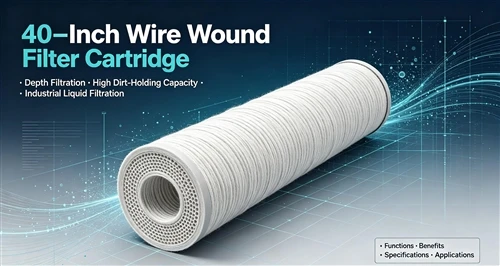
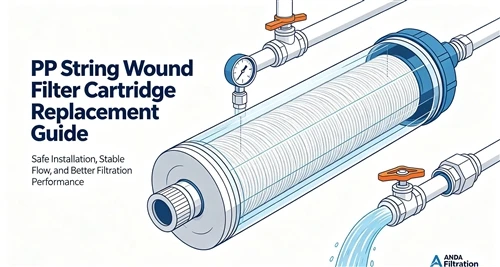
When a liquid contains sediment, rust, scale, or other suspended particles, filtration is often the first step in protecting downstream equipment and maintaining process quality. Among the many types of depth filtration products available today, string wound filter cartridges remain a practical choice for applications where high dirt-holding capacity and reliable particulate removal are important.
Unlike surface filters that primarily capture contaminants on the outer surface, a string wound cartridge uses a continuous strand of filter yarn wound around a central core. The winding pattern creates a graded-density structure, allowing particles to be captured at different depths within the filter media.
This construction makes string wound filters particularly useful for water treatment, industrial process fluids, chemical processing, food and beverage production, and other applications with relatively high levels of suspended solids.
What Is a String Wound Filter Cartridge?
A string wound filter cartridge is a depth filtration element made by winding filter yarn around a rigid central core.
Depending on the application, the yarn can be made from materials such as polypropylene, cotton, or other compatible fibers. The core provides mechanical support, while the winding pattern determines the size and distribution of the filtration passages.
As liquid flows from the outside toward the center of the cartridge, larger particles are generally captured in the outer layers, while smaller particles can penetrate deeper into the filter structure.
This progressive filtration mechanism provides several practical benefits:
For this reason, string wound cartridges are often used as a pre-filtration or depth-filtration stage rather than as the final filtration step in a highly sensitive process.
Water Treatment and RO Pretreatment
Water treatment is one of the most common applications for string wound filter cartridges.
Raw water can contain sand, silt, rust, scale, and other suspended particles. If these contaminants enter pumps, membranes, valves, or other downstream equipment, they can increase maintenance requirements and shorten equipment service life.
A string wound cartridge can be installed as a pre-filter to reduce this particulate load before the water reaches the next stage of treatment.
Common applications include:
- Industrial process water
- Municipal water treatment
- Well water filtration
- RO pretreatment
- Cooling water filtration
- General sediment removal
- Water reuse systems
In RO systems, for example, a wound cartridge can serve as one of the upstream filtration stages to reduce suspended solids before water reaches the membrane system.
The appropriate micron rating depends on the quality of the incoming water, the particle size distribution, the required flow rate, and the protection requirements of the downstream equipment.
Food and Beverage Processing
Food and beverage production often requires reliable removal of suspended particles from process liquids.
String wound cartridges can be used for compatible applications involving process water, syrups, edible oils, beverages, and other liquid products. The depth-filtration structure allows suspended particles to be retained throughout the cartridge rather than accumulating only on the surface.
Potential applications include:
Material selection is especially important in food and beverage applications. The filter media, core, housing, and operating conditions should all be evaluated according to the specific process and applicable requirements.
A polypropylene filter cartridge can be considered when chemical compatibility and polypropylene construction are suitable for the process.
Chemical Processing
Chemical processing is another important application for wound depth filtration.
Industrial chemical liquids can contain unwanted particles introduced during raw-material handling, production, storage, or transportation. These particles may affect product quality or interfere with pumps, valves, nozzles, and other process equipment.
A string wound filter can be used to remove suspended contaminants from compatible chemical liquids before they move to the next stage of production.
Typical applications may include:
For chemical applications, filter selection should never be based on micron rating alone. The chemical composition, concentration, temperature, pressure, and filter-material compatibility all need to be considered.
For example, polypropylene yarn and a polypropylene core can provide a useful combination for many compatible liquid applications, but the actual chemical compatibility should always be confirmed before use.
Electroplating and Surface Treatment
Electroplating solutions need to remain relatively clean to maintain consistent process conditions.
Suspended particles, metal debris, and other contaminants can affect plating quality and may contribute to deposits or defects on finished surfaces.
String wound cartridges can be used in filtration systems for compatible plating solutions to help remove suspended solids from the process liquid.
Typical uses include:
- Plating bath filtration
- Surface treatment solutions
- Metal finishing processes
- Process-water filtration
- Particle removal from recirculating liquids
In continuous recirculation systems, cartridge selection should take into account the contaminant load, required flow rate, chemical compatibility, and acceptable pressure drop.
Industrial Oils and Lubricating Fluids
Not all filtration applications involve water.
Industrial equipment may also require filtration of hydraulic fluids, lubricating oils, cutting fluids, and other process liquids. Suspended particles in these fluids can contribute to wear of pumps, valves, bearings, and other precision components.
For compatible oil-based liquids, string wound cartridges can provide depth filtration for particulate removal.
Applications can include:
Hydraulic oil pre-filtration
Lubricating oil filtration
Cutting fluid filtration
Industrial process oils
Equipment protection
Because oil viscosity can vary considerably with temperature and formulation, filter performance should be evaluated under actual operating conditions. A cartridge that works well with water may behave differently when used with a more viscous liquid.
Industrial Cooling Water
Cooling systems continuously circulate water through equipment, heat exchangers, cooling towers, and other components.
Over time, suspended solids, corrosion products, scale, and other particles can accumulate in the circulation loop. These contaminants can reduce system cleanliness and increase the load on downstream equipment.
String wound filter cartridges can be used as part of a side-stream or process filtration system to remove suspended particles from cooling water.
The objective is not simply to achieve the finest possible filtration. Instead, the cartridge should provide an appropriate balance between particle removal, flow rate, pressure drop, and service life.
Wastewater and Process Water
Industrial wastewater and process water can contain varying levels of suspended solids.
Although string wound cartridges are not a substitute for every type of wastewater treatment process, they can serve as a filtration stage when particulate removal is required.
Potential uses include:
Process-water clarification
Reclaimed water pre-filtration
Suspended-solid reduction
Equipment protection
Pre-filtration before finer treatment stages
For heavily contaminated water, a coarser pre-treatment stage may be used before cartridge filtration. This can help prevent the wound cartridge from loading too quickly.

Why Is String Wound Filtration Useful for High-Solids Applications?
The main advantage of a string wound filter is its depth-filtration structure.
With a conventional surface filter, contaminants can accumulate primarily on the filter surface. Once the surface becomes heavily loaded, pressure drop may increase rapidly.
A wound cartridge distributes filtration through the depth of the media. The outer layers can capture larger particles, while smaller particles are retained deeper inside the cartridge.
This structure provides more available space for contaminant retention and makes wound cartridges particularly useful when the incoming liquid contains a relatively high concentration of suspended solids.
However, actual cartridge life depends on many factors, including:
Contaminant concentration
Particle size
Liquid viscosity
Flow rate
Filtration rating
Cartridge dimensions
Operating pressure
Upstream filtration
For this reason, a longer cartridge is not automatically the right solution for every system. Cartridge selection should be based on the complete operating condition.
How to Choose the Right String Wound Filter Cartridge
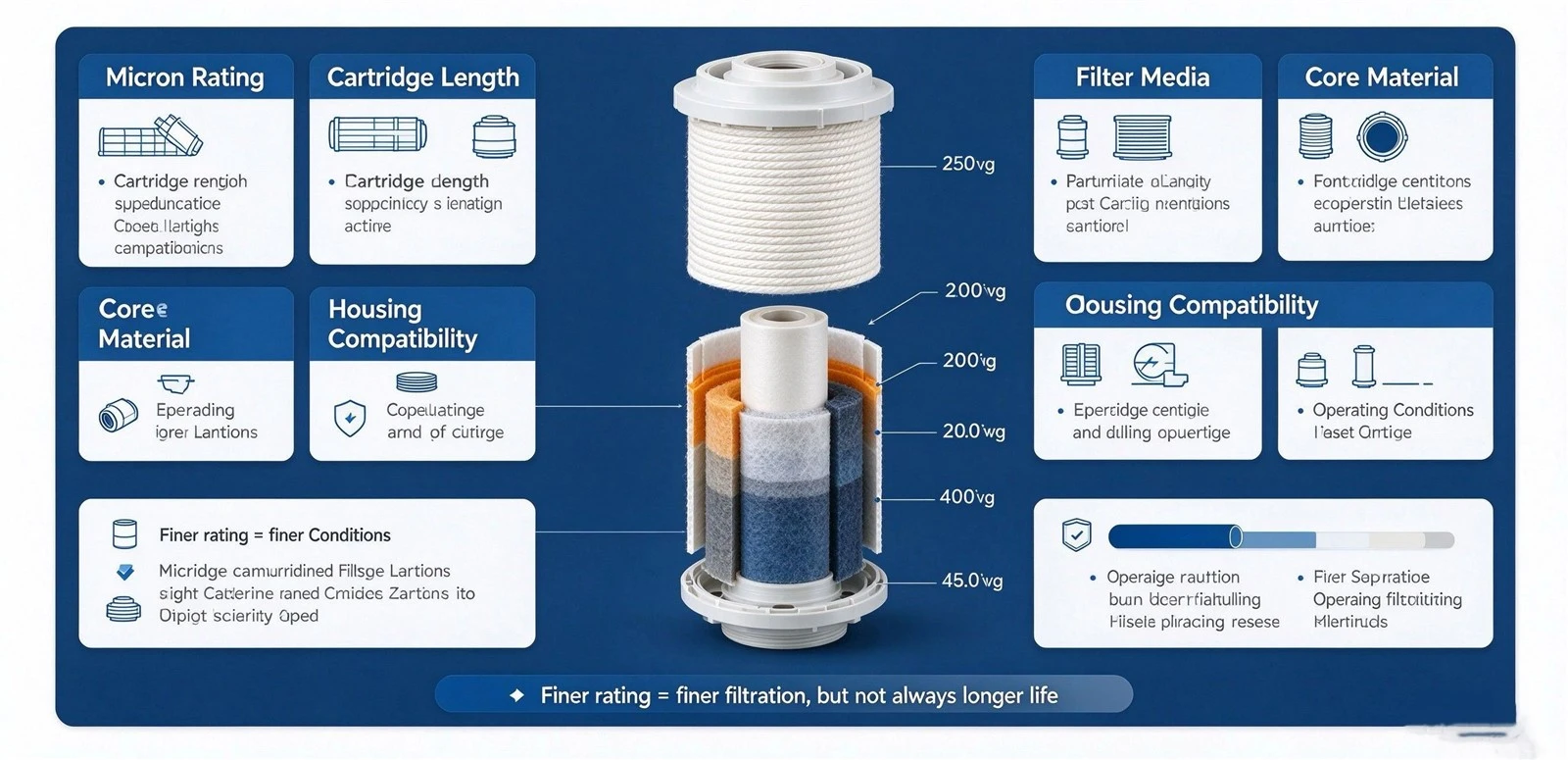
The correct cartridge should be selected according to the filtration system rather than by micron rating alone.
Micron Rating
The micron rating determines the approximate particle size range the cartridge is designed to retain.
Common ratings for industrial wound cartridges include 5, 10, 20, 30, 50, 75, and 100 μm, although available specifications vary by manufacturer and cartridge design.
A lower micron rating provides finer particulate filtration, but it can also result in faster pressure-drop buildup when the incoming liquid contains a large amount of solids.
01
Cartridge Length
Common cartridge lengths include 10, 20, 30, and 40 inches, with other configurations available for different housings.
Longer cartridges generally provide more filtration media and contaminant-holding capacity, provided that the housing and system are designed for them.
02
Filter Media
Polypropylene is widely used when good chemical compatibility and a synthetic filter medium are required.
Other yarn materials may be appropriate for different fluids and operating conditions. The filter media should always be selected according to the liquid being processed.
03
Core Material
The central core provides structural support to the wound media.
Polypropylene cores are suitable for many general industrial applications. Stainless steel or other core materials may be considered when higher mechanical strength, temperature resistance, or specific process requirements are involved.
04
Filter Housing Compatibility
The cartridge must match the filter housing in terms of length, diameter, inner diameter, and end configuration.
Checking these dimensions before purchasing can prevent installation problems and reduce the risk of bypass caused by an incorrect cartridge configuration.
05
String Wound Filters as Part of a Multi-Stage Filtration System
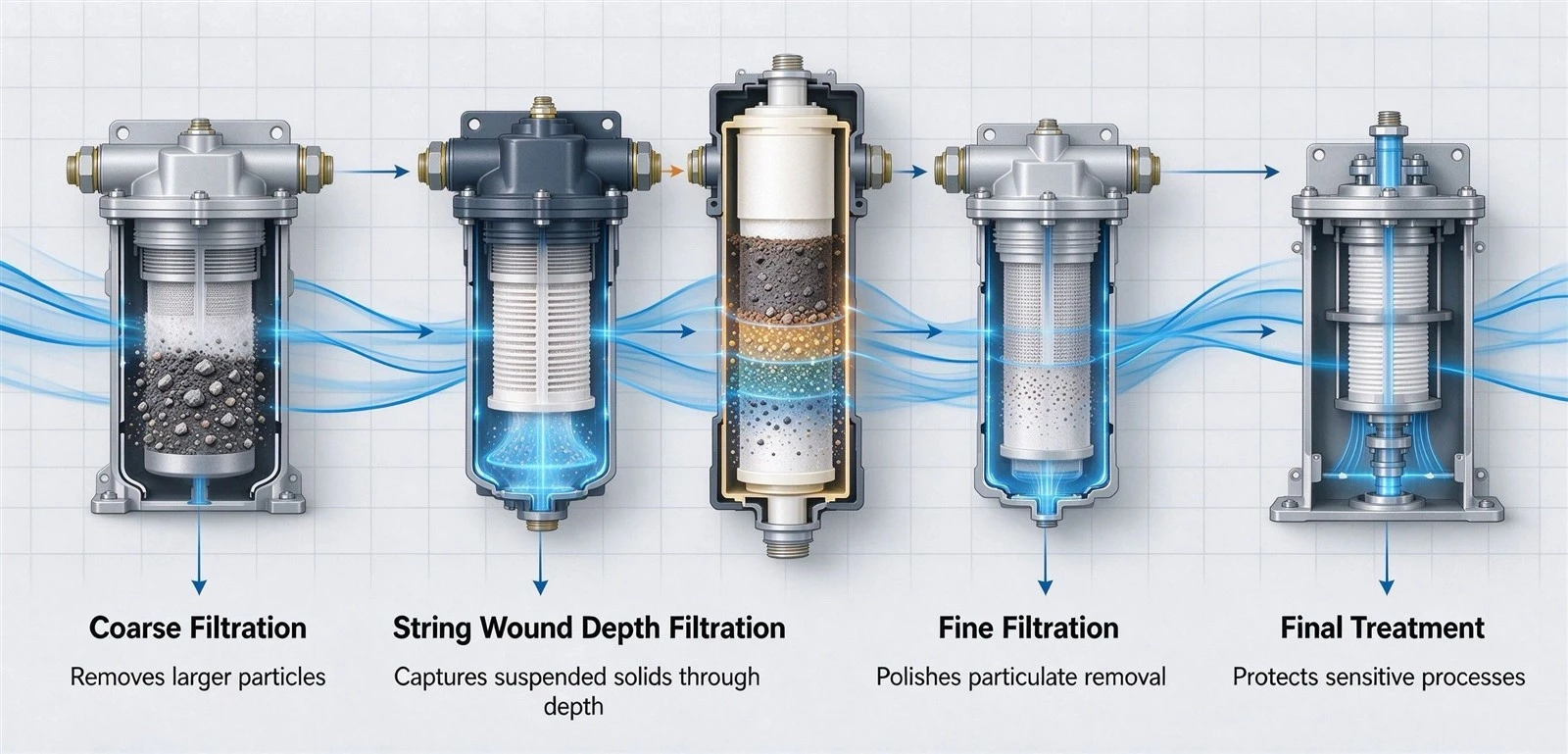
In many industrial systems, one filter cartridge does not need to perform every filtration task.
A multi-stage approach can be more practical.
For example:
Coarse filtration → String wound depth filtration → Fine filtration → Final treatment
A coarse filter can remove larger particles first, while the string wound cartridge handles suspended solids through depth filtration. A finer cartridge can then provide additional particle removal before the liquid reaches sensitive equipment or the final processing stage.
This approach can distribute the contaminant load across different filtration stages and help prevent premature loading of the finer filter.
The actual configuration depends on the liquid, contaminant profile, target cleanliness, flow rate, and downstream process.
Why Businesses Still Use String Wound Filter Cartridges
With newer filtration technologies available, string wound cartridges continue to have a place in industrial filtration because their basic design addresses several common filtration challenges.
They offer:
- A simple and proven construction
- High available contaminant-holding volume
- Flexible filtration ratings
- Multiple media options
- A wide range of cartridge sizes
- Compatibility with many standard housings
- Cost-effective pre-filtration for many applications
The technology is particularly useful when the primary requirement is reliable removal of suspended particles rather than highly specialized membrane or absolute filtration performance.
ANDA's String Wound Filter Cartridge Solutions

ANDA focuses on the production of filter yarn, filter cores, and string wound filter cartridges, providing an integrated supply chain for wound filtration products.
For polypropylene applications, ANDA supplies PP string wound filter cartridges designed for water treatment and compatible industrial liquids.
Different filtration ratings, cartridge lengths, and configurations can be selected according to the requirements of the filtration system.
ANDA also supports OEM and customized requirements for overseas customers, including cartridge specifications, packaging, and private-label programs.
For buyers who are not sure which configuration to use, the most useful information to provide is the liquid being filtered, target micron rating, flow rate, existing housing dimensions, operating temperature, and approximate contaminant load.
These details allow the cartridge configuration to be evaluated based on the actual application rather than simply selecting a filter by size or price.
Final Thoughts
String wound filter cartridges remain a practical depth-filtration solution for applications where suspended solids, sediment, and relatively high contaminant loading are part of the filtration challenge.
From water treatment and RO pretreatment to food and beverage processing, chemical filtration, electroplating, industrial oils, and cooling water, their applications are determined by the combination of filter media, winding structure, micron rating, cartridge dimensions, and operating conditions.
The key to good filtration performance is not choosing the finest filter available. It is choosing a cartridge that matches the liquid, contaminant load, required filtration level, and filtration system.
For industrial buyers, distributors, and filtration-system integrators, understanding these factors can make cartridge selection more predictable and help build a more efficient filtration process.
ANDA provides polypropylene filter yarn, PP cores, and string wound filter cartridges for industrial filtration applications and customized OEM requirements.