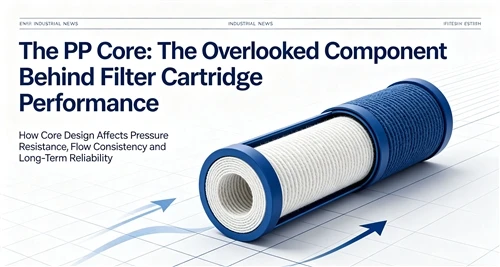
When you look at a string wound filter cartridge, the first thing you notice is usually the filter yarn. You can see the winding pattern, the density, the material, and sometimes even the color.
The plastic tube running through the center, however, rarely gets the same attention.
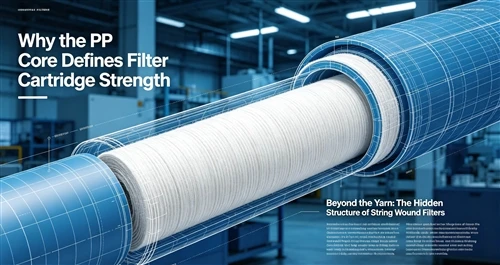
That tube is the filter cartridge core, and although it may look like a simple structural component, it plays a critical role in the cartridge's ability to withstand pressure, maintain its shape, and deliver consistent flow.
In other words, the core is not simply there to hold the cartridge together. A poorly designed or improperly selected core can limit the performance of the entire cartridge-even when the filter media itself is well designed.

So, what does the core actually do, and why does its quality matter?
More Than a Tube: What the Filter Core Actually Does
The core is the central supporting structure inside a string wound filter cartridge. Most designs use a cylindrical tube with openings distributed along its length.
Its primary functions are structural support and flow distribution.

1. Providing Structural Support Under Differential Pressure
As a filter cartridge collects contaminants, the pressure difference between the upstream and downstream sides can increase significantly. Under high differential pressure-for example, around 0.2–0.4 MPa or higher-the cartridge is exposed to substantial mechanical stress.
The core helps prevent the wound filter media from being compressed inward, distorted, or structurally damaged.
Without adequate support, the filter media can deform under pressure. Once the internal structure begins to collapse, the cartridge may no longer maintain its intended filtration path. In severe cases, the media can be damaged and create preferential flow paths, allowing inadequately filtered liquid to pass downstream.
This is one reason the mechanical strength of the core should be considered when selecting a filter cartridge for demanding applications.
2. Controlling Flow Through the Cartridge
The openings in the core are equally important.
In a conventional string wound cartridge, liquid typically travels from the outside of the cartridge through the wound filter media and into the central core. From there, the filtered liquid flows through the hollow center toward the cartridge outlet.
The size, number, and distribution of the core openings affect how efficiently this flow can take place.
If the openings are too small or the available open area is insufficient, they can become a restriction and contribute to additional pressure drop. If the openings are excessively large or poorly distributed, the core may lose mechanical strength or fail to provide adequate support for the surrounding filter media.
A well-designed core therefore has to strike a balance between mechanical strength and hydraulic performance.
PP Core vs. Stainless Steel Core: Which One Makes Sense?
Core material should be selected according to the operating environment, not simply based on price or preference.
For most ambient-temperature water treatment and general industrial filtration applications, polypropylene (PP) is a practical and widely used choice. Stainless steel, on the other hand, becomes more attractive when temperature, pressure, or chemical conditions become more demanding.

1.Polypropylene (PP) Core
PP cores are popular because they offer a useful combination of low weight, corrosion resistance, chemical compatibility, and cost efficiency.
Typical advantages include:
- Lightweight construction for easier handling and installation
- Good corrosion resistance in a wide range of water and chemical applications
- Cost-effective performance for high-volume filtration systems
- Good chemical compatibility across many conventional filtration environments
- Suitable mechanical strength for a wide range of standard operating conditions
A typical PP core can operate at temperatures up to approximately 80°C, depending on the specific design and operating conditions, and can be suitable for liquids across a broad pH range.

For example, PP cores are commonly used in RO pretreatment, potable water filtration, process water treatment, and general chemical liquid filtration.
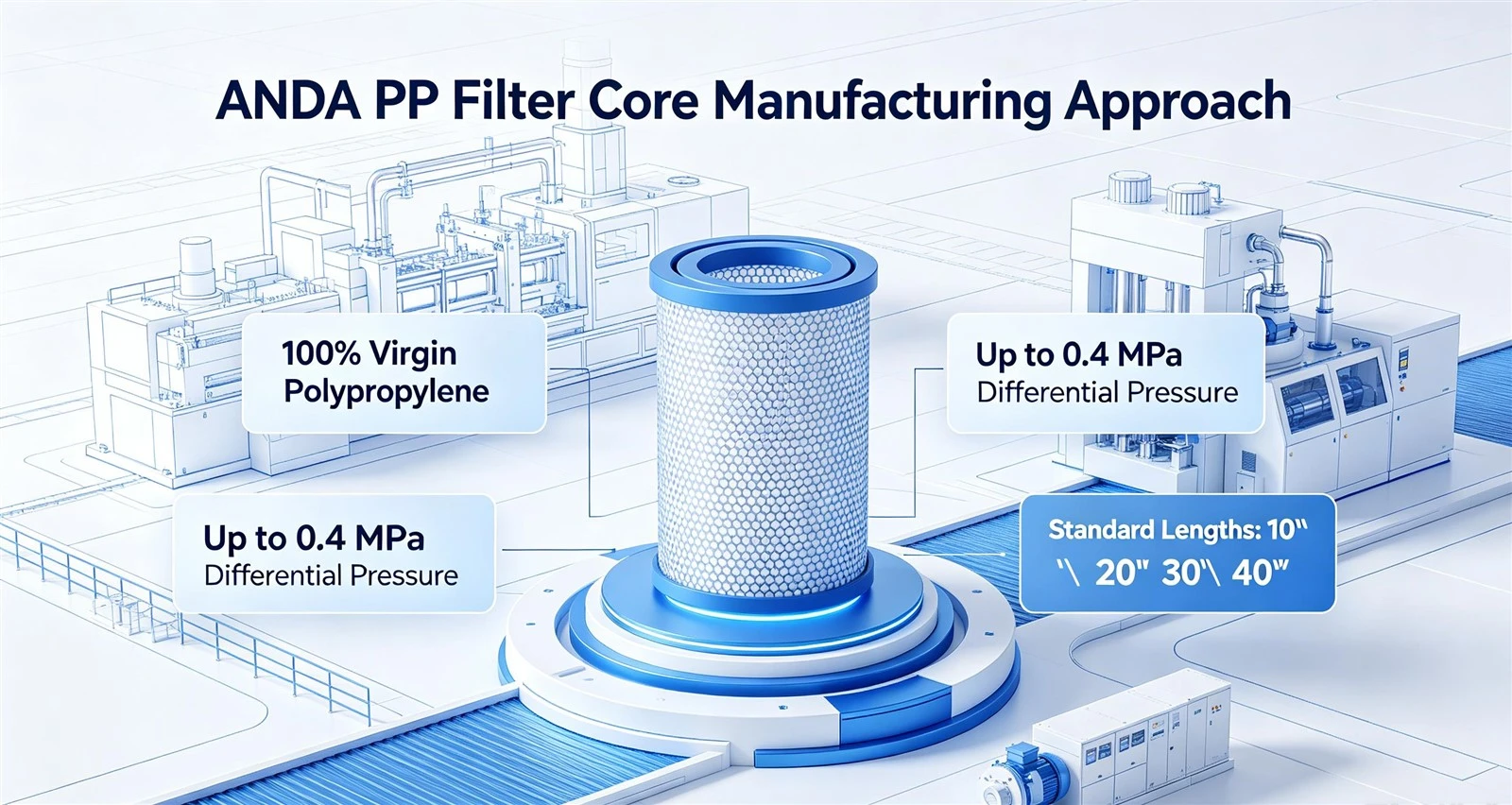
ANDA manufactures PP filter cores from 100% virgin polypropylene using injection molding. Under the specified operating conditions, these cores are designed to maintain structural stability at differential pressures of up to 0.4 MPa.
2.Stainless Steel Core: SUS304 and SUS316L
Stainless steel cores are intended for applications where polypropylene may not provide sufficient mechanical or thermal performance.
Compared with PP, stainless steel offers significantly higher mechanical strength and better resistance to elevated temperatures. Depending on the grade selected, it can also provide improved resistance to aggressive chemical environments.
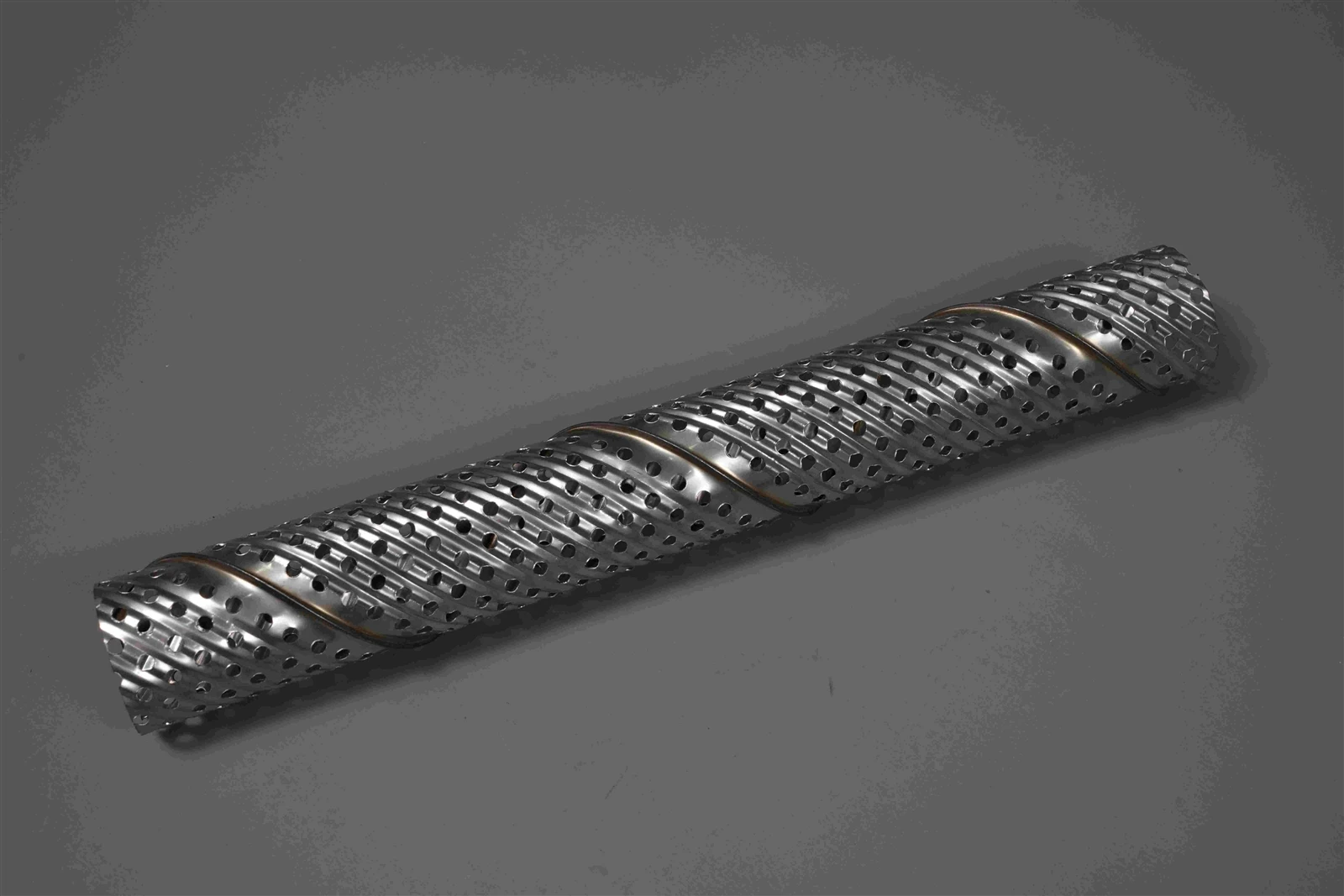
A stainless steel core may be appropriate when:
- Operating temperatures are above the practical range of a PP core
- Hot-water sanitation is required
- Steam or high-temperature cleaning processes are involved
- Higher mechanical strength is required
- The filtration process operates under more demanding pressure conditions
- The chemical environment requires a different material than polypropylene
SUS304 and SUS316L are common stainless steel options, with SUS316L generally preferred for applications requiring higher corrosion resistance.
The basic distinction is straightforward: PP is the practical choice for most conventional filtration systems, while stainless steel is better suited to more demanding thermal, mechanical, or chemical environments.
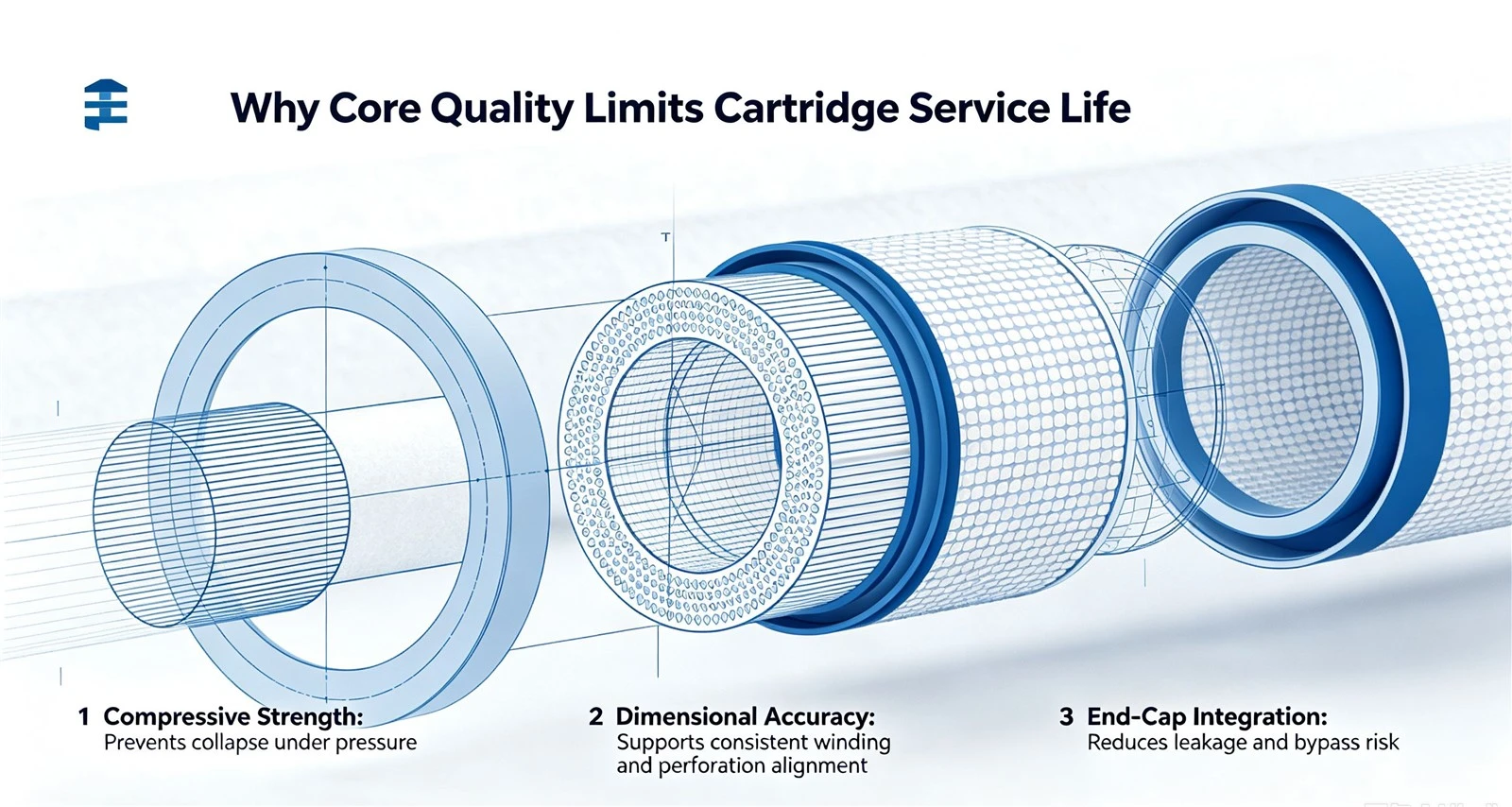
Why Core Quality Can Limit Cartridge Service Life
The service life of a string wound cartridge is often associated with the filter yarn, winding density, contaminant loading, and water quality.
But the core can be just as important.
A cartridge can use high-quality filter media and still perform poorly if the supporting core is not strong, accurately manufactured, or properly integrated into the finished cartridge.
1.Compressive Strength
The first consideration is mechanical strength.
A properly manufactured PP core should maintain its structural integrity within its specified differential-pressure range. For ANDA's PP cores, the design target is structural stability at differential pressures up to 0.4 MPa under specified conditions.
By contrast, an undersized or poorly manufactured core may begin to deform at substantially lower pressures.
Core deformation can affect the geometry of the surrounding wound media. Once that geometry changes, the original filtration structure and flow distribution can also change, potentially reducing filtration consistency and increasing the risk of bypass.
2.Dimensional Accuracy and Perforation Design
The core's dimensions matter more than they may appear.
Outside diameter, wall thickness, overall length, and perforation geometry all need to remain within appropriate manufacturing tolerances.
These dimensions influence how evenly the filter yarn can be wound around the core and how consistently the finished cartridge performs.
The perforations also need to be properly matched to the surrounding filter media. If an opening is too large relative to the media structure, the filter material may be pushed into the opening under pressure. If the openings are too small, the available flow area may become unnecessarily restrictive.
Good core design is therefore not simply about making more holes. It is about achieving the right open area, structural strength, and flow distribution.
3.End-Cap and Core Integration
The connection between the core and the cartridge end caps is another detail that is easy to overlook.
Core length and dimensional accuracy need to provide adequate bonding or sealing space at both ends of the cartridge. A reliable connection helps prevent leakage around the filtration media and keeps the intended flow path intact.
If the end-cap connection fails or develops a gap, liquid can take the path of least resistance rather than passing through the filter media. At that point, even a high-quality filter cartridge can lose much of its intended filtration effectiveness.
This is why the core should be considered as part of the complete cartridge structure-not as an isolated plastic component.
How ANDA Approaches PP Filter Core Manufacturing
For a string wound cartridge manufacturer, filter performance starts long before the yarn is wound.
The core provides the structural foundation around which the entire cartridge is built. For this reason, ANDA pays close attention to core material, dimensional consistency, perforation design, and compatibility with the finished cartridge.
ANDA's PP filter cores are injection molded from 100% virgin polypropylene and are designed with the following characteristics:
- Consistent mechanical strength: Designed to maintain structural integrity at differential pressures of up to 0.4 MPa under specified conditions.
- Uniform perforation distribution: Helps provide consistent flow paths throughout the cartridge and minimize localized flow restrictions.
- Controlled dimensions: Available in common cartridge lengths, including 10", 20", 30", and 40", with outside diameters of approximately 30–63 mm, depending on the configuration.
- End-cap bonding compatibility: Core dimensions are designed to provide the necessary bonding area for secure cartridge assembly and help reduce the risk of leakage.
- Material consistency: Manufactured from 100% virgin polypropylene for stable and repeatable production performance.
For applications that require greater mechanical strength, elevated-temperature performance, or a different level of material resistance, SUS304 and SUS316L stainless steel cores are also available.
The right choice ultimately depends on the cartridge configuration, operating pressure, temperature, chemical environment, and filter housing requirements.
Don't Overlook the Core When Selecting a Filter Cartridge
When comparing string wound filter cartridges, it is easy to focus on the specifications printed on the outside of the cartridge: filter material, micron rating, cartridge length, and winding density.
Those specifications certainly matter.
But the component inside the cartridge deserves the same attention.
The core supports the filter media under differential pressure, provides the central flow path, and contributes to the dimensional stability of the finished cartridge. Its material and design can directly affect how reliably the cartridge performs under real operating conditions.
So the next time you are evaluating a string wound filter cartridge, don't stop at the filter media.
Ask a few additional questions:
- What material is the core made from?
- How is the core manufactured?
- What differential pressure is it designed to withstand?
- How are the perforations designed and distributed?
- Is the core appropriate for the operating temperature and chemical environment?
These may seem like small details. In a filtration system, however, small structural details can have a significant impact on long-term reliability.
A filter cartridge is only as strong and stable as the structure supporting its filtration media.