Is a Finer Filter Always Better?
"If a finer filter removes more particles, why not choose a 0.1 micron filter cartridge instead of a 1 micron one?"
It sounds like a reasonable question. After all, better filtration should mean cleaner water and better protection for downstream equipment. However, choosing a finer filter without considering actual operating conditions can create problems that are easy to overlook during purchasing.
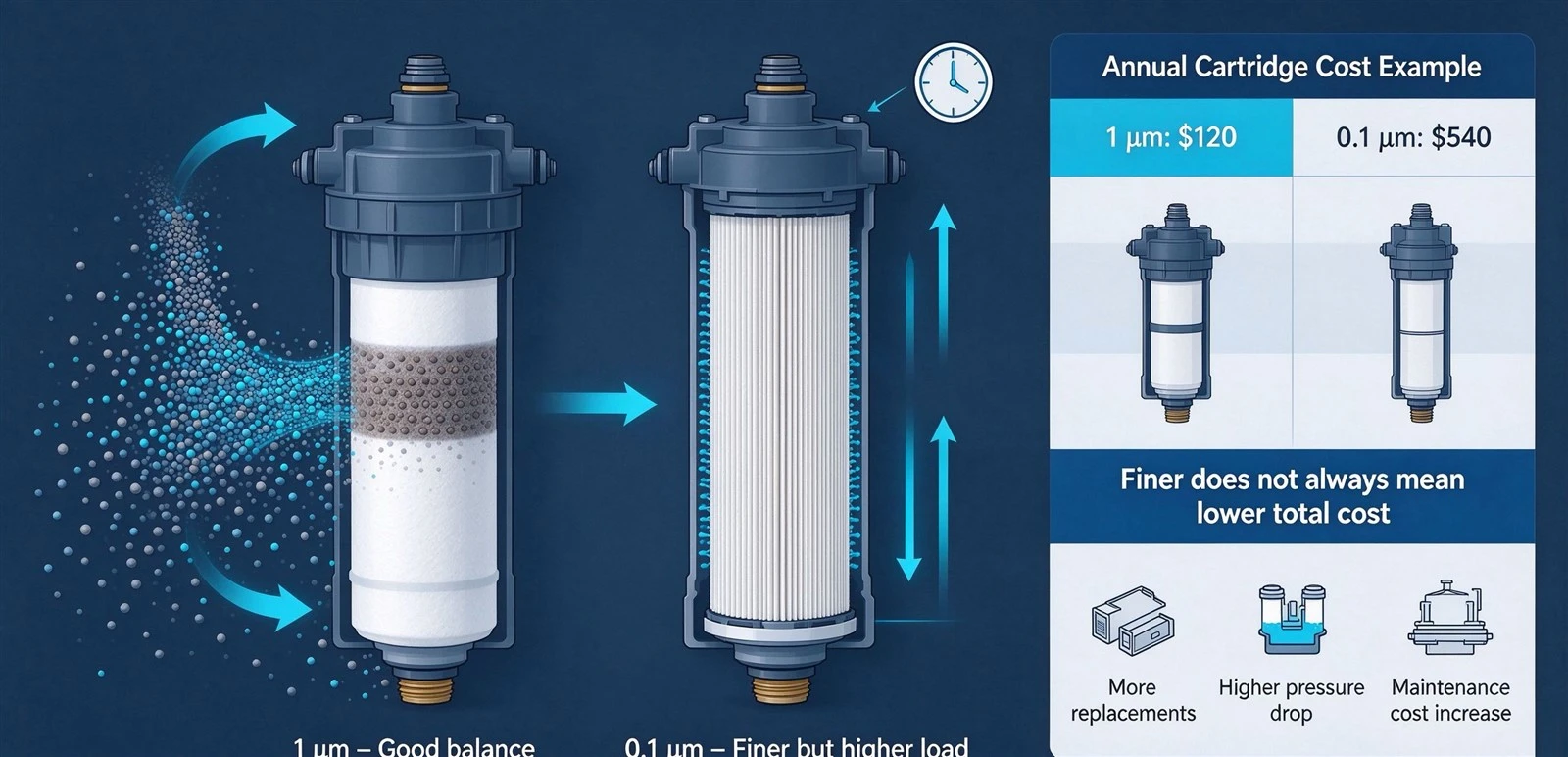
In an industrial water filtration system, a filter cartridge with a smaller micron rating may capture finer particles, but it can also clog more quickly when the incoming fluid contains a high concentration of suspended solids. The result may be more frequent cartridge replacements, rising pressure drop, reduced flow rates, and additional maintenance costs.
For some applications, a 0.1 micron filter is essential. For others, a 1 micron filter or a properly designed multi-stage filtration system may deliver better overall performance at a lower operating cost.
The key is not to choose the finest filtration available. It is to select a filter cartridge with the right micron rating for your water quality requirements, operating conditions, and maintenance budget.
1. Nominal vs. Absolute Micron Ratings: What Should Buyers Know?
When comparing industrial filter cartridges, buyers often assume that two products carrying the same micron rating will deliver similar filtration performance. This is not necessarily true.
The difference often comes down to how the manufacturer defines and verifies its filtration rating.
Nominal Filtration Rating
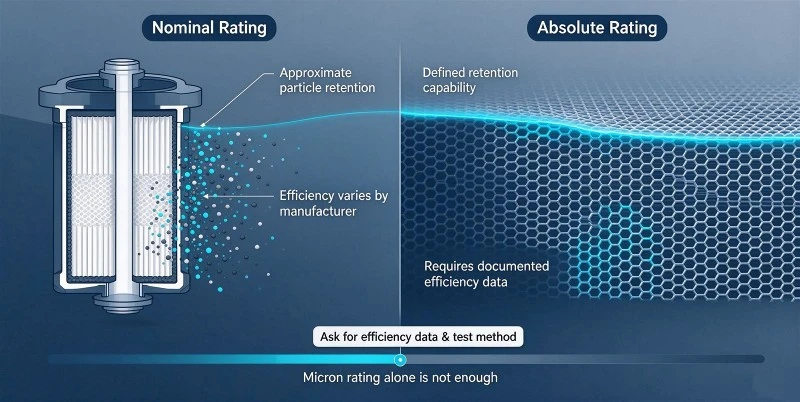
A nominal micron rating indicates the approximate particle size a filter is designed to retain. However, the term does not have one universally applied efficiency threshold across all filter products.
One manufacturer's nominal 1 micron filter may have a different particle retention efficiency from another manufacturer's product with the same rating. The actual performance depends on the filter media, construction, test method, operating conditions, and the manufacturer's stated rating criteria.
For buyers, the practical implication is straightforward: a micron rating alone does not tell you how efficiently a filter cartridge removes particles of a particular size.
Absolute Filtration Rating
An absolute micron rating is generally intended to describe a more tightly defined particle retention capability. However, the term is not used identically by every manufacturer, and it should not automatically be interpreted as 100% particle removal under all conditions.
For a more reliable comparison, ask suppliers for documented particle retention efficiency, the test method used, and any relevant performance reports. Where applicable, a beta ratio can also help quantify particle removal efficiency.
For example, a beta ratio of 100 at a specified particle size corresponds to 99% removal efficiency under the defined test conditions. This is more informative than relying on a micron rating alone.
Questions to Ask Before Purchasing
Before comparing filter cartridge prices, confirm three things:
- Is the stated micron rating nominal or absolute, and how is it defined?
- What particle retention efficiency has been demonstrated under the specified test conditions?
- Can the supplier provide relevant test data or third-party verification?
These questions help you compare products on performance rather than relying on specifications that may not be directly comparable.
2. The Hidden Cost of Choosing a Finer Filter Cartridge
A smaller micron rating can improve particle removal, but it does not automatically improve the economics of an industrial filtration system.
The most important factors include dirt-holding capacity, pressure drop, flow requirements, and replacement frequency.
Faster Clogging and More Frequent Replacements
Consider a production line that currently uses 5 micron filter cartridges and replaces them approximately every three months.
The operator switches to 1 micron cartridges in the hope of improving water quality. If the incoming water contains a substantial amount of suspended solids, the finer filter media may accumulate particles more quickly and reach the allowable terminal pressure drop sooner.
The replacement interval could become significantly shorter, depending on the filter design and operating conditions.
This outcome is not inevitable. A well-designed 1 micron cartridge may perform effectively for an extended period in relatively clean water. However, when the solids loading is high, moving directly to finer filtration without assessing the upstream water quality can increase maintenance requirements.
A Simple Calculation of Annual Filter Costs
Suppose a facility is evaluating two filter cartridge options.
| Cost factor | Existing option | Finer filtration option |
|---|---|---|
| Unit price per cartridge | $30 | $45 |
| Replacements per year | 4 | 12 |
| Annual cartridge cost | $120 | $540 |
In this hypothetical example, annual cartridge expenditure increases from $120 to $540, representing a 4.5-fold increase.
The calculation excludes labor, disposal, production interruptions, and other maintenance expenses. Actual costs will depend on the number of cartridges installed and the service life achieved in the application.
For a large filtration system with multiple housings, these additional expenses can become much more significant.
Pressure Drop and Flow Rate Matter, Too
As particles accumulate in a filter cartridge, its resistance to flow generally increases. This is reflected in a rising differential pressure across the filter.
If the pressure drop becomes too high, the system may no longer maintain its required flow rate. Operators may need to replace the cartridges sooner, investigate pump performance, or adjust the filtration process.
A finer micron rating does not always mean a higher initial pressure drop, because filter construction and media design also matter. Nevertheless, the pressure drop throughout the cartridge's service life should be evaluated alongside its particle removal efficiency.
Ignoring differential pressure limits can also compromise filtration performance. Depending on the cartridge design and operating conditions, excessive pressure or mechanical stress may damage the filter and allow contaminants to pass downstream.
The real cost of filtration is therefore not just the purchase price. It includes the cost of maintaining the required water quality and flow rate throughout the operating cycle.
3. How to Choose the Right Micron Rating for Your Application
The best starting point is to identify what the downstream process needs to protect against.
Instead of asking, "What is the finest filter we can afford?", ask, "What particle size must be removed to meet the process requirements?"
The answer will depend on the equipment being protected, the quality of the incoming water, and the consequences of allowing contaminants to pass through.
Protecting Pumps, Pipes, and General Industrial Equipment
For general water treatment, the primary objective may be to remove suspended solids, rust particles, and other debris that could accumulate in pipes or affect equipment performance.
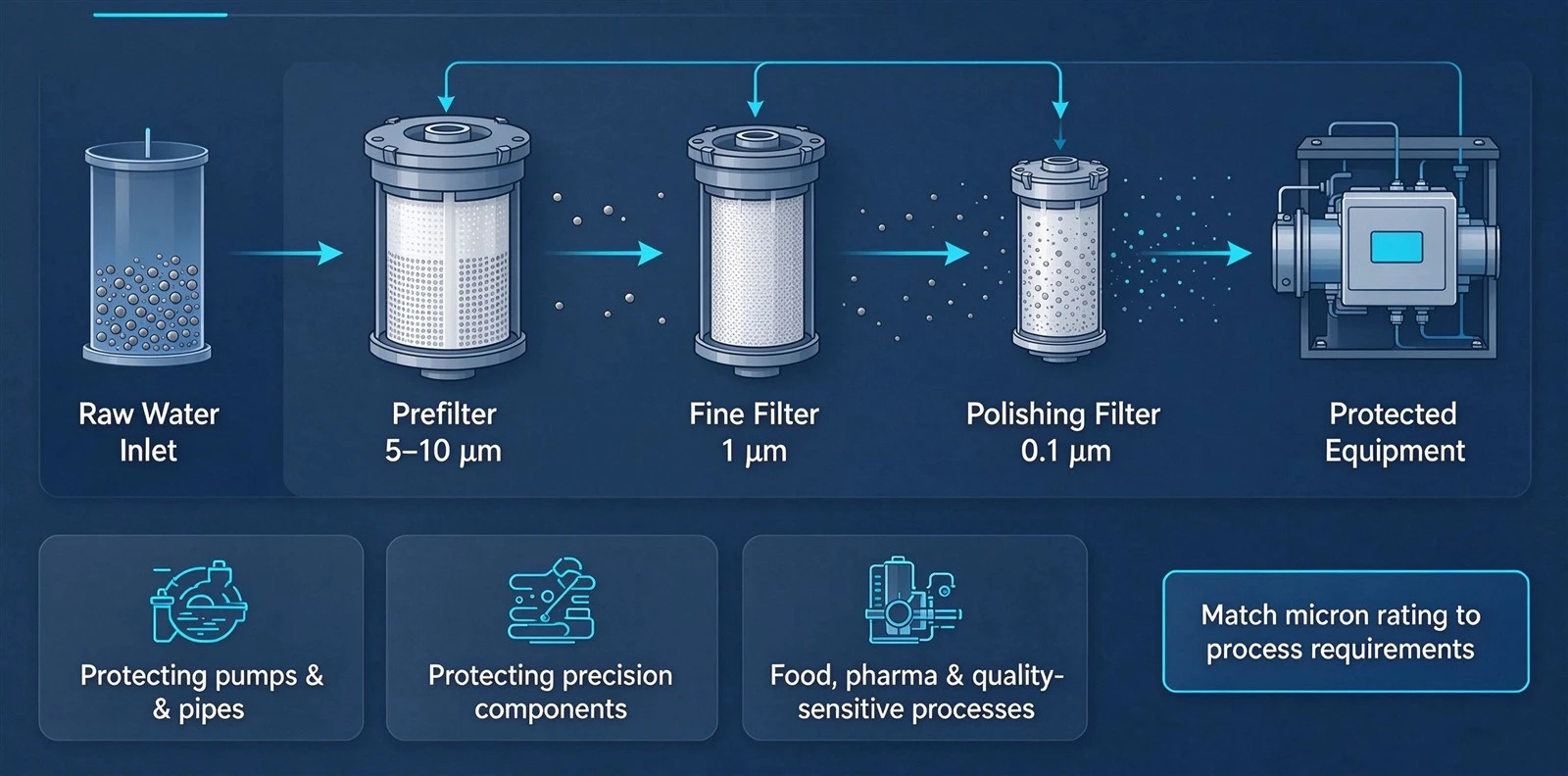
In these applications, a coarser prefilter followed by a finer filter, where necessary, can help distribute the solids load and extend the service life of downstream cartridges.
The appropriate micron rating should be determined by the incoming particle distribution and the equipment manufacturer's requirements rather than by a universal rule.
Protecting Precision Components
Precision valves, sensitive instruments, and other components with tight operating tolerances may require finer filtration.
However, the required rating varies by component and system design. A filter suitable for general hydraulic protection may not be sufficient for a sensitive servo system.
Always check the equipment manufacturer's recommended cleanliness level, particle size limits, and filtration requirements before selecting a cartridge.
Food, Pharmaceutical, and Other Quality-Sensitive Applications
In food processing, pharmaceutical production, and other applications with strict quality requirements, filtration selection may affect product quality, process consistency, and regulatory compliance.
A finer filter may be necessary, but micron rating is only one part of the decision. Buyers should also consider filter media compatibility, operating temperature, chemical resistance, sanitary requirements, and any applicable validation or certification requirements.
For critical applications, the selected cartridge should be supported by suitable performance documentation and application-specific testing.
Multi-Stage Filtration for Better Operating Efficiency
When incoming water contains a wide range of particle sizes, using a single fine filter to capture everything may not be the most practical approach.
A multi-stage filtration system can distribute the workload across different cartridge ratings.
For example, an upstream cartridge can remove larger suspended particles before the water reaches a finer downstream filter. This reduces the solids load on the final stage and may help extend its service life.
The exact arrangement depends on water quality, flow rate, required outlet quality, and the available filter housing configuration.
4. Four Operating Factors That Affect Filter Cartridge Service Life
Even when two systems use the same micron rating, their filter cartridges may have very different replacement intervals.
The reason is that filtration performance depends on more than particle size.

1. Suspended Solids Concentration
Water with a high concentration of suspended solids generally loads a filter cartridge more quickly than relatively clean water.
Where solids levels fluctuate significantly, evaluating pretreatment options and monitoring differential pressure can help prevent unexpected cartridge changes.
2. Fluid Temperature
Temperature affects fluid properties and filter media performance. Elevated temperatures may accelerate material aging or reduce compatibility with certain fluids.
Before selecting a cartridge, verify that the filter media, core, end caps, and other construction materials are suitable for the intended operating temperature.
3. Fluid Viscosity
Higher viscosity increases resistance to flow through the filter media under otherwise comparable conditions. This can affect the initial pressure drop and the system's ability to maintain the required flow rate.
When filtering viscous liquids, cartridge selection should account for operating temperature, viscosity, flow requirements, and the pressure limits of the filtration system.
4. Flow Rate and Operating Pressure
A cartridge must handle the actual operating flow rate without creating an unacceptable pressure drop.
Higher flow rates can increase the hydraulic load on the filter, while changes in pressure can affect the system's operating conditions. Filter sizing should therefore consider both the required flow rate and the manufacturer's recommended operating limits.
These factors explain why choosing a cartridge based on micron rating alone can lead to disappointing results. A suitable product must match the complete operating environment.
5. A Practical Checklist for Industrial Filter Cartridge Selection
Before requesting a quotation, prepare the following information. It will help suppliers recommend a suitable product and reduce the risk of unnecessary replacements.
First, identify the contaminants
Determine whether the water contains sand, rust, suspended solids, fine particles, or other impurities. Where possible, obtain particle size distribution data or water quality test results.
01
Second, define the required outlet quality
Identify the particle removal requirements of the downstream equipment or process. This establishes whether a nominal or absolute rating is appropriate and whether additional performance verification is needed.
02
Third, estimate the acceptable replacement interval
For continuously operating production lines, cartridge service life can have a substantial effect on maintenance planning. Consider the availability of replacement cartridges, labor requirements, and the cost of shutting down the system.
03
Fourth, confirm operating conditions
Provide the supplier with the fluid type, temperature, flow rate, operating pressure, and approximate suspended solids concentration. These details help determine whether the proposed cartridge is suitable for the application.
04
Finally, compare verified performance rather than price alone
Review the micron rating definition, particle retention data, pressure drop, cartridge dimensions, media compatibility, and available technical documentation.
05
A lower purchase price may not represent the lowest operating cost if the cartridge requires frequent replacement. Conversely, a more expensive, finer filter may be unnecessary if a less restrictive option already meets the process requirements.
6. How ANDA Helps Buyers Evaluate Filter Cartridge Options
For industrial buyers, selecting a filter cartridge is ultimately a balance between filtration performance, operating reliability, and long-term maintenance costs.
ANDA supplies filtration products for industrial and water treatment applications, including string wound filter cartridges and polypropylene melt blown filter cartridges. Different cartridge constructions serve different filtration requirements, making it important to match the product to the fluid, contaminant load, and intended operating conditions.
When evaluating a suitable filter cartridge, buyers should consider:
Filtration requirements:
Select an appropriate micron rating based on the required particle removal performance.
Filter media compatibility:
Confirm that the cartridge materials are suitable for the fluid and operating temperature.
System performance:
Evaluate the required flow rate, pressure drop, and expected solids loading.
Maintenance planning:
Consider cartridge service life, replacement frequency, and the overall cost of operation.
If you are comparing 0.1 micron and 1 micron filter cartridges, the right choice depends on the application rather than the rating alone.
Providing your water quality information, operating temperature, flow rate, and downstream filtration requirements can help narrow down suitable options and avoid unnecessary over-filtration.
Frequently Asked Questions
Q: Is a 0.1 micron filter better than a 1 micron filter?
A: Not necessarily. A 0.1 micron filter is designed for finer particle retention, but whether it is better depends on the required outlet quality, the filter's verified efficiency, and the operating conditions. If a 1 micron filter already meets the process requirements, moving to 0.1 micron filtration may add cost without providing a meaningful operational benefit.
Q: Does a finer micron rating always mean a shorter filter cartridge life?
A: No. Service life depends on the incoming particle load, filter media, cartridge design, flow rate, fluid properties, and allowable terminal pressure drop. Finer cartridges may clog more quickly in some applications, but the actual replacement interval should be evaluated under representative operating conditions.
Q: What is the difference between nominal and absolute micron ratings?
A: A nominal rating generally indicates an approximate particle retention capability, while an absolute rating is intended to describe a more specifically defined retention performance. Because manufacturers may use different definitions and test methods, buyers should request the applicable efficiency data and supporting documentation.
Q: How can I reduce filter cartridge replacement costs?
A: Start by confirming that the micron rating matches the actual process requirements. Evaluate incoming water quality, consider suitable upstream pretreatment, size the cartridge correctly for the required flow rate, and monitor differential pressure. These measures can help improve cartridge utilization and reduce avoidable maintenance.
Q: Which filter cartridge should I choose for industrial water treatment?
A: The best option depends on the water quality, particle characteristics, required outlet quality, flow rate, operating temperature, and filter housing specifications. A supplier with relevant application experience can help compare suitable cartridge types and filtration ratings.
Need Help Selecting the Right Filter Cartridge?
Choosing the correct micron rating can help you achieve the required filtration performance without adding unnecessary replacement and maintenance costs.
Contact ANDA with your application details, including the fluid type, operating temperature, flow rate, and downstream protection requirements. Our team can help you evaluate suitable filter cartridge options for your industrial filtration system.
Choose filtration based on performance requirements, not micron rating alone.