Water filtration systems rely on more than just the design of the filter housing. The material inside the filter cartridge also plays an important role in determining filtration performance, service life and operating costs.
Among the materials used in industrial filtration, polypropylene yarn has become a popular choice for manufacturing string wound filter cartridges. It offers a useful combination of chemical resistance, low moisture absorption, stable performance and cost efficiency.
But why do so many filter manufacturers choose polypropylene yarn instead of cotton or other synthetic materials? What makes it suitable for water filtration, and what should buyers consider when selecting it?
This article explains the main reasons behind its widespread use and helps filter manufacturers and industrial buyers understand how to choose the right PP filter yarn.
What Is Polypropylene Yarn?
Polypropylene yarn, commonly known as PP yarn, is a synthetic yarn made from polypropylene, a thermoplastic polymer.
It is widely used in industrial applications because of its relatively low density, moisture resistance and resistance to many common chemicals.
Unlike natural fibers, polypropylene does not readily absorb water. This characteristic makes it particularly useful in applications where the material is continuously exposed to water or other liquids.
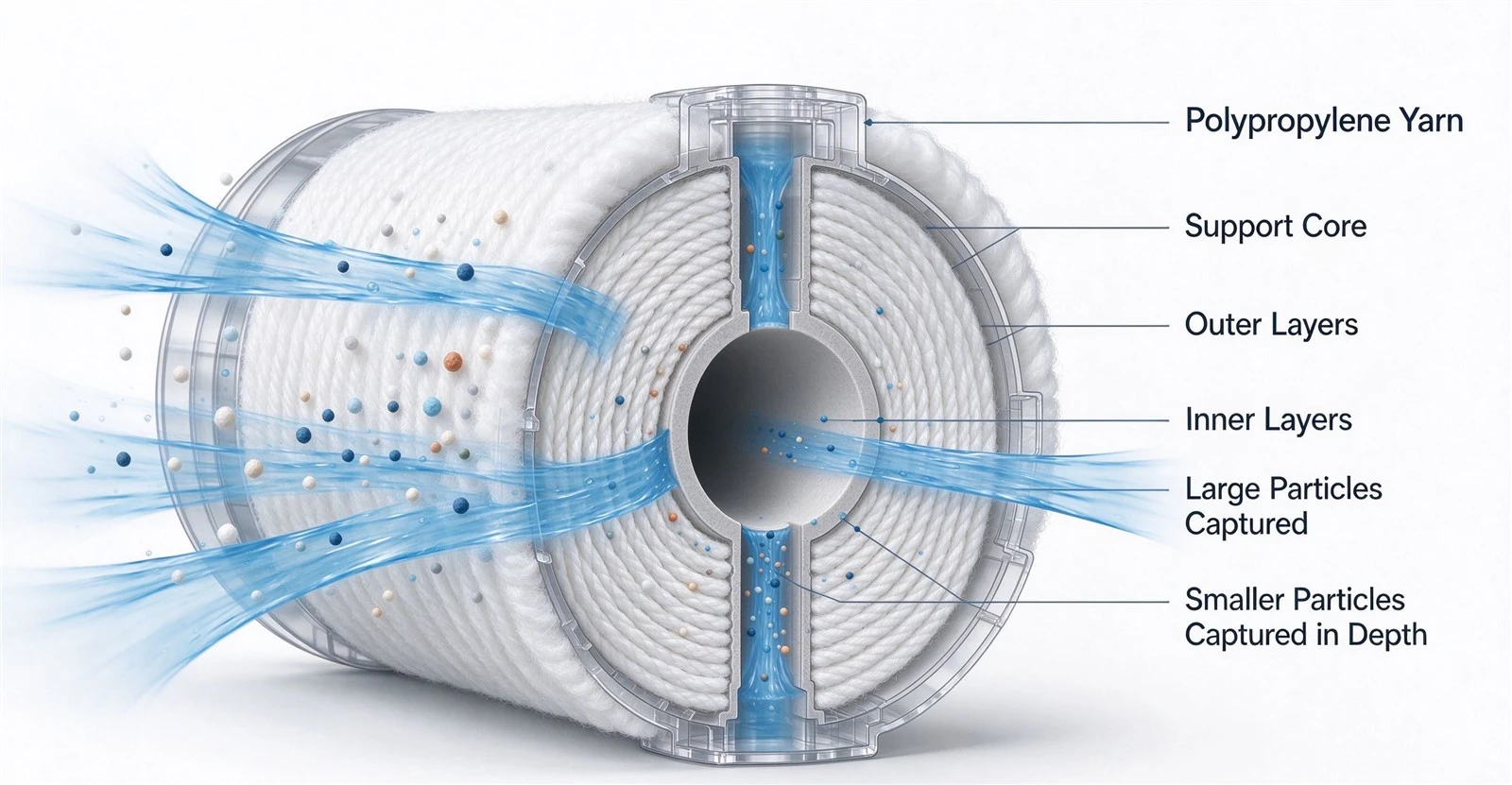
In the filtration industry, polypropylene yarn is mainly used to manufacture string wound filter cartridges. The yarn is wound around a central support core in a controlled pattern to create a filter structure that captures suspended particles as liquid passes through it.
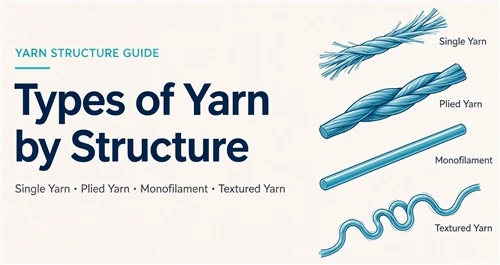
Depending on the spinning method and yarn construction, PP filter yarn can have different physical characteristics. These differences influence how the finished filter cartridge performs.


Why Is Polypropylene Yarn Used in Water Filter Cartridge Manufacturing?
Polypropylene is not selected simply because it is an inexpensive synthetic material. Its physical and chemical properties make it suitable for many water filtration applications.
Here are six important reasons why filter manufacturers use it.
1. Good Chemical Resistance
One of the main advantages of polypropylene yarn is its resistance to many common chemicals.
In industrial water treatment, filter cartridges may come into contact with dilute acids, alkalis and various process liquids. A filter material that cannot withstand the working environment may deteriorate too quickly or affect filtration stability.
Polypropylene offers good compatibility with many commonly used chemicals, making it a practical material for general industrial filtration.
However, chemical resistance is not unlimited. Compatibility depends on the chemical type, concentration, operating temperature and exposure time.
Buyers should check the material compatibility before selecting a filter cartridge.
2. Low Moisture Absorption
Water exposure is unavoidable in most filtration applications.
Natural fibers can absorb moisture, which may change their physical characteristics under certain operating conditions. Polypropylene, by comparison, has very low moisture absorption.
This property helps PP yarn maintain its material characteristics during continuous contact with water.
For water filter cartridge manufacturers, it provides a useful material option for producing filters intended for regular liquid filtration.
3. Stable Filtration Structure
In a string wound filter cartridge, the yarn is not simply wrapped around a core at random.
The winding pattern, yarn thickness and winding tension work together to create the filtration structure.
Polypropylene yarn can be processed into different yarn constructions to meet different manufacturing requirements.
When properly selected and wound, it helps form a stable filter structure that can retain suspended particles while allowing liquid to pass through.
The final performance still depends on the yarn quality and cartridge design, rather than the raw material alone.

4. Suitable for Depth Filtration
String wound filter cartridges are commonly used for depth filtration.
During manufacturing, yarn is wound around a central core in multiple layers. The outer layers can be more open, while the inner layers are wound more tightly.
This creates a gradual change in the spaces between the yarn layers.
As water passes through the cartridge, larger particles are generally retained closer to the outer surface, while smaller particles can travel further into the filter structure before being captured.
This arrangement allows the filter media to use more of its internal volume for particle retention.
The quality and consistency of the PP yarn are therefore important to the final filtration result.
5. Lightweight and Cost-Efficient
Polypropylene is a relatively lightweight polymer.
Its low density makes it practical for large-scale production and transportation. Compared with some alternative filtration materials, PP yarn can also offer an economical balance between material cost and application performance.
For filter cartridge manufacturers, this can help control production costs without sacrificing the material characteristics required for suitable filtration applications.
6. Versatile Manufacturing Options
Different filtration projects require different filter structures.
Polypropylene yarn can be manufactured using different spinning methods and yarn constructions. These options allow manufacturers to select materials according to their winding equipment and finished cartridge requirements.
For example, yarn bulkiness, linear density, fiber arrangement and surface characteristics can all influence the winding process and the structure of the finished filter.
This flexibility makes PP yarn suitable for a wide range of string wound filter cartridge designs.
How Does Polypropylene Yarn Work in String Wound Filter Cartridges?
To understand the importance of PP filter yarn, it helps to look at how a string wound filter cartridge is manufactured.
The production process generally involves three main stages.

Step 1: Yarn Preparation
Polypropylene yarn is prepared according to the required yarn specifications. Its thickness, strength, structure and consistency should meet the requirements of the winding process.
Step 2: Controlled Winding
The yarn is continuously wound around a central core using a specialized winding machine.
The winding pattern and tension determine the spacing between yarn layers. These factors influence the pore structure and filtration characteristics of the finished cartridge.
Step 3: Finished Cartridge Formation
After winding, the cartridge is prepared according to its required dimensions and construction.
The finished product is then checked for important characteristics such as appearance, dimensions, structural consistency and other application-specific requirements.
The relationship between yarn quality and winding conditions is important. Even a good-quality yarn cannot guarantee satisfactory filtration if the winding process is poorly controlled.
Polypropylene Yarn vs. Cotton Yarn for Water Filter Cartridges
Polypropylene yarn and cotton yarn are both used in string wound filter cartridge manufacturing. However, they have different material characteristics.
Understanding these differences helps buyers select the right material for their applications.
| Comparison | Polypropylene Yarn | Cotton Yarn |
|---|---|---|
| Material | Synthetic polymer | Natural cellulose fiber |
| Moisture absorption | Very low | Relatively high |
| Chemical resistance | Good against many common chemicals | Depends on chemical conditions |
| Water exposure | Suitable for many continuous wet applications | Absorbs water readily |
| Temperature resistance | Generally lower than cotton in some filter designs | Can be higher depending on construction |
| Typical applications | General water and chemical filtration | Selected liquid and industrial filtration applications |
Neither material is suitable for every filtration condition.
- PP yarn is often selected when low moisture absorption, chemical compatibility and economical production are important.
- Cotton yarn may be considered when its specific fiber characteristics and application requirements are more suitable.
The final choice should always be based on the actual liquid, operating temperature, filtration requirements and cartridge construction.


What Factors Affect the Quality of Polypropylene Filter Yarn?
Not all polypropylene yarn performs the same way in filter cartridge manufacturing.
The raw material is important, but the yarn manufacturing process also has a significant influence on the finished product.
Here are five factors worth considering.
1. Yarn Thickness and Uniformity
Yarn thickness affects the spacing between winding layers.
If the yarn has inconsistent thickness, the resulting filter structure may also become uneven.
Consistent yarn specifications help manufacturers maintain more stable winding conditions.
01
2. Yarn Strength
Yarn needs sufficient strength to withstand the tension applied during winding.
Insufficient strength may lead to yarn breakage and production interruptions.
For this reason, buyers should consider yarn strength alongside its thickness and structure.
02
3. Fiber Structure
Different spinning processes produce different yarn structures.
The arrangement of fibers, yarn bulkiness and surface characteristics can influence how the yarn behaves during winding.
Manufacturers should select a yarn construction that matches their equipment and desired cartridge design.
03
4. Manufacturing Consistency
For filter cartridge factories, consistency between batches is particularly important.
Large differences in yarn thickness, strength or appearance can affect production efficiency and finished cartridge quality.
A reliable yarn supplier should be able to maintain stable specifications across regular orders.
04
5. Application Compatibility
Before purchasing PP filter yarn, buyers should identify the intended filtration application.
Important considerations include:
- Type of liquid being filtered
- Operating temperature
- Chemical concentration
- Required filtration rating
- Cartridge dimensions
- Winding equipment and production method
Clear application requirements make it easier to select the appropriate yarn specifications.
05
Common Applications of Polypropylene Filter Yarn
Polypropylene yarn is widely used in the production of string wound filter cartridges for different industrial filtration applications.
Typical applications include:
1. Industrial Water Treatment:
Used in filter cartridges designed to remove suspended solids, sediment and other particulate contaminants from process water.
2. Pre-Filtration Systems:
Used as part of pre-filtration processes to reduce particle loading before water enters more sensitive filtration equipment.
3. Chemical Processing:
Suitable for selected chemical filtration applications where polypropylene has adequate chemical compatibility.
4. Electroplating and Surface Treatment:
Used in filtration systems that handle process liquids and require suitable resistance to the working chemical environment.
5. Manufacturing and Recycling Water:
Used in filter cartridges for industrial circulating water and selected wastewater treatment processes.
The suitability of a specific PP yarn depends on the operating conditions and the design of the finished cartridge.
How to Choose a Reliable Polypropylene Filter Yarn Supplier
For filter cartridge manufacturers, choosing a supplier is not only about comparing prices.
The quality of the yarn directly affects the winding process and can influence the consistency of finished filter cartridges.
Before placing an order, buyers should pay attention to the following points:
1. Product Specifications
Check yarn thickness, strength, structure and other technical parameters. Make sure the specifications match your production requirements.
2. Production Capability
A supplier with established production experience is better positioned to understand different yarn requirements and maintain consistent manufacturing standards.
3. Quality Control
Ask how raw materials, production processes and finished yarn are inspected.
4. Customization Support
Different filter cartridge designs may require different yarn specifications. Confirm whether the supplier can provide suitable options for your winding process.
5. Communication and Supply Stability
Clear technical communication and dependable order coordination are important for both domestic and international buyers.
Working with a supplier that understands filtration materials can help reduce material selection problems and improve production efficiency.
Polypropylene Filter Yarn Supply from Zibo Anda Textile Co., Ltd.
For manufacturers of string wound filter cartridges, selecting suitable raw materials is an important part of maintaining stable production.
Neither material is suitable for every filtration condition.
Zibo Anda Textile Co., Ltd. focuses on textile materials for industrial filtration and serves both domestic and international markets.
The company supplies polypropylene filter yarn for manufacturers looking for suitable materials for string wound filter cartridge production.
When selecting polypropylene yarn, different customers may have different requirements for yarn specifications, physical properties and production applications.
ANDA aims to provide suitable product options according to customers' material requirements and application needs.
Whether you are a filter cartridge manufacturer, filtration equipment supplier or industrial materials distributor, choosing the right PP yarn is an important step in achieving consistent production results.

If you are looking for a polypropylene filter yarn supplier, you can explore ANDA's product range and contact the company to discuss your requirements.