Few water treatment technologies strike such a fine balance between high‑efficiency physical separation and operational simplicity as ultrafiltration (UF). Also widely referred to as hollow‑fiber filtration across the industry, this pressure‑driven separation process has become the go‑to solution for removing micro‑sized particles, pathogens and colloids from water supplies.
Like all precision separation technologies, ultrafiltration has well‑defined performance limits. Whether you are sourcing water treatment hardware for residential, commercial or industrial facilities, understanding what UF can - and cannot - remove is critical for making well‑informed purchasing decisions. This article breaks down the real‑world science behind the 0.01 μm filtration threshold and outlines practical use‑cases for ultrafiltration systems.
The Physics of Pore Size: Why 0.01 μm Matters
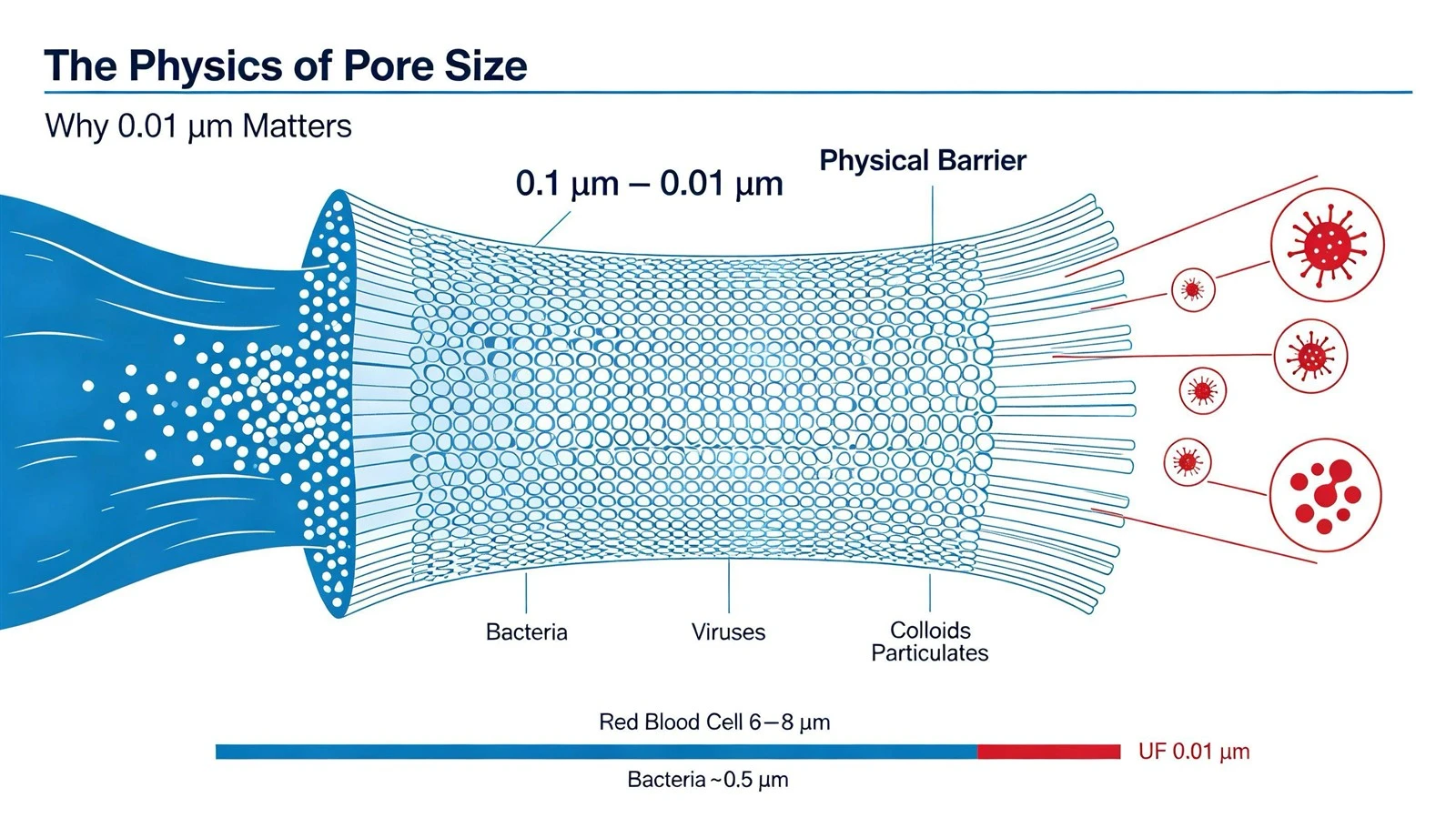
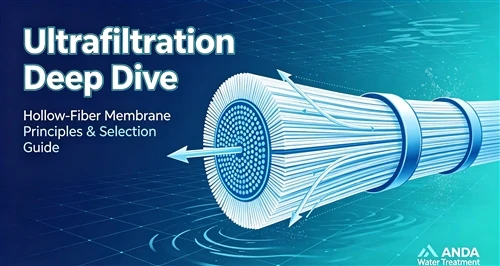
At its core, ultrafiltration operates as a physical sieving process. The "sieve" consists of bundles of hollow‑fiber membranes - tiny, straw‑like strands with micro‑perforated tube walls. System performance is governed by membrane pore size, with typical ultrafiltration pore ratings ranging from 0.1 μm down to 0.01 μm.
For reference: human red blood cells measure roughly 6‑8 μm across, while most bacteria sit around 0.5 μm. At a 0.01 μm pore rating, premium‑grade UF membranes form a robust physical barrier capable of retaining:
Bacteria
Viruses
Colloids and suspended solids
Particulate contaminants
Unlike chemical disinfection methods such as chlorination or UV treatment, ultrafiltration delivers a physical barrier effect. Even when raw‑water quality fluctuates, biologically safe permeate remains consistent. Water treated by qualified UF units can routinely meet standards for safe direct drinking.
Ultrafiltration's Hard Limits: Contaminants It Cannot Remove
While 0.01 μm membranes excel at capturing biological hazards and particulates, physical sieving has inherent constraints. Many water‑borne chemicals exist as dissolved molecules or ions, far smaller than UF membrane pores.
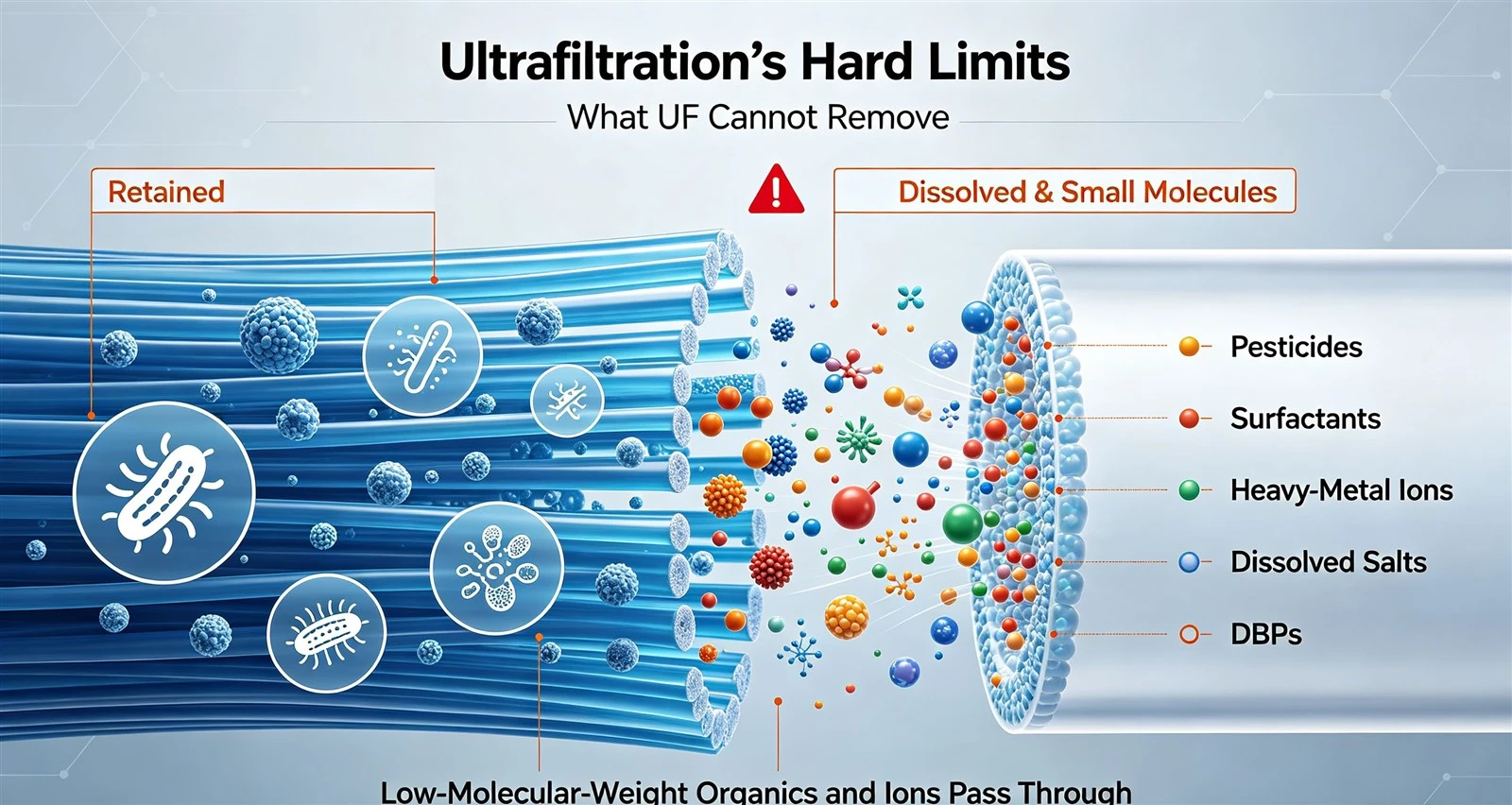
Simply put, ultrafiltration offers virtually no rejection for low‑molecular‑weight organics and dissolved ions. This category covers:
Pesticides and herbicides:
Agricultural runoff compounds small enough to pass freely through hollow‑fiber membrane walls.
sDetergents and surfactants:
Synthetic organic molecules with dimensions below typical UF cut‑off thresholds.
Heavy‑metal ions:
Dissolved lead, mercury, arsenic and similar contaminants exist at angstrom‑scale radii (1 Å = 0.0001 μm) - roughly 100 times smaller than 0.01 μm pores - and cannot be physically screened out.
Dissolved mineral salts:
Soluble iron, manganese, calcium and magnesium (hardness‑causing ions) remain unaffected by ultrafiltration.
Many chemical pollutants including residual chlorine and disinfection by‑products such as trihalomethanes require adsorption (activated carbon) or chemical reactions for effective removal. Even though UF permeate is microbiologically safe, it may still carry dissolved chemical impurities that impact taste, odour and long‑term health outcomes.
Membrane Materials and Configurations: How Ultrafiltration Membranes Are Built
Overall system efficiency heavily depends on membrane material selection. Most modern ultrafiltration modules use high‑performance polymers; Cellulose Acetate (CA) and Polyethersulfone (PES) represent the two most common options.
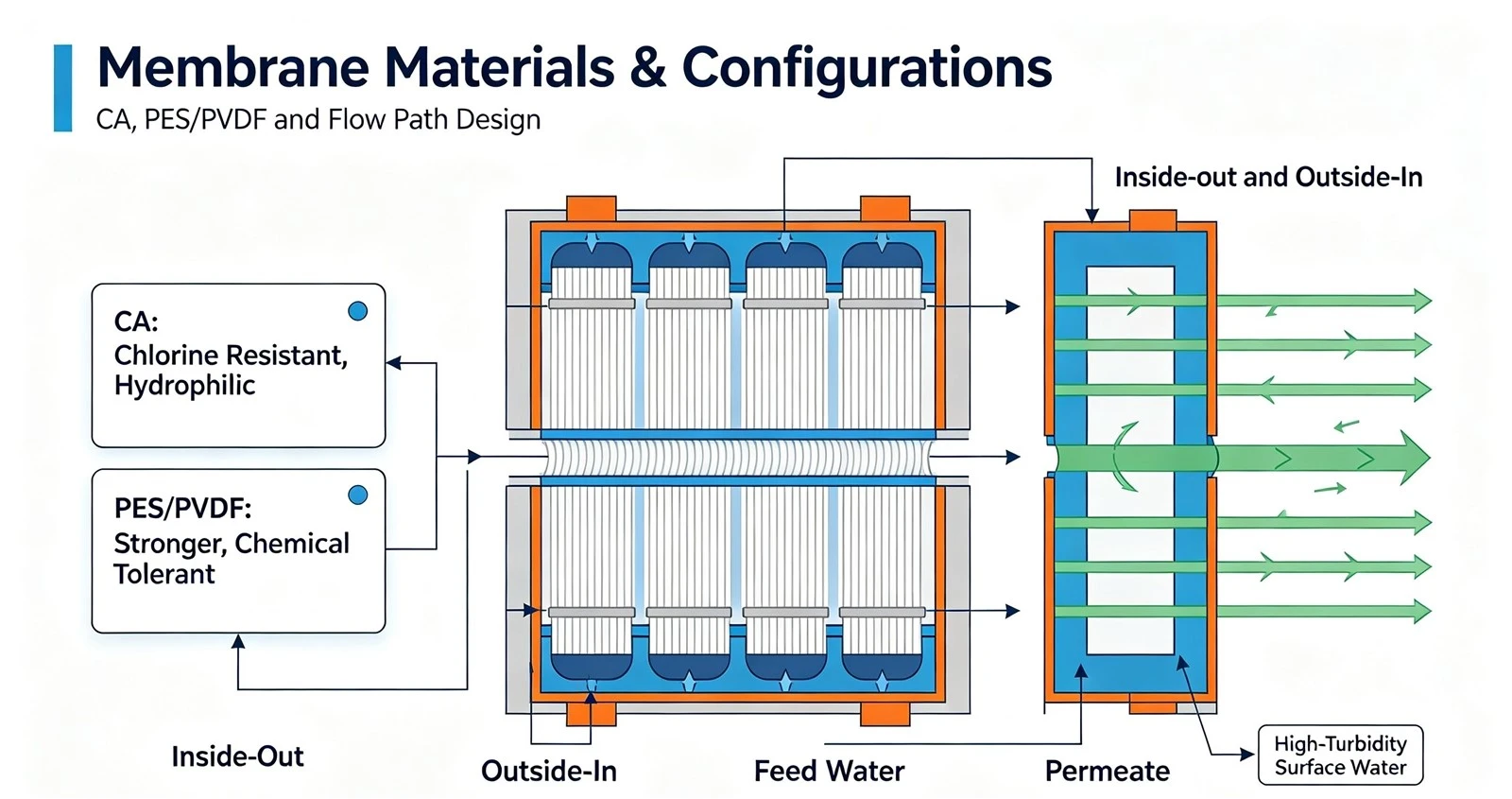
- Cellulose Acetate (CA): Offers excellent chlorine resistance and natural hydrophilicity, slowing membrane fouling rates.
- Polyethersulfone (PES) / Polyvinylidene Fluoride (PVDF): Delivers superior mechanical strength and broad chemical compatibility, extending service life under demanding industrial operating conditions.
Two primary flow configurations dominate UF system design: inside‑out (feed water flows from the hollow‑fiber interior toward the outer surface) and outside‑in (feed water flows across the fiber exterior into the lumen). Your raw‑water quality dictates the optimal layout. For high‑turbidity surface water, outside‑in configurations deliver superior pre‑filtration performance and cleanability, helping prevent premature fiber blockage.
Key Application Areas for Ultrafiltration
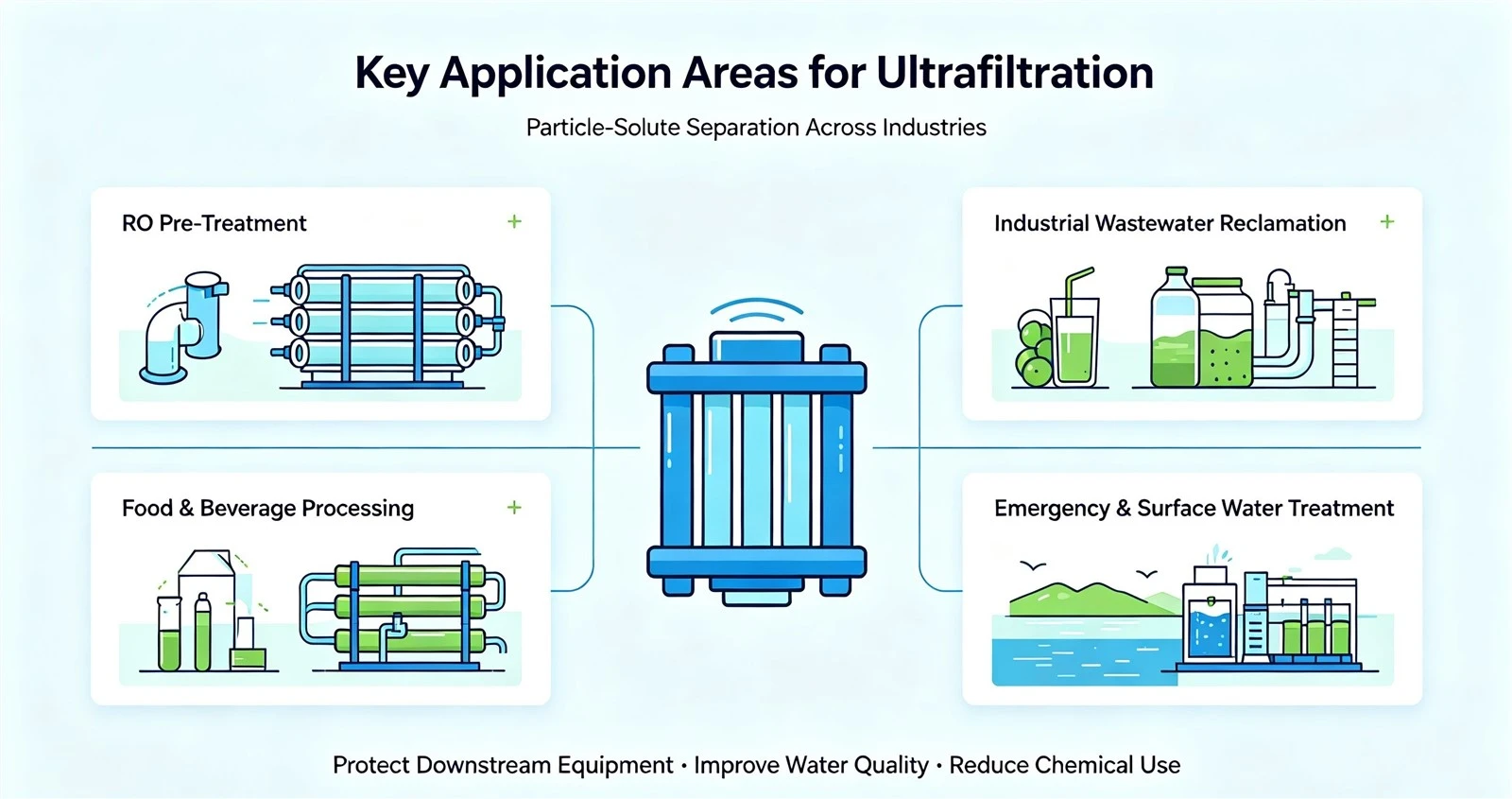
Despite its limitations with dissolved contaminants, ultrafiltration remains one of the most capable technologies for particle‑solute separation and concentration, deployed widely across these sectors:
- Reverse Osmosis (RO) Pre‑Treatment: Ultrafiltration removes over 99.9 % of particulates and bacteria, protecting costly RO membranes from fouling and cutting long‑term system maintenance expenses.
- Industrial Wastewater Reclamation: Efficiently clarifies challenging colloidal suspensions that prove difficult for alternative separation technologies.
- Food and Beverage Processing: Used for juice clarification, whey protein fractionation, yeast removal in beer production and other chemical‑free processing workflows.
- Emergency Potable Water and Surface Water Treatment: Provides reliable defence against water‑borne disease outbreaks for communities drawing water from rivers and lakes.
Finding the Right Solution: ANDA's Holistic Water‑Treatment Approach
Addressing complex water chemistry demands more than standalone membrane modules - it calls for solution‑driven system engineering. Industry practice is shifting away from single‑stage filtration toward multi‑stage integrated treatment systems.
This is where expert engineering adds tangible value. ANDA specialises in integrating ultrafiltration skids with complementary technologies: activated‑carbon filters for chemical contaminant adsorption, antiscalant dosing for hardness mitigation and other matched components to build complete water‑treatment ecosystems.
As a standalone unit, ultrafiltration is an excellent investment for physical and biological contaminant removal. If your source water carries heavy metals or agricultural chemical residues, a custom‑engineered advanced water‑treatment system from ANDA strategically combines ultrafiltration with complementary treatment stages to deliver consistent, high‑quality output tailored exactly to your site requirements.
We conduct thorough source‑water analysis, define target effluent specifications, and design systems that maximise ultrafiltration's strengths while compensating for its known shortcomings.
Conclusion: Is Ultrafiltration Right for You?
Ultrafiltration ranks among today's most dependable, energy‑efficient and environmentally responsible water‑treatment technologies. It generates high‑quality, particle‑free water with minimal chemical dosing, making it a cornerstone of modern water management.
Ultrafiltration is an ideal fit if your core priorities include:
- Removing bacteria, viruses and turbidity;
- Shielding downstream equipment from particulate damage;
- Achieving high water recovery rates (typically 90 % +).
Opt for a combined multi‑stage system (such as solutions engineered by ANDA) when you also need to:
- Eliminate chemical pollutants, heavy metals or pesticide residues;
- Adjust water hardness or pH levels;
- Meet stringent ultrapure‑water specifications for specialised industrial processes.

Once you understand both the distinct strengths and inherent limitations of 0.01 μm ultrafiltration, you move beyond simply purchasing filters and begin designing purpose‑built water‑treatment solutions.
For operators aiming for performance above standard filtration benchmarks, ANDA delivers technical consultation and custom system design to turn raw source water into fit‑for‑purpose process water.