A wire wound filter cartridge may look like a simple cylinder of tightly wrapped yarn, but its filtration performance depends on much more than the material visible on the outside.
The yarn, winding pattern, core, filtration rating, and operating conditions all work together to determine how effectively a cartridge captures suspended solids while maintaining stable flow. For water treatment and industrial filtration systems, understanding these structural details is often more useful than choosing a cartridge based on micron rating alone.
As a manufacturer of PP yarn, PP cores, and string wound filter cartridges, ANDA has long focused on the materials and construction behind wound filtration technology. This article takes a closer look at how a wire wound filter element is built, what makes it different from other depth filtration products, and how to select the right configuration for a specific application.
What Is a Wire Wound Filter Cartridge?
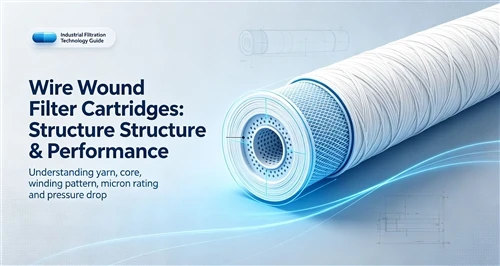
A wire wound filter cartridge is a type of depth filter made by winding continuous filter yarn around a rigid porous core.
During manufacturing, the yarn is wound around the core in a controlled pattern. The spacing between individual strands creates a network of passages through which liquid can flow. Larger particles are captured near the outer surface, while smaller particles can penetrate deeper into the winding before being trapped.
This gives a string wound filter cartridge its characteristic depth filtration structure.
Unlike a simple surface filter, where contaminants mainly accumulate on one side of the filter media, a wound cartridge provides multiple layers of filtration throughout its depth. This structure can be particularly useful when the incoming liquid contains a relatively broad range of particle sizes.
The performance of the finished cartridge therefore depends not only on the nominal micron rating but also on the consistency of the yarn and the precision of the winding process.
The Structure Behind Wound Filtration
A typical wire wound filter cartridge consists of three important elements:

1. Filter Yarn
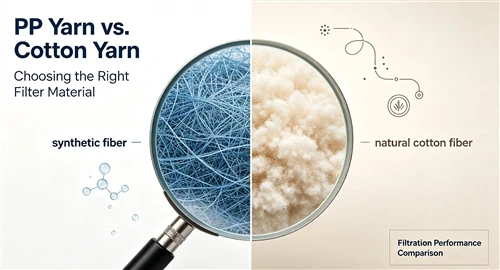
The yarn is the actual filtration medium. Depending on the application, different materials can be selected to provide the required chemical compatibility, temperature resistance, and filtration characteristics.
Polypropylene is widely used for applications involving water, acids, alkalis, and many chemical solutions. Cotton-based media can also be used in applications where compatibility with oils, organic solvents, beverages, or pharmaceutical liquids is required.
The physical characteristics of the yarn matter as much as its chemical composition. Yarn consistency affects the uniformity of the winding structure, which in turn influences flow resistance and contaminant retention.
For manufacturers producing wound cartridges at scale, stable filter yarn quality is therefore an important part of maintaining cartridge-to-cartridge consistency.
2. Filter Core
The core supports the wound media and provides an internal passage for the filtered liquid.
Core material should be selected according to the operating environment. Polypropylene cores are suitable for many general water and chemical filtration applications, while stainless steel cores can be considered where higher temperature resistance or greater structural strength is required.
The relationship between the yarn and core should not be overlooked. A high-quality yarn cannot compensate for an improperly selected or poorly manufactured core.


The winding process determines the density and distribution of the filtration passages.
A tighter winding structure generally provides finer filtration, while a more open structure can allow higher flow with lower resistance. The objective is not simply to make the cartridge as dense as possible. The winding pattern needs to match the desired balance between particle retention, pressure drop, flow rate, and service life.
This is one reason why two cartridges with the same nominal micron rating can perform differently in actual filtration systems.
Filtration Ratings Available for Different Applications
Wire wound filter cartridges are commonly manufactured in a range of filtration ratings to accommodate different levels of particulate removal.
The specifications listed by ANDA include:
- 1 μm
- 5 μm
- 10 μm
- 20 μm
- 30 μm
- 50 μm
- 75 μm
- 100 μm
The correct rating should be selected according to the particle load and the filtration objective of the system.
For example, a fine-rated cartridge may be appropriate when the downstream equipment requires tighter particulate control. A coarser cartridge may be more suitable as a preliminary filtration stage when the feed liquid contains a heavier sediment load.
Choosing the smallest available micron rating is not automatically the best solution. If the filter is too fine for the incoming water or process liquid, pressure drop may increase rapidly and cartridge replacement intervals may become shorter.
For this reason, filtration rating should always be considered together with feed-water quality, flow requirements, contaminant concentration, and the capacity of the filter housing.
Common Dimensions of Wire Wound Filter Elements
The original ANDA specifications cover several commonly used cartridge dimensions.
The listed outer diameters include approximately 60 mm and 65 mm, while inner diameters include approximately 28 mm and 30 mm. Standard cartridge lengths include:
- 10 inches
- 20 inches
- 30 inches
- 40 inches
These dimensions allow wound cartridges to be matched with different filter housings and processing systems.
However, physical dimensions are only one part of cartridge selection. The end configuration, core structure, media material, filtration rating, and operating pressure should also be checked before ordering.
For OEM and bulk filtration applications, confirming the housing interface and operating conditions in advance can help avoid compatibility problems.
Material Selection Matters More Than It First Appears
One of the main advantages of wound filtration technology is the flexibility of media selection.

Polypropylene Wound Filter Media
PP yarn is widely used for water treatment and industrial applications because polypropylene offers good resistance to many acids, alkalis, and chemical solutions.
According to the technical information provided by ANDA, polypropylene wound elements can be used with water and various non-organic solutions, with the applicable service temperature depending on the core and construction used.
For polypropylene yarn with a polypropylene skeleton, the listed operating temperature is up to approximately 60°C. Stainless steel-supported polypropylene configurations can accommodate higher temperatures, subject to the specific cartridge design.
Cotton Wound Filter Media
Absorbent cotton yarn provides another option for applications requiring a different filtration medium.
ANDA's technical information identifies cotton wound elements with stainless steel cores for applications including water, oil, alkaline solutions, beverages, pharmaceuticals, and organic solvents. The listed working temperature for this configuration can reach approximately 120°C.
The important point is that filter media should be selected according to the actual process liquid rather than simply according to price or nominal micron rating.

Where Are Wire Wound Filter Cartridges Used?
The versatility of wound filtration makes this technology suitable for a broad range of industries.
Typical applications include:
Water and beverage processing:
Mineral water, beverage water, syrups, edible oils, alcoholic beverages, and other liquid products may require particulate filtration before subsequent processing or packaging.
Chemical processing:
Wound cartridges can be used for compatible chemical solutions, process liquids, printing fluids, and other industrial liquids.
Electronics and surface treatment:
Applications can include process water, organic solvents, printed circuit board manufacturing, electroplating solutions, and related processes.
Industrial oils:
Hydraulic oil, lubricating oil, cutting oil, and other industrial fluids can require removal of suspended particles to protect downstream components.
Pharmaceutical processing:
Depending on material compatibility and process requirements, wound filtration can be applied to certain pharmaceutical liquids, preparation water, and related process streams.
Specialized industrial applications:
Other uses include resin processing, bearing cleaning, laser cooling water, ultrasonic cleaning solutions, and electroplating systems.
The common requirement across these applications is straightforward: suspended contaminants need to be controlled without creating unnecessary restrictions on liquid flow.
Pressure Drop Is an Important Selection Factor
Filtration efficiency is only one side of cartridge performance.
A filter that removes particles effectively but creates excessive pressure drop may increase energy consumption, reduce system throughput, and require frequent replacement.
ANDA's published specifications list a maximum withstand pressure of approximately 0.5 MPa and a maximum pressure drop of approximately 0.2 MPa for the referenced wound filter configuration.
In practical operation, actual pressure drop will depend on several variables, including:
- Feed-liquid viscosity
- Particle concentration
- Filtration rating
- Flow rate
- Cartridge length
- Winding density
- Filter housing design
- Degree of cartridge loading
As contaminants accumulate within the depth of the cartridge, flow resistance naturally increases. Monitoring differential pressure can therefore provide a useful indication of when a cartridge is approaching the end of its service life.
Why Filter Yarn Quality Matters
When purchasing a wound filter cartridge, it is easy to focus on the finished product and overlook the material from which it is made.
However, the yarn is effectively the foundation of the filtration structure.
Variations in yarn diameter, strength, surface characteristics, or winding consistency can change the geometry of the filtration passages. Over a complete cartridge, even small inconsistencies can potentially affect flow distribution and particle retention.
This is particularly important for manufacturers supplying large quantities of cartridges to water treatment companies, filtration equipment manufacturers, and industrial users.
For that reason, filter yarn manufacturing quality should be evaluated as part of the overall filtration solution rather than treated as a separate raw-material issue.
ANDA: Focusing on the Materials Behind String Wound Filtration
Zibo Anda Textile Co., Ltd. specializes in filtration materials and wound filtration products, including PP yarn, PP core, and string wound filter cartridges.
Founded in 2000, ANDA has developed its business around filtration-related textile materials and has established long-term cooperation with customers in China and overseas markets. The company's product range includes polypropylene yarn for filtration, industrial-grade and food-grade PP yarn, filter cores, stainless steel cores, and complete string wound filter cartridges.
This product structure allows ANDA to look at wound filtration from both the material and finished-cartridge perspective.
For customers purchasing filter cartridges in volume, this can be valuable because cartridge performance begins long before the finished filter leaves the production line. The consistency of the yarn, compatibility of the core, winding process, and final cartridge specifications all contribute to the performance of the filtration system.
Choosing the Right Wire Wound Filter Cartridge
There is no single wound cartridge configuration that works best for every filtration system.
Before selecting a cartridge, buyers should consider at least five factors:
- What type of liquid will be filtered?
- What contaminants need to be removed?
- What micron rating is actually required?
- What flow rate and pressure conditions will the cartridge experience?
- Does the cartridge material and dimension match the existing filter housing?
Temperature and chemical compatibility should also be verified when the application involves aggressive liquids or elevated operating temperatures.
For OEM projects or applications with unusual requirements, it is generally more practical to discuss the operating conditions with the filter manufacturer rather than selecting a cartridge solely from a standard product table.
Final Thoughts
The structure of a wire wound filter cartridge may appear uncomplicated, but its filtration behavior is the result of several components working together.
The filter yarn determines much of the filtration medium's behavior. The core provides structural support and an internal flow path. The winding pattern establishes the depth filtration structure, while micron rating, cartridge dimensions, temperature, pressure, and liquid characteristics determine whether the finished element is suitable for the application.
For this reason, choosing a wound filter should go beyond comparing prices or micron numbers.
A better approach is to evaluate the entire filtration system-from the liquid being processed to the material used to manufacture the cartridge.
ANDA supplies PP yarn, PP cores, and string wound filter cartridges for customers seeking consistent filtration materials and finished filtration solutions. For OEM, wholesale, or application-specific requirements, ANDA can work with customers to identify a suitable material, cartridge construction, and specification.