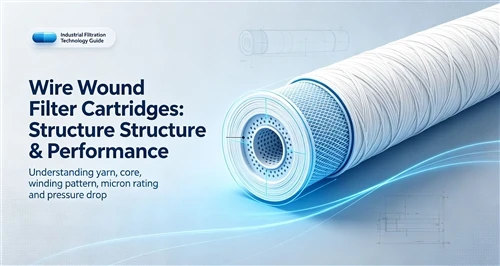
he wire wound filter element is a kind of deep filter element, which is used for filtration with low viscosity and low impurity quality. It is made of textile fiber thread (polypropylene thread, degreased cotton thread, etc.) accurately wound on the porous skeleton (polypropylene or stainless steel) according to specific process. It has a honeycomb structure with sparse outside and dense inside, which can effectively remove suspended solids, particles, rust and other sundries in the fluid, It has very excellent filtration characteristics.
The good winding can show the filtering effect of the deep filter material. The ideal condition is that it is more and more dense from the outside to the inside. Therefore, when winding, the density of the filter material must be controlled by the thickness of the wire or different winding tension. The winding filter element with this internal dense and external sparse structure can have the depth effect of the deep filter material, effectively improve the filtering efficiency and intercept more dirt particles. The filtration accuracy of the wound filter material is determined by the thickness and winding density of the wire. The thinner the wire, the closer it can lean together, the smaller the pore and the higher the accuracy; Similarly, the denser the wire structure, the higher the filtration accuracy. However, in the process of filtration, the filter material must be able to maintain its specific structure and pore size in order to provide stable and uniform filtration quality.
characteristic:
Acid and alkali resistance, large amount of pollution
Large flux and good chemical compatibility
Deep filtration without any adhesive
1. Dimensions:
Filter material: polypropylene, degreasing cotton thread, glass fiber
Center rod: polypropylene, stainless steel
Outer diameter: φ 63mm、 φ 115mm
Inner diameter: φ 28mm、 φ 30mm
Length: 10 "~ 40"
Accuracy: 1.0 ~ 100um
2. Operating parameters:
PH value: 1 ~ 13
Operating temperature: 60 ℃ (polypropylene)
120 ℃ (degreasing cotton thread, stainless steel frame)
200 ℃ (glass fiber, stainless steel frame)
Maximum tolerable differential pressure (60 ℃): 0.01Mpa forward / 0.06mpa reverse