Price is usually one of the first numbers procurement teams look at when buying industrial filter cartridges.
That makes sense. Filter cartridges are consumables, and when a plant goes through hundreds or even thousands of them each year, even a small reduction in unit cost can appear significant on a purchasing report.
But there is a problem with looking at the purchase price in isolation.
A cartridge that costs less per piece may need to be replaced more often. It may create more pressure drop, increase energy demand, consume more compressed air during cleaning, or fail prematurely under demanding operating conditions.
Once those costs are added up, the initial "saving" can disappear surprisingly quickly.
For industrial filtration, the better question is not simply:
How much does each cartridge cost?
It is:
How much does that cartridge cost to operate over its useful life?
That distinction comes down to several performance characteristics that are easy to overlook during procurement. Here are three that deserve much more attention.
1. Micron Rating Alone Doesn't Tell the Whole Filtration Story
Micron rating is often the first specification buyers compare.
A cartridge may be listed as 1, 5, 10 or 20 microns, and it is tempting to assume that the number tells you exactly what the filter will remove.
It doesn't.
One of the first things to determine is whether the rating is nominal or absolute.
A nominal rating generally indicates that the filter removes a specified percentage of particles at or above a stated size under defined test conditions.
An absolute rating is intended to represent a much higher level of particle retention and is normally associated with a defined test method and efficiency level.
That difference matters when selecting a cartridge for a specific application.
For example, a string wound cartridge with a relatively coarse nominal rating may be perfectly suitable for general pre-filtration, sediment removal or applications where the downstream equipment is not particularly sensitive to fine particles.
The situation changes when the cartridge is protecting equipment such as RO membranes, precision nozzles, laboratory equipment or other components where particle breakthrough can create a much larger problem.

In those applications, simply comparing "5 micron" with "5 micron" is not enough.
The procurement team should ask:
- Is the rating nominal or absolute?
- What test standard was used?
- What particle size was tested?
- What retention efficiency was achieved?
- Is the stated performance relevant to the actual application?
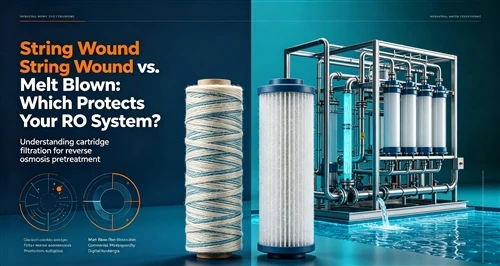
For RO pretreatment, for instance, cartridge selection should be based on the membrane manufacturer's requirements, feed-water conditions and the performance of the upstream filtration stages rather than on micron rating alone.
A lower micron number is not automatically a better filter.
The right cartridge is the one that provides the required level of protection without creating unnecessary flow resistance or replacement costs.
2. Initial Pressure Drop Can Cost More Than the Cartridge Itself
Pressure drop is one of the most overlooked specifications in filter selection.
It is also one of the easiest to understand.
Whenever fluid or air passes through a filter, the filter creates resistance to flow. That resistance is measured as pressure drop.
A clean cartridge with a low initial pressure drop allows the system to move the required flow with less resistance.
As the filter loads with contaminants, pressure drop generally increases. If the filter becomes heavily loaded, the pump or fan has to work harder to maintain the required operating conditions.
That is where a seemingly inexpensive cartridge can become expensive to operate.

Consider an industrial dust-collection system.
If a cartridge starts with a relatively high pressure drop and loads quickly, the fan may have to operate against increasing resistance for a large portion of its service life. Depending on the system design, operating schedule and motor characteristics, that can translate into higher electricity consumption.
The same principle applies to liquid filtration.
A cartridge that becomes restrictive too quickly can reduce flow, increase pump demand or force operators to change the cartridge before its physical capacity has been fully utilized.
This is why clean pressure drop and pressure-drop progression should be evaluated together.
A useful comparison between two cartridges should look at more than the starting number.
Ask:
- What is the initial pressure drop at the required flow rate?
- How does pressure drop change as the cartridge loads?
- What is the recommended end-of-life pressure differential?
- How much usable filter media is available?
- Has the cartridge been tested under conditions similar to the application?
These questions are much more useful than simply asking which cartridge has the lower purchase price.
A cartridge that costs a few dollars less but creates significantly more resistance throughout its service life may ultimately cost the plant far more in energy and maintenance.
3. Cartridge Dimensions Don't Tell You How Much Dirt It Can Hold
A cartridge that fits the housing is not necessarily the right cartridge for the application.
Physical compatibility is only the starting point.
Another important characteristic is dirt-holding capacity-the amount of contaminant a filter can retain before reaching its specified terminal pressure drop or becoming unsuitable for continued operation.

This matters particularly in applications with high sediment or particulate loading.
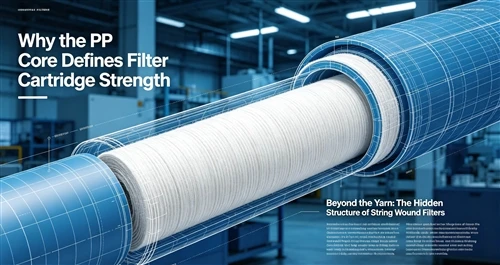
String wound and melt-blown cartridges are both commonly used as depth-filtration media. Instead of relying exclusively on a thin surface layer to capture contaminants, depth media can retain particles throughout the structure of the filter material.
But not all cartridges with the same dimensions have the same usable capacity.
Media density, fibre structure, winding pattern, pore structure, available filtration area and manufacturing consistency can all affect performance.
Two cartridges may both be labeled as 20" × 2.5" and 5 micron, yet behave very differently in the field.
One may maintain acceptable flow for weeks, while another reaches its terminal pressure drop much sooner.
That difference becomes particularly important when labor costs and system downtime are taken into account.
Structural Integrity Matters, Too
Dirt-holding capacity is only part of the equation.
The cartridge also needs to remain mechanically stable throughout its operating life.
A filter exposed to high differential pressure can experience structural problems if the media, core, end caps or bonding system are not properly designed for the application.
Potential failure modes include:
- Media deformation
- Core collapse
- End-cap separation
- Bonding failure
- Media tearing
- Internal bypass
The last one is especially concerning.
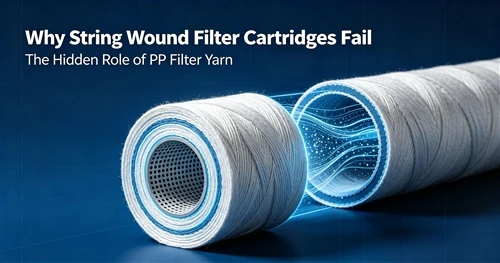
Once a cartridge loses its structural integrity, contaminants may bypass the intended filtration path and reach downstream equipment.
At that point, the cartridge is no longer simply "clogged."
It has become a potential source of contamination.
For this reason, procurement teams should evaluate structural performance alongside filtration efficiency and dirt-holding capacity, particularly in applications involving high differential pressure or demanding operating cycles.
The Better Way to Compare Filter Cartridge Costs
The most useful purchasing metric is rarely the price printed on the quotation.
It is total cost of ownership (TCO).
For industrial filter cartridges, TCO can include:
- Purchase cost - the initial price paid for each cartridge.
- Energy cost - additional pump or fan energy associated with pressure drop.
- Replacement labor - the time required to inspect, remove and install cartridges.
- Downtime - production losses associated with filter changes or unexpected failures.
- Compressed-air consumption - particularly relevant to pulse-cleaned dust-collection systems.
- Disposal cost - the cost of handling and disposing of spent filter media.
- Downstream equipment risk - potential costs caused by inadequate filtration or cartridge failure.
This is why two cartridges with identical dimensions and similar micron ratings can produce very different operating costs.
The cartridge with the lowest purchase price is not necessarily the lowest-cost option.
In many industrial applications, a more meaningful comparison is:
Cost per operating hour
or:
Cost per unit of filtered water or air
rather than simply:
Cost per cartridge
That shift in perspective can completely change the purchasing decision.

What Procurement Teams Should Ask Before Switching to a Lower-Cost Cartridge
Before replacing an existing cartridge with a cheaper alternative, it is worth collecting actual operating data.
At minimum, compare:
Filtration Performance
Micron rating
Nominal vs. absolute rating
Retention efficiency
Applicable test method
01
Hydraulic or Airflow Performance
Initial pressure drop
Pressure drop at operating flow
Terminal pressure differential
Pressure-drop increase over service life
02
Service Life
Dirt-holding capacity
Average replacement interval
Actual contaminant loading
Operating hours per cartridge
03
Mechanical Performance
Core construction
End-cap design
Media bonding
Differential-pressure resistance
Resistance to collapse or bypass
04
Operating Cost
Cartridge price
Replacement labor
Energy consumption
Compressed-air consumption
Disposal
Downtime
05
Only after these factors are compared does the purchase price become meaningful.
A cartridge that costs 20% more but lasts twice as long may be less expensive over the course of a year.
Likewise, a cartridge with a slightly higher unit price but significantly lower pressure drop may reduce energy costs enough to justify the difference.
The numbers will vary from one plant to another.
That is precisely why real operating conditions matter.
ANDA: A Performance-Based Approach to Filter Cartridge Manufacturing
Industrial filtration is ultimately not about buying a plastic housing filled with filter media.
It is about maintaining consistent particle removal throughout the cartridge's operating life.
That is the principle behind ANDA's approach to string wound and melt-blown filter cartridges.
For string wound applications, ANDA uses polypropylene filter yarn and controlled winding structures to create a graded filtration profile through the depth of the cartridge. The winding density can be configured to support progressive particle capture while maintaining the required balance between filtration performance and flow resistance.
For melt-blown cartridges, polypropylene microfibres are formed into a depth-filtration structure designed for consistent particle retention and reliable flow performance.
Material selection also matters.
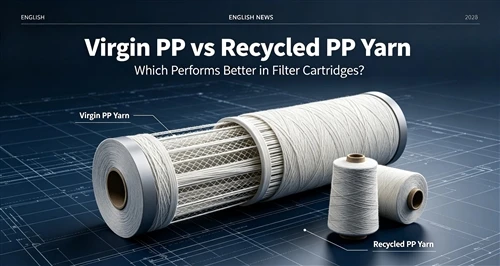
ANDA's polypropylene filter yarn is produced from 100% polypropylene raw material, with controlled manufacturing processes intended to maintain consistent fibre characteristics and filtration performance.
Rather than positioning a cartridge simply as a lower-cost alternative, the goal is to match the filter structure to the customer's actual operating conditions.
Those conditions can include:
Feed-water quality
Particle loading
Required flow rate
Operating pressure
Temperature
Chemical compatibility
Housing configuration
Expected replacement interval
A cartridge that works well in one application may not be the right choice for another.
That is why cartridge selection should start with the process-not the quotation.
The Cheapest Cartridge Is Not Always the Cheapest Solution
Industrial filtration is one of those areas where purchasing decisions can have consequences far beyond the procurement department.
A lower-priced cartridge may look attractive on a spreadsheet.
But if it creates higher pressure drop, requires more frequent replacement, consumes more compressed air, increases labor requirements or exposes downstream equipment to greater contamination risk, the initial saving can quickly disappear.
The more useful question is not:
"How much does this cartridge cost?"
It is:
"What will this cartridge cost us over its entire service life?"
That is the difference between price-driven procurement and performance-driven procurement.
For plants that are evaluating a new filter cartridge supplier or comparing an existing cartridge with an alternative, ANDA can review the application requirements and recommend a suitable filtration configuration based on actual operating conditions.
The objective is not to offer the lowest price on the quotation.
It is to help customers achieve a filtration solution that makes economic sense over the long term.