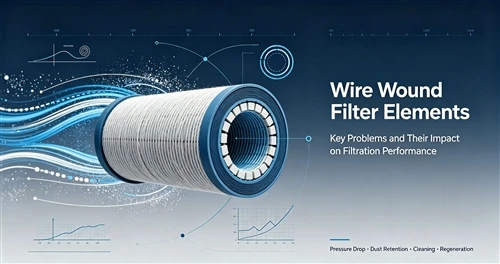
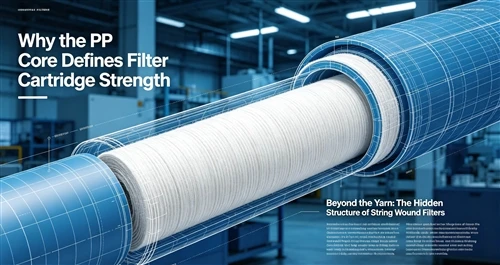
Wire wound filter elements are widely used in industrial filtration because their continuously wound fiber structure can provide effective particle retention while offering flexibility in filtration density and material selection. However, the performance of a wire wound filter element cannot be judged by filtration efficiency alone.
In real operating conditions, pressure drop, dust retention, cleaning performance, and regeneration behavior are closely connected. When dust becomes trapped too deeply within the filter media or pulse-jet cleaning fails to remove it evenly, the filter element gradually develops a higher residual pressure drop. The result is increased system resistance, reduced airflow, higher energy consumption, and ultimately a shorter service life.
For filtration system designers and procurement teams, understanding these mechanisms is essential when selecting wire wound filter elements and designing an appropriate cleaning strategy.
Why Pressure Drop Matters in Wire Wound Filtration
Pressure drop is one of the most useful indicators of how a filter element is performing during operation.
As air or liquid passes through the filter media, the resistance created by the fiber structure determines how much pressure is required to maintain the desired flow rate. As captured particles accumulate, the effective filtration pathways become increasingly restricted, causing the pressure drop to rise.
For a wire wound filter element, the pressure-drop curve is influenced by several factors, including:
- Filtration velocity
- Dust or contaminant concentration
- Fiber material and diameter
- Winding density
- Filter media structure
- Particle size distribution
- Operating conditions
- Cleaning frequency and cleaning intensity
A gradual increase in pressure drop is normal as filtration proceeds. The concern begins when the filter cannot return to a sufficiently low resistance after cleaning.
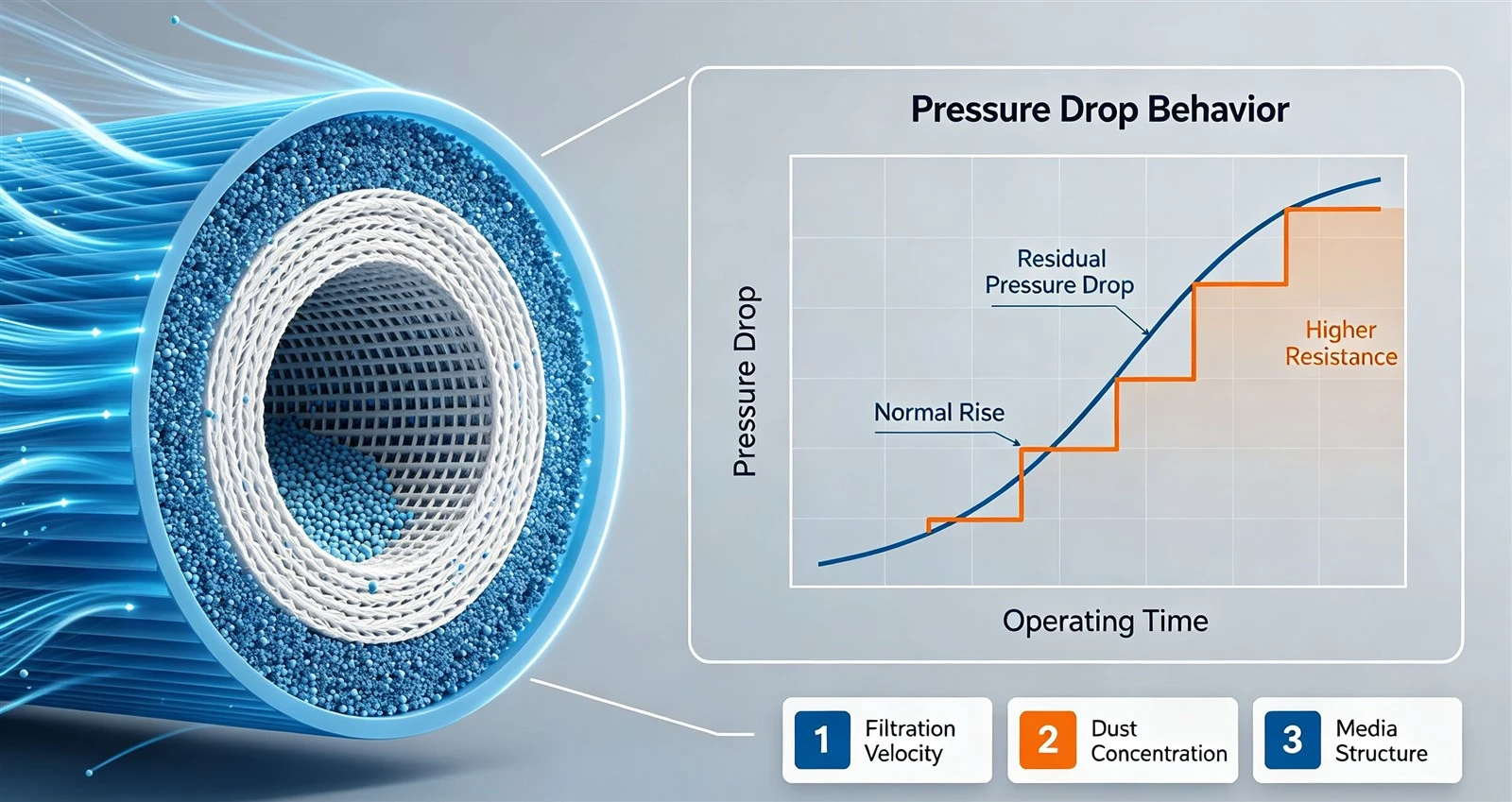
This is where residual pressure drop becomes particularly important.
Residual Pressure Drop: An Often-Overlooked Performance Indicator
After a cleaning cycle, some particles inevitably remain within or on the filter media. The pressure drop measured after cleaning is commonly referred to as residual pressure drop.
A small residual pressure drop indicates that the cleaning process has effectively restored much of the filter's original permeability. A continuously increasing residual pressure drop, however, suggests that contaminants are accumulating faster than they can be removed.
This creates a cycle:
Dust accumulation → incomplete cleaning → higher residual pressure drop → greater airflow resistance → reduced filtration efficiency and service life.
Over time, the filter may still appear visually intact while its actual operating performance has deteriorated significantly.
For this reason, evaluating only the initial pressure drop of a wire wound filter element is not enough. Long-term pressure-drop behavior should also be considered.
The Challenge of Dust Retention Inside the Fiber Layer
One of the fundamental challenges in wire wound filtration is controlling where particles are captured.
Ideally, contaminants should be retained in a manner that provides effective filtration without causing excessive blockage. However, depending on the fiber structure and operating conditions, fine particles can penetrate deeper into the filter layer.
Once particles become embedded within the fiber network, they are much more difficult to remove through pulse-jet cleaning.
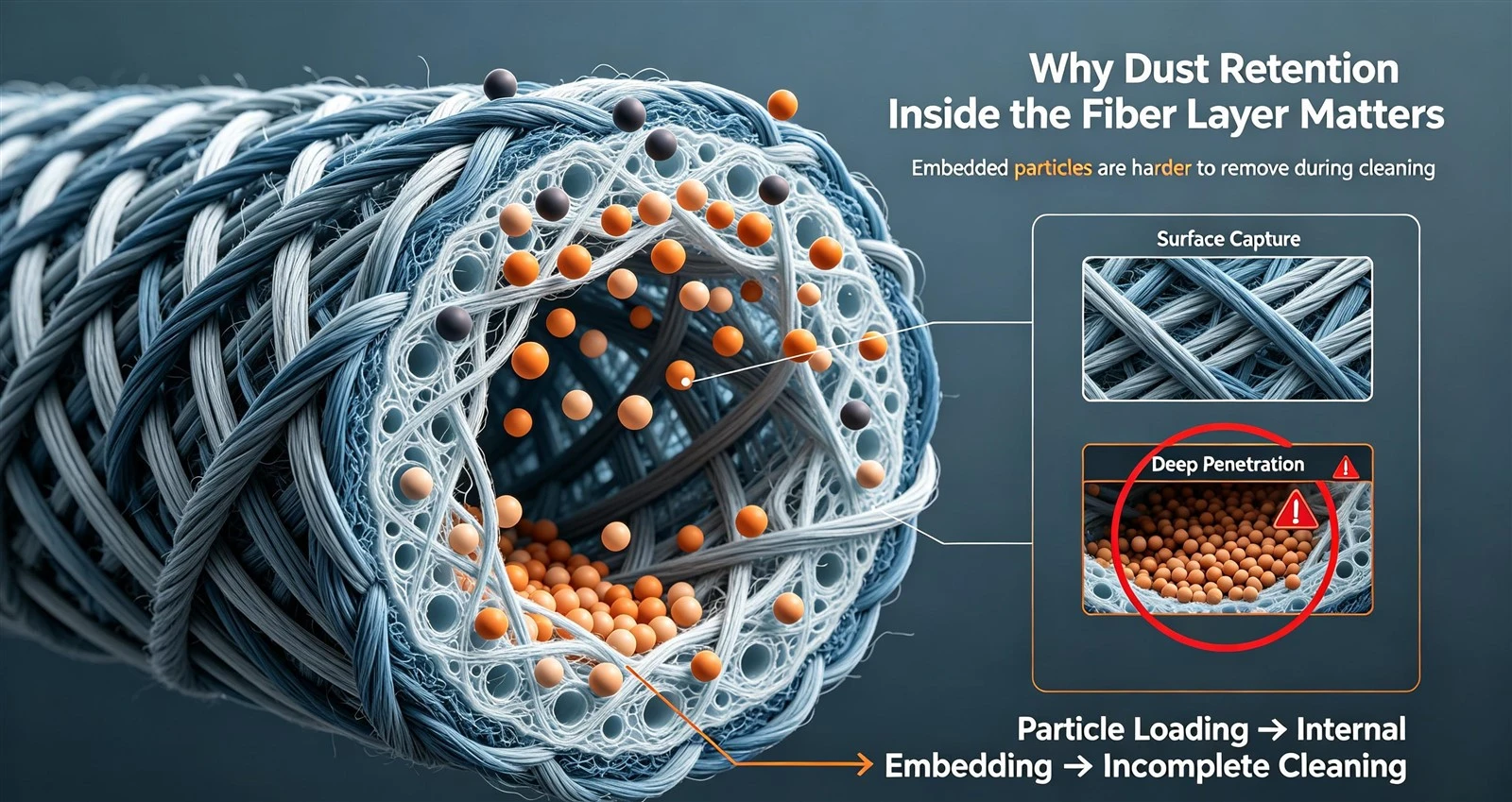
This is particularly important for applications involving fine dust or high contaminant concentrations. A filter element may initially provide excellent airflow and filtration performance, but its resistance can increase rapidly if the media structure promotes excessive internal dust penetration.
The design of the winding structure therefore plays a major role in determining how the filter behaves throughout its operating cycle.
Why Pulse-Jet Cleaning Does Not Always Restore the Filter
Pulse-jet cleaning is commonly used to remove accumulated dust from filter bags and other industrial filter media. A short burst of compressed air creates a reverse pressure wave that causes the filter media to flex, helping dislodge the accumulated dust layer.
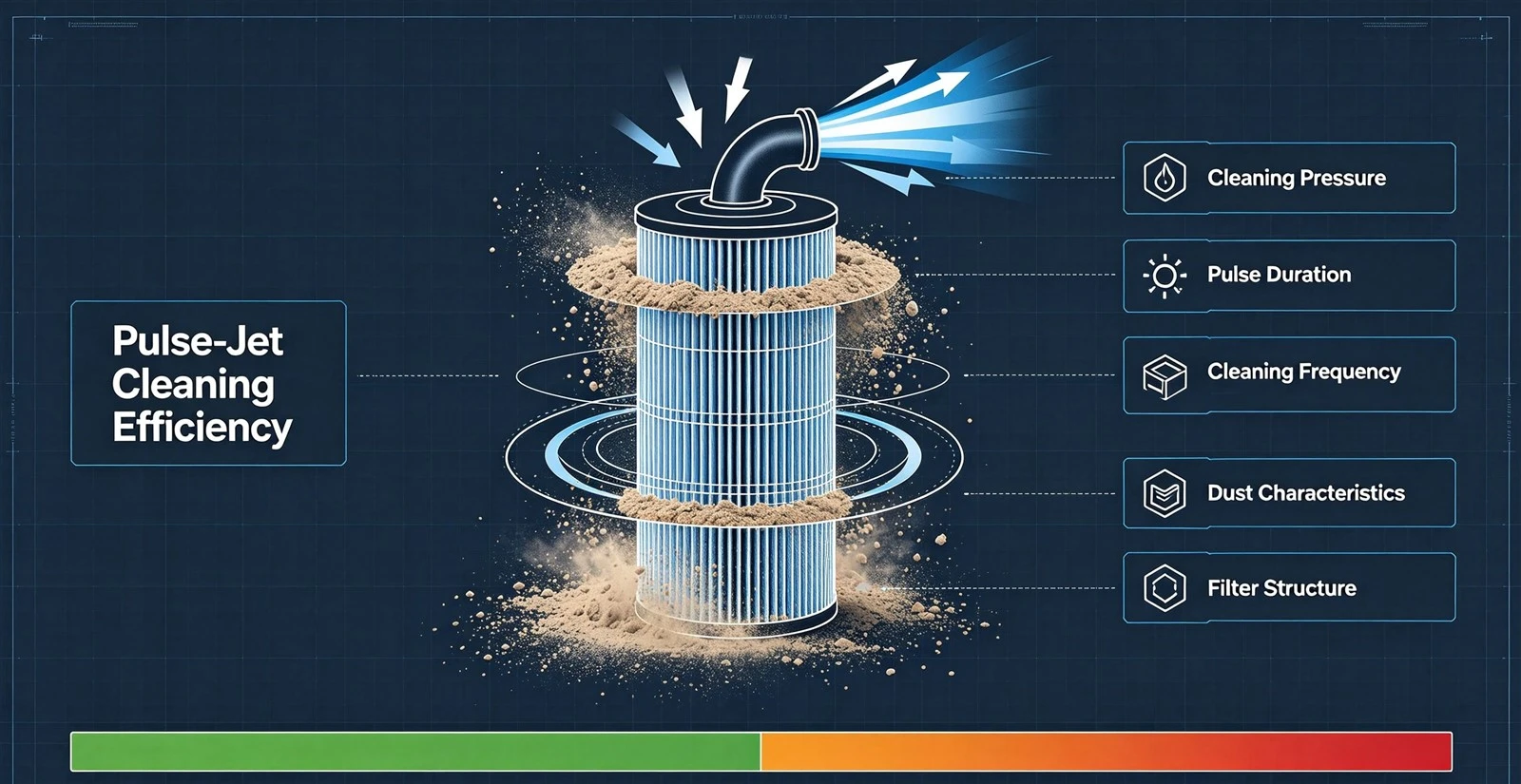
However, cleaning effectiveness is not determined simply by the presence of a pulse.
Several factors influence the actual cleaning result:
1. Cleaning pressure
Insufficient pressure may not generate enough mechanical force to remove accumulated particles. Excessive pressure, on the other hand, can place unnecessary mechanical stress on the filter media.
2. Pulse duration
The duration of the compressed-air pulse affects how the cleaning energy is transferred to the filter element. An unsuitable pulse duration can reduce cleaning effectiveness while increasing compressed-air consumption.
3. Cleaning frequency
Cleaning too frequently may interrupt stable filtration conditions and accelerate media fatigue. Cleaning too infrequently can allow the dust layer to become excessively compacted.
4. Dust characteristics
Particle size, shape, moisture content, and cohesiveness all affect how easily accumulated dust can be released.
5. Filter structure
The physical structure of the filter media determines how particles are captured and how effectively mechanical or pneumatic cleaning forces can reach the contaminated areas.
Consequently, poor regeneration performance is not necessarily caused by the cleaning system alone. The filter media and the cleaning parameters must be considered as one operating system.
Filtration Velocity Can Change the Pressure-Drop Curve
Filtration velocity is another critical variable in wire wound filter applications.
When filtration velocity increases, more fluid passes through the filter media within a given period. The resulting increase in flow resistance can accelerate pressure-drop growth, particularly when the filter is already carrying a significant contaminant load.
This means that a wire wound filter element selected for one operating condition may not perform identically under a substantially higher filtration velocity.
For engineering applications, it is therefore important to evaluate the filter under realistic operating conditions rather than relying solely on nominal specifications.
A practical evaluation should consider:
Actual flow rate + effective filtration area + contaminant concentration + operating cycle + cleaning conditions.
Looking at any single parameter in isolation can lead to an inaccurate assessment of filter performance.
The Effect of Dust Concentration
The concentration of incoming dust also has a direct influence on filter resistance.
A higher dust concentration means that the filter media receives a greater contaminant load over the same operating period. If the cleaning system cannot keep pace with this accumulation, the residual pressure drop will gradually increase.
This is especially relevant in industrial environments where dust concentration fluctuates significantly throughout the production cycle.
For example, a filter operating under relatively clean conditions may show stable pressure-drop behavior, while the same filter can experience rapid resistance growth during periods of high dust loading.
Therefore, filter selection should be based not only on average operating conditions but also on realistic peak loading scenarios.
The Initial Filtration Stage Deserves Special Attention
The pressure-drop behavior during the initial stage of filtration can differ considerably from the stable filtration stage.
When a new filter element begins operating, the filter media has not yet developed its normal contaminant layer. As particles begin to accumulate, the filtration structure changes dynamically.
This initial period is sometimes referred to as the dust-loading or filter-conditioning stage.
During this stage, the pressure drop may change more rapidly than it does after a relatively stable dust layer has formed. The factors influencing the pressure-drop curve can also be more complex.
Understanding this transition is important because the initial filtration behavior can affect subsequent cleaning cycles and long-term operating resistance.
For laboratory testing and system design, recording pressure-drop changes from the beginning of filtration can therefore provide more useful information than measuring only the final stabilized value.
Why Single-Filter-Bag Testing Is Valuable
Full-scale filtration systems contain many interacting variables, making it difficult to determine the influence of a single parameter.
A controlled single-filter-bag test can help isolate specific relationships between operating conditions and pressure-drop behavior.
For example, experiments can be designed to examine how changes in:
affect both the instantaneous pressure drop and the residual pressure after cleaning.
Particular attention should be paid to the residual pressure during the early filtration cycles. These measurements can help identify whether the filter media is readily regenerable or whether contaminants are becoming increasingly embedded in the fiber structure.
Such data can provide a useful engineering basis for selecting pulse-jet parameters and determining whether a particular filter design is appropriate for the intended application.
Choosing a Wire Wound Filter Element for Long-Term Operation
When selecting a wire wound filter element, buyers often focus on filtration rating, dimensions, and initial price. These specifications are important, but they do not tell the whole story.
A more complete evaluation should include:
1. Filtration performance
The filter should provide the required level of particle retention without creating unnecessary flow resistance.
2. Pressure-drop behavior
The initial pressure drop and the rate at which pressure drop increases during operation should both be considered.
3. Regeneration capability
For applications using pulse cleaning, the filter should be compatible with the intended cleaning method and operating parameters.
4. Structural consistency
Uniform winding and consistent fiber distribution are important for maintaining predictable filtration performance from one filter element to another.
5. Service life
A filter with a slightly higher initial purchase price may offer a lower total operating cost if it maintains stable pressure drop for a longer period and requires fewer replacements.
This is why filter selection should be evaluated from a total operating cost perspective rather than purchase price alone.
How Filter Manufacturers Can Improve Filter Regeneration
Improving regeneration performance starts with understanding the relationship between filter structure and contaminant behavior.
A well-designed wire wound filter should balance several competing requirements:
High particle retention + controlled pressure drop + effective cleaning + mechanical durability.
Increasing filtration density may improve particle capture, but excessive density can also increase flow resistance. A more open structure may reduce initial pressure drop, but it may allow more particles to penetrate deeper into the media.
The objective is therefore not simply to make the filter "denser" or "more open." The goal is to develop a structure that matches the contaminant characteristics and operating conditions of the application.
Material selection is equally important. Different fibers have different surface characteristics, mechanical properties, and chemical resistance. These differences can influence particle adhesion and the ability of the filter media to withstand repeated cleaning cycles.
ANDA's Approach to Wire Wound Filter Media
As a manufacturer focused on filtration materials and filter-related solutions, ANDA pays close attention to the relationship between filter media structure, pressure drop, contaminant loading, and service life.
For wire wound filtration applications, material selection and winding consistency are particularly important because they influence the internal flow paths through which the filtered medium travels.
ANDA's experience with filtration materials supports customers in evaluating filter media according to their actual application requirements rather than relying on a single filtration specification.
For industrial buyers, this approach can be especially valuable when developing or sourcing wire wound filter elements for different flow rates, contaminant conditions, and filtration systems.
The objective is straightforward: provide filtration materials that deliver predictable performance throughout the operating cycle-not just acceptable results when the filter is new.
A Better Way to Evaluate Wire Wound Filter Performance
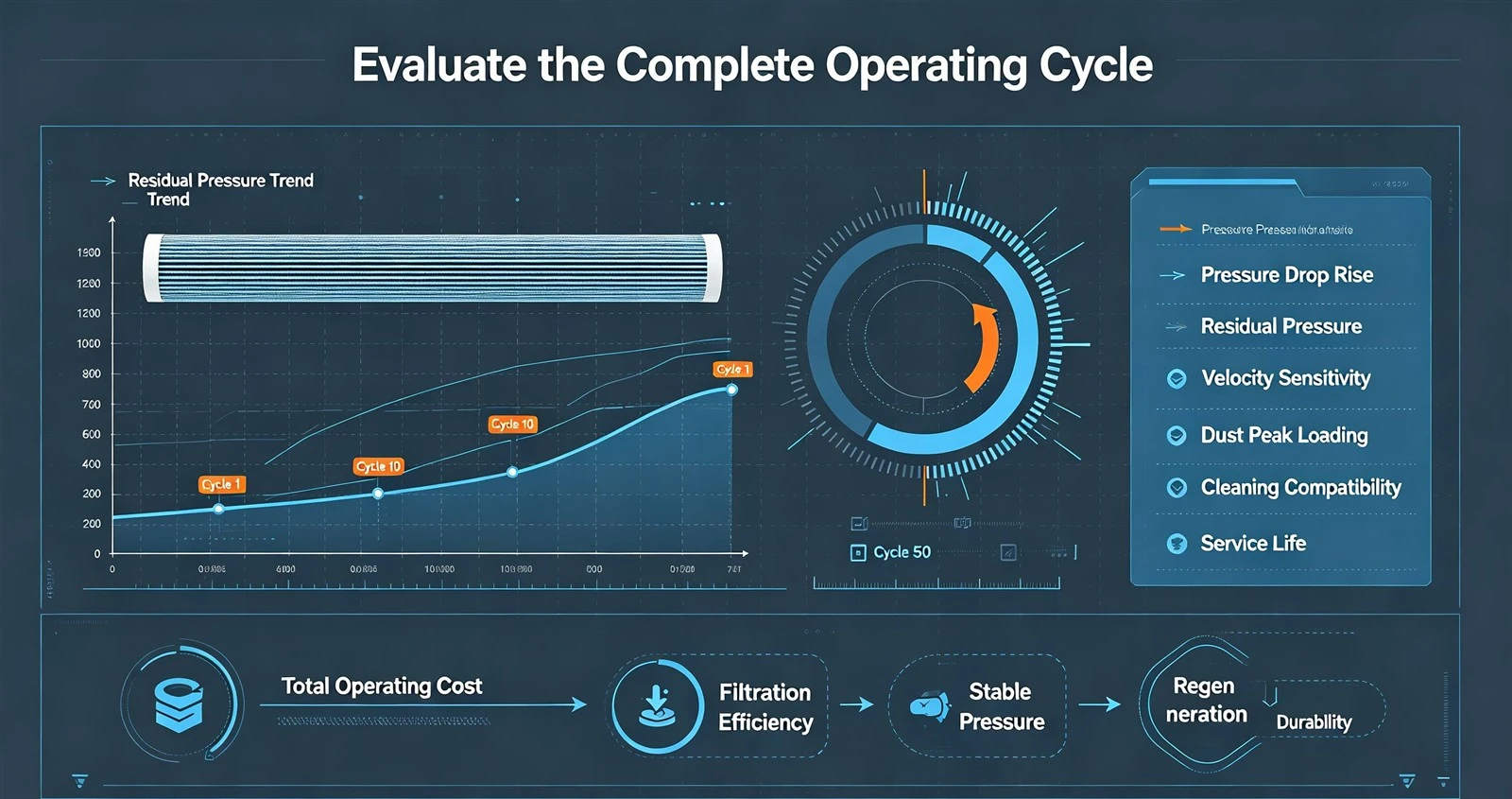
The most reliable way to evaluate a wire wound filter element is to look at its complete operating cycle.
Instead of asking only:
"How efficiently does this filter remove particles?"
engineers and procurement teams should also ask:
- How quickly does the pressure drop increase?
- How much pressure drop remains after cleaning?
- Does the residual pressure stabilize or continue rising?
- How does the filter respond to higher dust concentrations?
- How sensitive is performance to filtration velocity?
- Can the filter withstand repeated cleaning cycles?
- What is the expected service life under actual operating conditions?
These questions provide a much clearer picture of long-term filtration performance.
A filter element is not simply a barrier that captures contaminants. It is a dynamic component whose performance changes continuously as filtration and cleaning take place.
Final Thoughts
The main problems associated with wire wound filter elements are often not visible during the first few hours of operation. The more important issues emerge over repeated filtration and cleaning cycles.
Dust retained within the fiber layer, incomplete pulse-jet cleaning, uneven regeneration, and continuously increasing residual pressure drop can gradually increase system resistance and reduce filter service life.
For this reason, pressure drop should be treated as a key performance indicator throughout the entire filtration cycle.
Understanding the effects of filtration velocity, dust concentration, media structure, and cleaning parameters can help engineers develop more reliable filtration systems and help procurement teams make better long-term purchasing decisions.
For manufacturers such as ANDA, the challenge is not simply to produce a filter material that meets an initial filtration requirement. The greater objective is to achieve a practical balance between filtration efficiency, pressure stability, regeneration performance, durability, and overall operating cost.