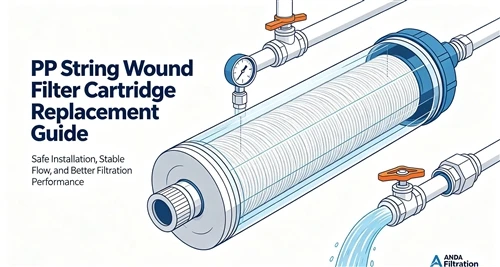
A water filtration system can only perform as well as the filter cartridge inside it. When a filter becomes loaded with sediment, rust, particles, or other contaminants, water flow can gradually decrease and pressure loss can increase. Replacing the filter cartridge at the right time is therefore an important part of routine filtration system maintenance.
For households, food and beverage facilities, and other applications that use PP string wound filter cartridges, replacement is generally straightforward. However, installing a new cartridge is more than simply removing the old one and putting in a replacement. The housing needs to be opened safely, air must be removed from the system, and the valves should be reopened in the correct sequence.
This guide explains how to replace a PP string wound filter cartridge safely and efficiently, along with practical tips for determining when replacement is necessary.
Why Does a PP Filter Cartridge Need to Be Replaced?
A filter cartridge gradually accumulates the particles it removes from the fluid. As the contaminant load increases, the available filtration area becomes increasingly restricted.
Several signs can indicate that a replacement is due:
- Water flow has noticeably decreased.
- Pressure drop across the filter has increased.
- The cartridge appears heavily contaminated.
- Water quality is no longer meeting the required standard.
- The cartridge has reached its recommended service interval.
- The system is consuming more energy because of increased resistance.

There is no universal replacement interval for every filtration system. Actual cartridge life depends on the incoming water quality, contaminant concentration, flow rate, operating hours, and the required filtration rating.
For this reason, a three-month replacement interval may be suitable for some household or light-duty applications, but it should not be treated as a fixed rule for every installation.
Five Steps to Replace a PP String Wound Filter Cartridge
Before beginning, prepare the correct replacement cartridge and make sure the new cartridge matches the filter housing in terms of dimensions, length, diameter, connection type, and filtration rating.

Step 1: Shut Off the Water Supply
First, close the water inlet valve supplying the filtration system.
Then open the clean-water faucet or downstream outlet to release residual pressure inside the system. Allow the water to stop flowing before opening the filter housing.
This step is important because opening a pressurized filter housing can cause water to escape suddenly and may make cartridge replacement difficult or unsafe.
Step 2: Remove the Old Cartridge and Install the New One
Open the filter housing carefully and remove the used cartridge.
Inspect the inside of the housing for accumulated sediment or debris. If necessary, clean the housing before installing the replacement.
Place the new PP string wound filter cartridge into the housing and make sure it is seated correctly. Check the sealing components, including the O-ring or gasket, for signs of wear or damage.
Once everything is correctly positioned, close and tighten the filter housing.
Avoid excessive force when tightening. The housing should be properly sealed without damaging the threads or sealing components.
Step 3: Reopen the Inlet Valve Gradually and Release Trapped Air
Open the water inlet valve slightly rather than turning it on fully at once.
Allow water to enter the system gradually and release the trapped air. If the filtration system is equipped with a pressure-relief or air-release valve, follow the manufacturer's instructions to remove the air.
Air trapped inside the housing can cause abnormal flow, noise, or prolonged discharge after cartridge replacement.
The goal at this stage is to fill the filter housing with water and stabilize the system before normal operation.
Step 4: Flush the New Filter Cartridge
Once most of the air has been removed, gradually increase the water supply.
Flush the new cartridge for approximately one minute, or follow the flushing instructions supplied by the cartridge manufacturer.
Flushing is particularly important with a newly installed filter because it helps remove loose particles or residual manufacturing material that may be present after installation.
Do not use the initial flush water for drinking or production until the water runs clear and the filtration system has returned to normal operating conditions.
Step 5: Restore Normal Operation
Check the outlet flow and make sure the system is operating normally.
If the water flow is stable and there are no leaks around the filter housing, fully open the inlet valve and close the clean-water faucet.
At this point, the filter system should be ready for normal operation.
After replacement, it is also a good practice to inspect the housing and connections once more for leakage.
What If Water Continues to Flow Abnormally After Replacement?
Occasionally, a filtration system may continue running longer than expected after a cartridge replacement.
One possible cause is trapped air inside the system.
If this occurs, first turn on the outlet faucet and allow the system to discharge air and water. Follow the equipment manufacturer's recommended procedure for removing trapped air.
Some systems may require gently repositioning or shaking the unit to help trapped air escape, but this should only be done when permitted by the equipment manufacturer. Avoid turning over or moving a pressurized filtration unit.
If abnormal flow continues, check the cartridge installation, housing seal, valve position, and other connections before restarting the system.
How Often Should a PP Filter Cartridge Be Replaced?
The replacement interval depends heavily on actual operating conditions.
For some residential filtration systems, a cartridge may be replaced approximately every three months. In commercial and industrial applications, however, the service life can vary considerably.
A better approach is to monitor the filter's operating performance rather than relying solely on a calendar.
Key factors include:
- Incoming water quality: Water containing high levels of sediment, rust, or suspended solids will load a cartridge more quickly.
- Filtration rating: A finer filter may capture smaller particles but can also experience a faster pressure increase when the incoming fluid contains a high contaminant load.
- Flow rate: Higher flow rates can increase the amount of contaminant passing through the filter over a given period.
- Daily operating time: A cartridge used continuously will generally accumulate contaminants faster than one used intermittently.
- Required water quality: Applications with strict cleanliness requirements may require more frequent replacement.
For critical applications, monitoring differential pressure and following the equipment or process manufacturer's replacement criteria can provide a more reliable indication of cartridge condition.
PP String Wound Filter Cartridge vs. Other Filter Types
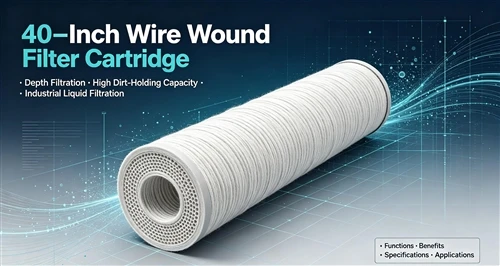
PP string wound cartridges are commonly selected for applications where depth filtration is required.
Unlike a simple surface filter, a string wound cartridge uses a carefully wound filtration medium to create a graded structure. Depending on the winding pattern and density, the structure can capture particles at different depths within the cartridge.
This design can provide several practical advantages:
- Good depth filtration capability
- High contaminant-holding capacity
- Stable filtration performance
- Relatively low initial pressure drop
- Multiple filtration ratings for different applications
- Compatibility with a variety of liquid filtration systems
However, cartridge selection should always be based on the actual fluid, contaminant characteristics, flow requirements, temperature, pressure, and desired filtration precision.
Choosing a cartridge solely by size or micron rating may result in poor system performance.
Where Are PP String Wound Filter Cartridges Used?
PP string wound filter cartridges are widely used for liquid prefiltration and particle removal.
Typical applications include:

Food and Beverage Processing
Filtration is often required to remove suspended particles and other physical impurities from process liquids, ingredients, and water.

Water Treatment
String wound cartridges can be used as prefilters to reduce sediment and particulate loading before downstream treatment equipment.

Chemical Processing
Depending on chemical compatibility and operating conditions, polypropylene-based filtration media can be used for removing particulate contaminants from certain process liquids.

General Industrial Filtration
They can also be used in a wide range of industrial liquid filtration systems where reliable particulate removal and high dirt-holding capacity are required.
The exact application should always be evaluated against the cartridge's material compatibility, temperature range, pressure rating, and filtration performance.
What Should You Check When Buying a PP String Wound Filter Cartridge?

Replacing a cartridge with the wrong specification can reduce filtration efficiency or create unnecessary pressure loss.
Before purchasing a replacement, check the following:
1. Filter Material
Confirm that polypropylene is suitable for the liquid being filtered and the intended operating environment.
2. Micron Rating
Select the filtration rating according to the size and concentration of the particles that need to be removed.
3. Cartridge Dimensions
Check the cartridge length, outer diameter, inner diameter, and end configuration to ensure compatibility with the filter housing.
4. Flow and Pressure Requirements
A cartridge should provide the required flow rate without creating excessive pressure drop.
5. Contaminant-Holding Capacity
For fluids with a high particle load, a cartridge with greater dirt-holding capacity may help extend service intervals and reduce maintenance frequency.
6. Application Requirements
Food, beverage, chemical, water treatment, and general industrial applications may have different material and compliance requirements. Always verify the applicable specifications before installation.
Choosing a Reliable PP Filter Cartridge Manufacturer
The quality of a string wound cartridge depends on more than the polypropylene material itself.
The winding structure, yarn characteristics, cartridge density, manufacturing consistency, dimensional accuracy, and quality control can all affect filtration performance.
For buyers sourcing cartridges for commercial or industrial applications, it is worth asking suppliers about:
- Filter media composition
- Available micron ratings
- Cartridge dimensions
- Manufacturing tolerances
- Flow and pressure-drop data
- Contaminant-holding performance
- Application compatibility
- Quality-control procedures
- OEM and customized options
A consistent manufacturing process is particularly important when cartridges are purchased in large quantities, because variations between batches can affect downstream filtration performance.
PP Filter Cartridge Replacement: A Simple Maintenance Task With a Big Impact
Replacing a PP string wound filter cartridge is a relatively simple maintenance procedure, but doing it correctly can help maintain stable flow, reduce unnecessary pressure loss, and protect downstream filtration equipment.
The basic process is straightforward:
- Shut off the water supply.
- Release system pressure.
- Remove the used cartridge.
- Install the new cartridge correctly.
- Reopen the water supply gradually.
- Remove trapped air.
- Flush the new cartridge.
- Check flow and connections before returning to normal operation.
The most important point is that cartridge replacement should be based on actual operating conditions rather than an arbitrary schedule. A three-month interval may work for some systems, while other applications may require a shorter or longer service life.
For filtration system operators and industrial buyers, selecting the right cartridge specification and maintaining consistent replacement practices are just as important as the replacement procedure itself.
About ANDA
For buyers looking for PP string wound filter cartridges for water treatment, food and beverage processing, chemical processing, and other liquid filtration applications, ANDA focuses on filtration products designed for consistent particulate removal and reliable operating performance.
With attention to filter media, winding structure, dimensional consistency, and application requirements, ANDA can support customers looking for standard filtration cartridges as well as solutions tailored to specific filtration systems.
When selecting a replacement cartridge, providing the housing dimensions, required micron rating, operating conditions, fluid type, and target flow rate can help ensure that the selected filter is suitable for the application.